
Here is the thing most people do not realize about Bombora vs 6sense: 6sense licenses Bombora’s data. The topic-level intent that 6sense uses as one of its signal inputs comes, in part, from the same publisher co-op that Bombora sells directly. So this is not a comparison of two competing intent datasets. It is a comparison of buying the raw data source versus buying the platform that layers predictive analytics, advertising, and workflow on top of that same data.
The question is not “whose intent data is better.” It is “do I need the raw feed or do I need the platform?”
If your team needs neither, and instead needs source-verified buying signals from earnings calls, job postings, and news that your reps can reference on calls, WhiteWhale is a third option built on a fundamentally different data architecture. More on that below.
Head-to-head comparison
Feature | Bombora | 6sense | |
|---|---|---|---|
What it is | Third-party intent data provider (the upstream co-op) | Enterprise ABM analytics and advertising platform | Buying signal detection platform |
Core approach | Tracks content consumption across ~5,000 B2B publisher sites; flags “surge” when activity exceeds baseline | Layers predictive buying-stage models, advertising, and workflow on top of intent data (including Bombora-sourced) | You define custom triggers; system finds matches with verified sources from earnings calls, job postings, and news |
Intent data source | The source. Bombora operates the co-op that most of the industry licenses | Bombora-derived + proprietary signals processed through Signalverse (1T+ signals daily) | Not intent data. Event signals from earnings calls, job postings (ATS), 8,000+ news feeds, press releases |
Topic taxonomy | 17,210 pre-defined topics; custom topics require 3 to 4 month lead time | Inherits Bombora topics + proprietary topic categories | No taxonomy. You define signals specific to your business |
Signal resolution | Account-level only; no contact identification | Account-level with buying-stage prediction; contact data via credits | Account-level with linked source, direct quotes, and cited facts |
Can you verify the signal? | No. Surge scores are proprietary; cannot see which articles were read or by whom | No. Predictive scores are proprietary; cannot see the evidence behind a stage assignment | Yes. Every result links to the original source |
Predictive analytics | No. Bombora delivers the data; you build the analytics | Yes. 4-stage buying journey prediction (Awareness, Consideration, Decision, Purchase) | No predictive scoring. Signals are verifiable events |
ABM advertising | No. Bombora is a data feed, not an activation platform | Native display, retargeting, LinkedIn orchestration | Not available |
AI agents | No | RevvyAI (recommended actions, account summaries) | AI scans unstructured sources to match custom signal definitions |
Activation layer | None. You feed Bombora data into your own CRM, ABM platform, or orchestration layer | Ads, alerts, and sales workflow built into the platform | Signals delivered to Slack, HubSpot, Salesforce, or Clay |
Implementation | Weeks; requires data integration into your existing stack | Weeks to months; requires dedicated RevOps | Days; most teams live in under a week |
Pricing | ~$25K to $100K+/yr, quote-based, annual contracts | Free Sales Intelligence tier (50 credits/mo); paid ABM tiers quote-based, median $62,820/yr per Vendr | Plans from $200/mo, month-to-month, no annual contract |
G2 rating | 4.3/5 | 3.9/5 | 5.0/5 |
Analyst recognition | Forrester Wave Leader, Intent Data, Q1 2025 | Gartner MQ Leader for ABM (5 consecutive years) | N/A (early-stage) |
Why this comparison is different from every other vendor matchup
Most vendor comparisons pit two competitors selling the same thing. Bombora and 6sense are not competitors in the traditional sense. They have a supplier-customer relationship. Bombora operates the publisher co-op. 6sense licenses that co-op data and builds a platform on top of it. ZoomInfo, Cognism, Apollo, and dozens of other vendors also license Bombora data.
This means the comparison is really about three layers:
Layer 1: The raw data. Bombora’s Company Surge data from roughly 5,000 B2B publisher sites. This is the same foundational layer whether you buy it from Bombora directly or consume it through 6sense, ZoomInfo, or anyone else.
Layer 2: The analytics. 6sense adds predictive buying-stage models, account scoring, and AI-driven recommendations on top of the raw data. Bombora does not do this. If you buy Bombora directly, you get the surge scores and build your own analytics.
Layer 3: The activation. 6sense adds native advertising (display, retargeting, LinkedIn), sales alerts, and workflow. Bombora does not activate. If you buy Bombora directly, you feed the data into your own CRM, ABM platform, or orchestration layer for activation.
The question comes down to which layers you already have and which you need to buy.
When Bombora is the better choice
You already have an analytics and activation layer
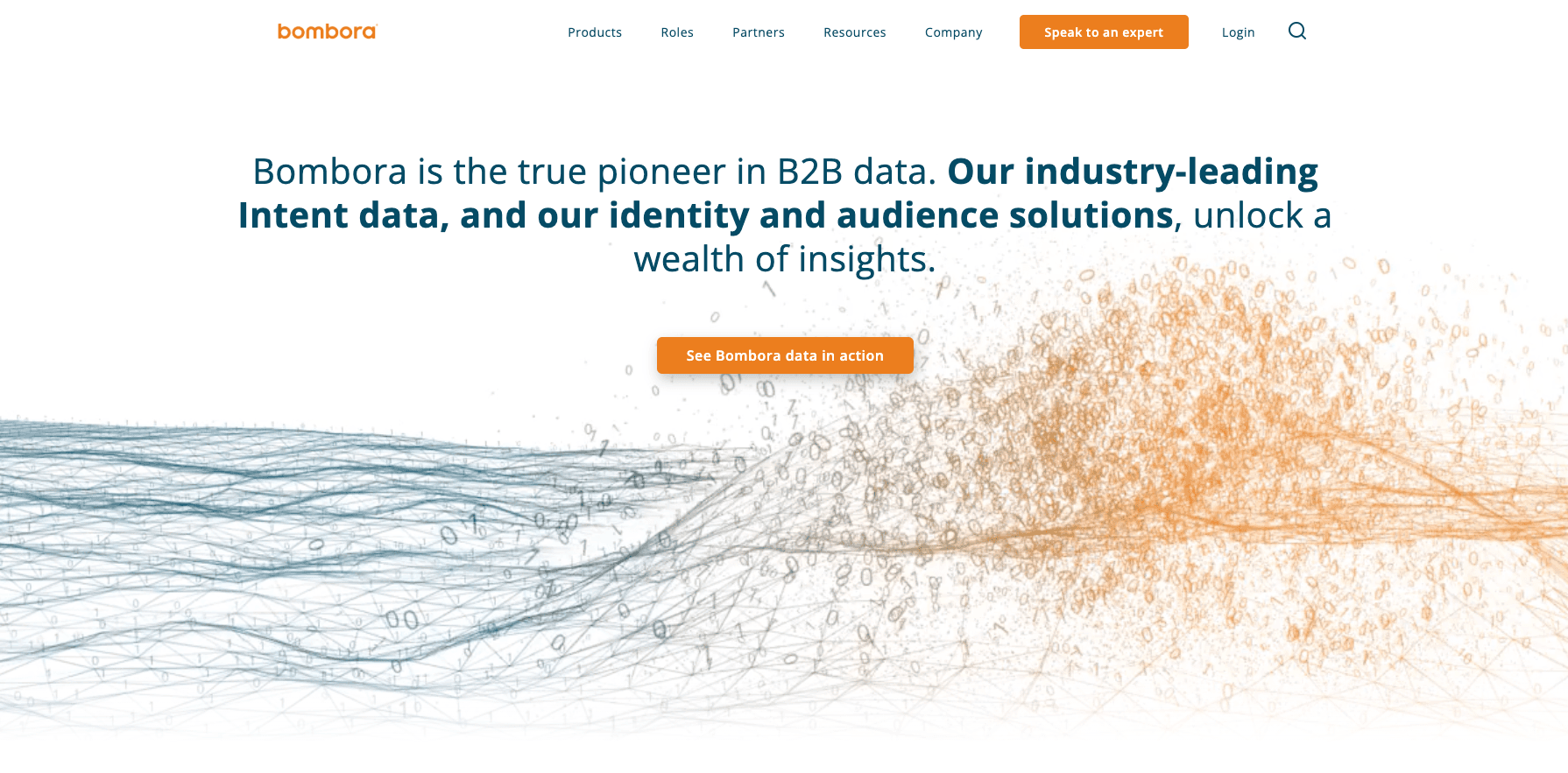
If your team already runs marketing automation (HubSpot, Marketo, Pardot), a CRM with lead scoring (Salesforce, HubSpot), and an engagement platform (Outreach, Salesloft), you may not need 6sense’s analytics and advertising layer at all. You need the raw intent data to feed into the stack you already have. In that case, Bombora direct gives you the fullest topic taxonomy (17,210 topics) at a lower cost than paying for 6sense’s platform on top of it.
You need the full topic taxonomy without a reseller’s filtering
When 6sense processes Bombora data through its Signalverse, it applies its own scoring, filtering, and weighting. This means you see 6sense’s interpretation of the data, not the raw data itself. If your data science team wants to build custom models on raw surge scores, or if you need access to all 17,210 topics without a reseller’s layer on top, Bombora direct is the path.
You want to avoid platform lock-in
Bombora integrates with virtually every CRM, ABM, and marketing automation platform on the market. You can switch your downstream stack without switching your intent data source. 6sense is a platform. Switching away from 6sense means losing the analytics, advertising, and workflow you built inside it. Bombora as a data layer gives you more architectural flexibility.
Your budget supports intent data but not an enterprise ABM platform
Bombora contracts run roughly $25,000 to $100,000+ per year. 6sense median is $62,820 per year, but that is for the ABM platform, not just intent data. If your budget is $30K to $50K and you already have a marketing and sales stack, Bombora’s data feed is more cost-effective than 6sense’s full platform at a similar or higher price point.
When 6sense is the better choice
You need the predictive layer, not just the data
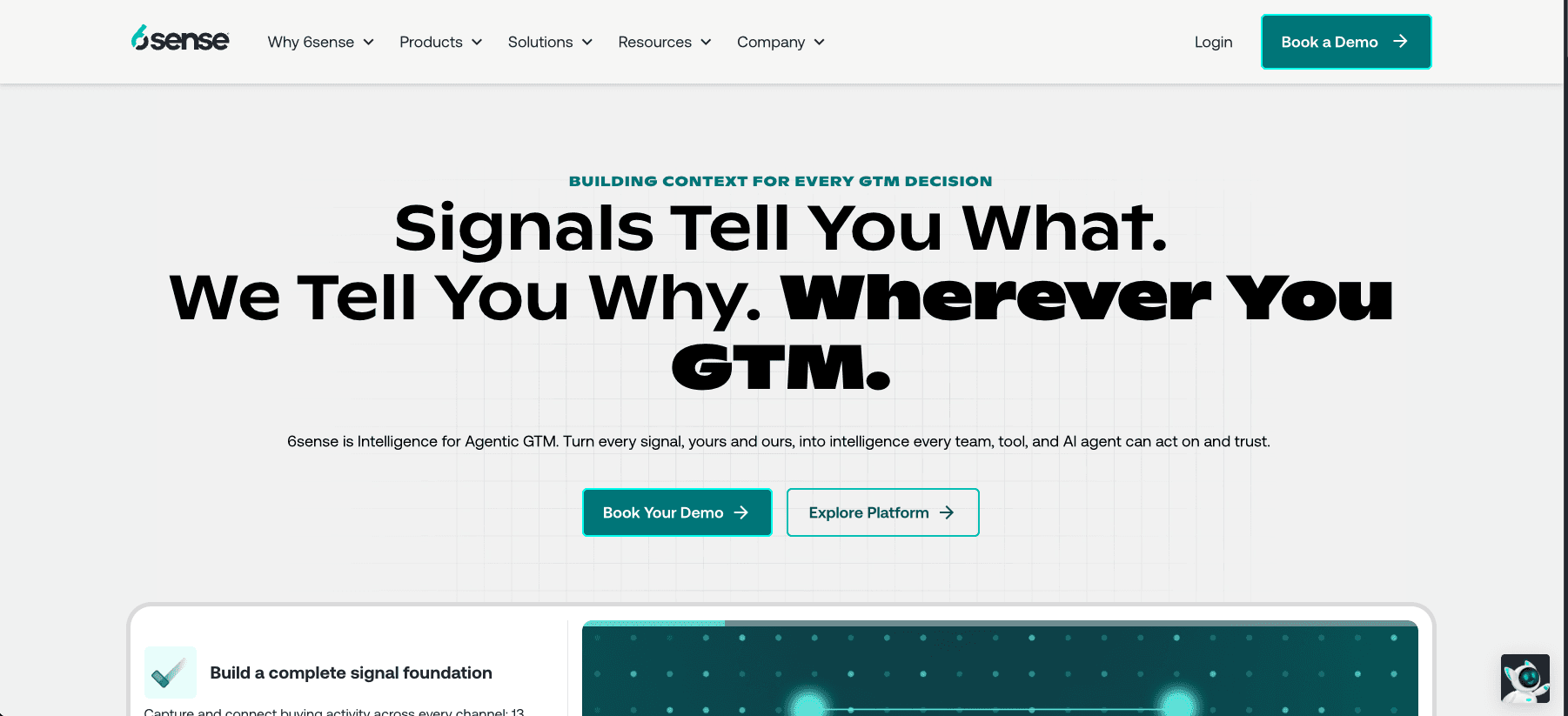
If your marketing team needs to know which accounts are in the Awareness stage versus the Decision stage, and wants to align campaigns, content, and sales outreach to those stages automatically, 6sense’s predictive model provides that capability. Bombora delivers surge scores. 6sense translates those scores (plus proprietary signals) into a buying-stage prediction that is actionable for campaign orchestration. If you buy Bombora alone, you need to build that predictive layer yourself.
ABM advertising is a primary activation channel
If display advertising, retargeting, and LinkedIn audience syndication are core parts of your demand generation strategy, 6sense’s native ad capabilities eliminate the need for a separate DSP or ABM advertising platform. Bombora has no activation layer at all. You would need to pair Bombora with a separate advertising platform (Demandbase, RollWorks, or a DSP) to achieve what 6sense does natively.
You want a single platform for intent, analytics, and activation
6sense consolidates intent data, predictive analytics, advertising, and sales workflow into one platform. This reduces vendor count and integration complexity for teams that value consolidation. Buying Bombora separately means you also need separate tools for scoring, analytics, advertising, and activation, which means more integrations, more vendors, and more operational complexity.
You do not have a data science team to build custom models
Bombora delivers raw surge scores. Turning those scores into actionable insights requires data science resources: building scoring models, setting thresholds, creating segmentation logic, and maintaining the analytics over time. 6sense does this for you through its pre-built predictive models. Teams without data science capacity are better served by 6sense’s built-in analytics than by raw Bombora data they cannot fully exploit.
Where both share the same fundamental limitation
Whether you buy the raw data from Bombora or the platform from 6sense, the underlying signal type is the same: anonymous content consumption patterns across a publisher co-op. Neither tells you what specifically happened at an account. Neither provides the original source, a direct quote, or a verifiable fact your rep can reference on a call.
Bombora tells you “Acme Corp is surging on cloud migration.” 6sense tells you “Acme Corp is in the Decision stage for cloud infrastructure.” Both are useful for prioritization. Neither gives your rep something to say when Acme’s VP of IT picks up the phone.
This is the structural gap that WhiteWhale fills.
The third option: WhiteWhale for custom signals
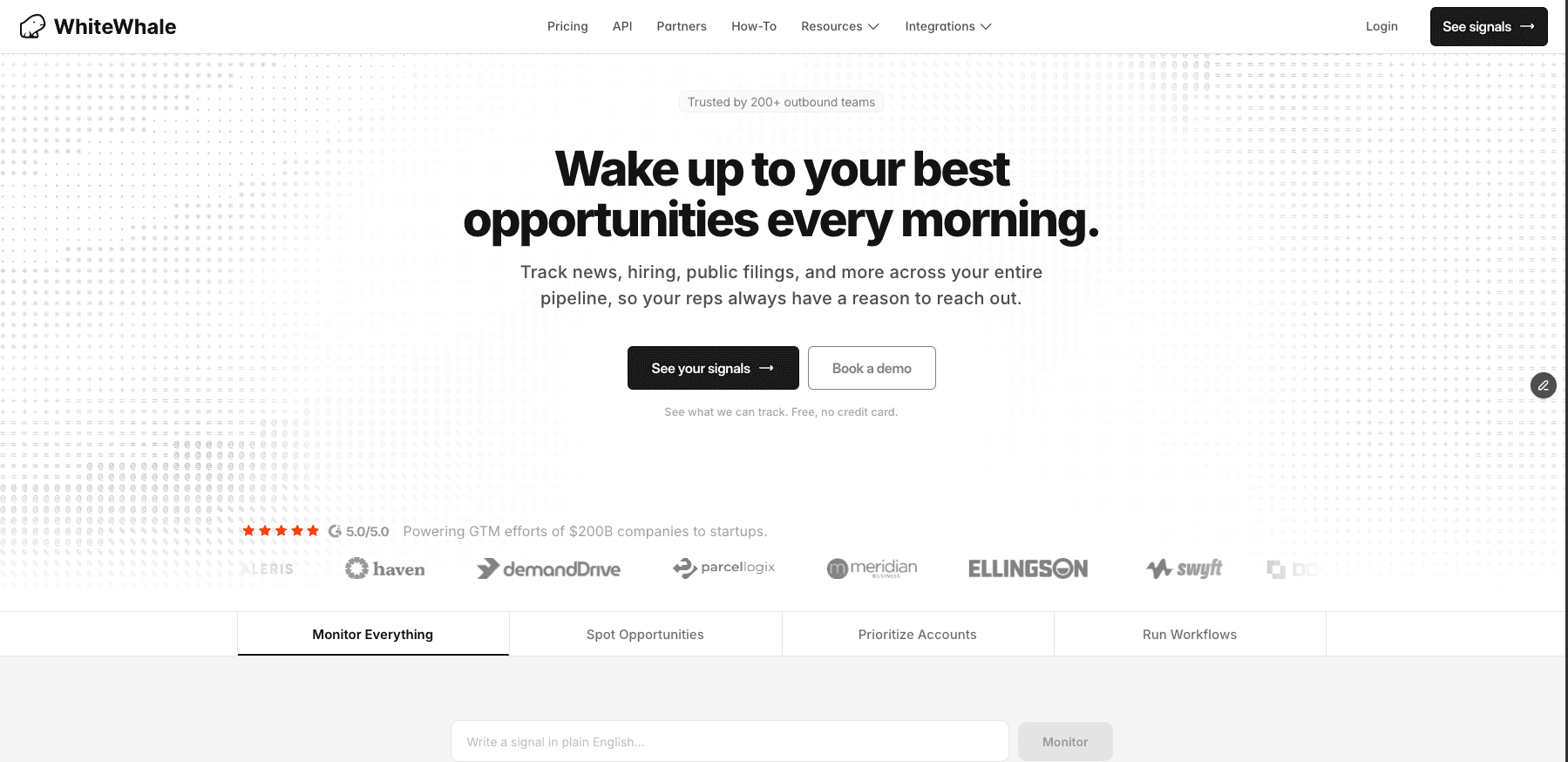
WhiteWhale does not use Bombora data. It does not track anonymous content consumption. It does not predict buying stages. It takes a fundamentally different approach.
You track signals specific to your business, so you reach out to prospects at the right time. When a signal fires, you get the result in Slack, email or in platform with the original source linked and direct quotes pulled out, so your reps can reference specific details on calls.
The goal is to have prospects say “thank you for calling, we were just talking about this”. That’s what the hundreds of sellers using WhiteWhale experience after signing up.
WhiteWhale monitors earnings call transcripts, job postings from company ATS systems (Greenhouse, Lever, Workday, Ashby), 8,000+ news feeds, press releases, and company websites. The signal is not “this account is surging.” The signal is “this account’s CFO committed $15M to cloud infrastructure on their Q3 earnings call, and they are hiring 3 cloud architects.”
The data architecture is different, and the difference matters on the phone.
A rep using Bombora or 6sense data says: “Our data suggests your company might be interested in cloud solutions.” The prospect hears a generic pitch based on a score they cannot verify.
A rep using WhiteWhale data says: “Your CFO mentioned on the Q3 call that cloud infrastructure modernization is your top priority for 2027, and I noticed you posted three cloud architect roles last week. We help companies making that transition with [specific value prop].” The prospect hears someone who did their homework and arrived at the right moment.
For teams selling to industries where buyers do not research through publisher networks, the difference is even more pronounced. Manufacturing, construction, healthcare, automotive, logistics, legal, telecommunications, and media buyers leave almost no footprint in Bombora’s publisher co-op. Their buying signals live in earnings calls, regulatory filings, job postings, and industry news, exactly what WhiteWhale monitors.
Plans start at $200/month, month-to-month, no annual contract. See pricing.
For a detailed WhiteWhale vs Bombora comparison, see WhiteWhale vs Bombora. For all signal platforms compared, see best buying signal platforms.
The pricing comparison
Bombora | 6sense | WhiteWhale | |
|---|---|---|---|
Annual cost (entry) | ~$25,000 to $30,000/yr | Free tier (50 credits/mo); paid from ~$11,500/yr | $2,400/yr (month-to-month) |
Annual cost (mid-tier) | ~$50,000 to $75,000/yr | ~$40,000 to $70,000/yr | $6,000/yr |
Annual cost (enterprise) | ~$75,000 to $100,000+/yr | ~$100,000 to $175,000/yr | $12,000/yr |
Contract | Annual | Annual (paid tiers) | Month-to-month |
What you get | Raw topic surge data feed | Predictive analytics + advertising + workflow built on the same data | Source-verified event signals from different sources entirely |
A team can run WhiteWhale for an entire year at the enterprise tier ($12,000) for less than the entry cost of Bombora ($25,000) or the median cost of 6sense ($62,820). The question is which type of signal your team needs, not which is “better.”
FAQ
Does 6sense use Bombora data?
Yes. 6sense licenses Bombora’s publisher co-op data as one of its signal inputs, alongside its own proprietary signals. The topic-level intent within 6sense’s Signalverse is partly derived from the same co-op data that Bombora sells directly. 6sense adds predictive scoring and advertising on top of this shared data layer.
Is it cheaper to buy Bombora directly or through 6sense?
It depends on what you need. Bombora contracts start around $25,000 to $30,000 per year for the raw data feed. 6sense’s median is $62,820 per year but includes predictive analytics, advertising, and workflow on top of the data. If you only need the intent data and already have your own analytics and activation stack, Bombora direct is cheaper. If you need the full platform, 6sense’s price includes capabilities you would otherwise need to buy separately.
Can I use Bombora and 6sense together?
You could, but it is uncommon and rarely cost-effective. 6sense already licenses Bombora data as part of its signal mix. Buying Bombora separately on top of a 6sense contract means paying for the same underlying data twice. The exception: if your data science team wants raw Bombora surge scores for custom modeling that 6sense’s pre-built analytics do not support.
Is Bombora’s data accurate?
Bombora’s Company Surge methodology, tracking content consumption spikes above a company’s historical baseline, is the industry standard for topic-level intent. Forrester named it a Leader in its Q1 2025 intent data Wave. The main limitations are that it is account-level only (no contact identification), covers a broad but not comprehensive set of B2B topics, and measures content consumption, not purchase intent directly. A “surge” means employees at a company read more about a topic than usual. It does not mean they are buying.
What is the difference between intent data and buying signals?
Intent data tracks anonymous content consumption patterns and produces probabilistic scores. Buying signals are broader: they include intent data but also event triggers (earnings call commitments, leadership changes, CapEx increases), job postings (revealing technology migrations and hiring surges), and regulatory changes. Bombora and 6sense provide intent data. WhiteWhale provides buying signals from a different set of sources with source verification attached to every result.
Which is better for outbound sales teams?
Neither Bombora nor 6sense is optimized for outbound. Bombora is a raw data feed with no activation layer. 6sense’s activation is advertising and sales alerts, not outbound outreach. For outbound teams, WhiteWhale provides the “why now” signal with evidence that makes cold outreach warm. Pair it with a contact data provider (Cognism for EU, Clay for enrichment) for the complete outbound stack.
About the author
Jack Porter is Co-Founder of WhiteWhale, a buying signal platform for B2B sales teams. Since 2025, Jack has spoken with 1,875 sales, GTM, and marketing leaders about their technology stack, what signals actually drive pipeline, and where intent data falls short. Those conversations informed every recommendation on this page. He can be reached on LinkedIn.
Here is the thing most people do not realize about Bombora vs 6sense: 6sense licenses Bombora’s data. The topic-level intent that 6sense uses as one of its signal inputs comes, in part, from the same publisher co-op that Bombora sells directly. So this is not a comparison of two competing intent datasets. It is a comparison of buying the raw data source versus buying the platform that layers predictive analytics, advertising, and workflow on top of that same data.
The question is not “whose intent data is better.” It is “do I need the raw feed or do I need the platform?”
If your team needs neither, and instead needs source-verified buying signals from earnings calls, job postings, and news that your reps can reference on calls, WhiteWhale is a third option built on a fundamentally different data architecture. More on that below.
Head-to-head comparison
Feature | Bombora | 6sense | |
|---|---|---|---|
What it is | Third-party intent data provider (the upstream co-op) | Enterprise ABM analytics and advertising platform | Buying signal detection platform |
Core approach | Tracks content consumption across ~5,000 B2B publisher sites; flags “surge” when activity exceeds baseline | Layers predictive buying-stage models, advertising, and workflow on top of intent data (including Bombora-sourced) | You define custom triggers; system finds matches with verified sources from earnings calls, job postings, and news |
Intent data source | The source. Bombora operates the co-op that most of the industry licenses | Bombora-derived + proprietary signals processed through Signalverse (1T+ signals daily) | Not intent data. Event signals from earnings calls, job postings (ATS), 8,000+ news feeds, press releases |
Topic taxonomy | 17,210 pre-defined topics; custom topics require 3 to 4 month lead time | Inherits Bombora topics + proprietary topic categories | No taxonomy. You define signals specific to your business |
Signal resolution | Account-level only; no contact identification | Account-level with buying-stage prediction; contact data via credits | Account-level with linked source, direct quotes, and cited facts |
Can you verify the signal? | No. Surge scores are proprietary; cannot see which articles were read or by whom | No. Predictive scores are proprietary; cannot see the evidence behind a stage assignment | Yes. Every result links to the original source |
Predictive analytics | No. Bombora delivers the data; you build the analytics | Yes. 4-stage buying journey prediction (Awareness, Consideration, Decision, Purchase) | No predictive scoring. Signals are verifiable events |
ABM advertising | No. Bombora is a data feed, not an activation platform | Native display, retargeting, LinkedIn orchestration | Not available |
AI agents | No | RevvyAI (recommended actions, account summaries) | AI scans unstructured sources to match custom signal definitions |
Activation layer | None. You feed Bombora data into your own CRM, ABM platform, or orchestration layer | Ads, alerts, and sales workflow built into the platform | Signals delivered to Slack, HubSpot, Salesforce, or Clay |
Implementation | Weeks; requires data integration into your existing stack | Weeks to months; requires dedicated RevOps | Days; most teams live in under a week |
Pricing | ~$25K to $100K+/yr, quote-based, annual contracts | Free Sales Intelligence tier (50 credits/mo); paid ABM tiers quote-based, median $62,820/yr per Vendr | Plans from $200/mo, month-to-month, no annual contract |
G2 rating | 4.3/5 | 3.9/5 | 5.0/5 |
Analyst recognition | Forrester Wave Leader, Intent Data, Q1 2025 | Gartner MQ Leader for ABM (5 consecutive years) | N/A (early-stage) |
Why this comparison is different from every other vendor matchup
Most vendor comparisons pit two competitors selling the same thing. Bombora and 6sense are not competitors in the traditional sense. They have a supplier-customer relationship. Bombora operates the publisher co-op. 6sense licenses that co-op data and builds a platform on top of it. ZoomInfo, Cognism, Apollo, and dozens of other vendors also license Bombora data.
This means the comparison is really about three layers:
Layer 1: The raw data. Bombora’s Company Surge data from roughly 5,000 B2B publisher sites. This is the same foundational layer whether you buy it from Bombora directly or consume it through 6sense, ZoomInfo, or anyone else.
Layer 2: The analytics. 6sense adds predictive buying-stage models, account scoring, and AI-driven recommendations on top of the raw data. Bombora does not do this. If you buy Bombora directly, you get the surge scores and build your own analytics.
Layer 3: The activation. 6sense adds native advertising (display, retargeting, LinkedIn), sales alerts, and workflow. Bombora does not activate. If you buy Bombora directly, you feed the data into your own CRM, ABM platform, or orchestration layer for activation.
The question comes down to which layers you already have and which you need to buy.
When Bombora is the better choice
You already have an analytics and activation layer
If your team already runs marketing automation (HubSpot, Marketo, Pardot), a CRM with lead scoring (Salesforce, HubSpot), and an engagement platform (Outreach, Salesloft), you may not need 6sense’s analytics and advertising layer at all. You need the raw intent data to feed into the stack you already have. In that case, Bombora direct gives you the fullest topic taxonomy (17,210 topics) at a lower cost than paying for 6sense’s platform on top of it.
You need the full topic taxonomy without a reseller’s filtering
When 6sense processes Bombora data through its Signalverse, it applies its own scoring, filtering, and weighting. This means you see 6sense’s interpretation of the data, not the raw data itself. If your data science team wants to build custom models on raw surge scores, or if you need access to all 17,210 topics without a reseller’s layer on top, Bombora direct is the path.
You want to avoid platform lock-in
Bombora integrates with virtually every CRM, ABM, and marketing automation platform on the market. You can switch your downstream stack without switching your intent data source. 6sense is a platform. Switching away from 6sense means losing the analytics, advertising, and workflow you built inside it. Bombora as a data layer gives you more architectural flexibility.
Your budget supports intent data but not an enterprise ABM platform
Bombora contracts run roughly $25,000 to $100,000+ per year. 6sense median is $62,820 per year, but that is for the ABM platform, not just intent data. If your budget is $30K to $50K and you already have a marketing and sales stack, Bombora’s data feed is more cost-effective than 6sense’s full platform at a similar or higher price point.
When 6sense is the better choice
You need the predictive layer, not just the data
If your marketing team needs to know which accounts are in the Awareness stage versus the Decision stage, and wants to align campaigns, content, and sales outreach to those stages automatically, 6sense’s predictive model provides that capability. Bombora delivers surge scores. 6sense translates those scores (plus proprietary signals) into a buying-stage prediction that is actionable for campaign orchestration. If you buy Bombora alone, you need to build that predictive layer yourself.
ABM advertising is a primary activation channel
If display advertising, retargeting, and LinkedIn audience syndication are core parts of your demand generation strategy, 6sense’s native ad capabilities eliminate the need for a separate DSP or ABM advertising platform. Bombora has no activation layer at all. You would need to pair Bombora with a separate advertising platform (Demandbase, RollWorks, or a DSP) to achieve what 6sense does natively.
You want a single platform for intent, analytics, and activation
6sense consolidates intent data, predictive analytics, advertising, and sales workflow into one platform. This reduces vendor count and integration complexity for teams that value consolidation. Buying Bombora separately means you also need separate tools for scoring, analytics, advertising, and activation, which means more integrations, more vendors, and more operational complexity.
You do not have a data science team to build custom models
Bombora delivers raw surge scores. Turning those scores into actionable insights requires data science resources: building scoring models, setting thresholds, creating segmentation logic, and maintaining the analytics over time. 6sense does this for you through its pre-built predictive models. Teams without data science capacity are better served by 6sense’s built-in analytics than by raw Bombora data they cannot fully exploit.
Where both share the same fundamental limitation
Whether you buy the raw data from Bombora or the platform from 6sense, the underlying signal type is the same: anonymous content consumption patterns across a publisher co-op. Neither tells you what specifically happened at an account. Neither provides the original source, a direct quote, or a verifiable fact your rep can reference on a call.
Bombora tells you “Acme Corp is surging on cloud migration.” 6sense tells you “Acme Corp is in the Decision stage for cloud infrastructure.” Both are useful for prioritization. Neither gives your rep something to say when Acme’s VP of IT picks up the phone.
This is the structural gap that WhiteWhale fills.
The third option: WhiteWhale for custom signals
WhiteWhale does not use Bombora data. It does not track anonymous content consumption. It does not predict buying stages. It takes a fundamentally different approach.
You track signals specific to your business, so you reach out to prospects at the right time. When a signal fires, you get the result in Slack, email or in platform with the original source linked and direct quotes pulled out, so your reps can reference specific details on calls.
The goal is to have prospects say “thank you for calling, we were just talking about this”. That’s what the hundreds of sellers using WhiteWhale experience after signing up.
WhiteWhale monitors earnings call transcripts, job postings from company ATS systems (Greenhouse, Lever, Workday, Ashby), 8,000+ news feeds, press releases, and company websites. The signal is not “this account is surging.” The signal is “this account’s CFO committed $15M to cloud infrastructure on their Q3 earnings call, and they are hiring 3 cloud architects.”
The data architecture is different, and the difference matters on the phone.
A rep using Bombora or 6sense data says: “Our data suggests your company might be interested in cloud solutions.” The prospect hears a generic pitch based on a score they cannot verify.
A rep using WhiteWhale data says: “Your CFO mentioned on the Q3 call that cloud infrastructure modernization is your top priority for 2027, and I noticed you posted three cloud architect roles last week. We help companies making that transition with [specific value prop].” The prospect hears someone who did their homework and arrived at the right moment.
For teams selling to industries where buyers do not research through publisher networks, the difference is even more pronounced. Manufacturing, construction, healthcare, automotive, logistics, legal, telecommunications, and media buyers leave almost no footprint in Bombora’s publisher co-op. Their buying signals live in earnings calls, regulatory filings, job postings, and industry news, exactly what WhiteWhale monitors.
Plans start at $200/month, month-to-month, no annual contract. See pricing.
For a detailed WhiteWhale vs Bombora comparison, see WhiteWhale vs Bombora. For all signal platforms compared, see best buying signal platforms.
The pricing comparison
Bombora | 6sense | WhiteWhale | |
|---|---|---|---|
Annual cost (entry) | ~$25,000 to $30,000/yr | Free tier (50 credits/mo); paid from ~$11,500/yr | $2,400/yr (month-to-month) |
Annual cost (mid-tier) | ~$50,000 to $75,000/yr | ~$40,000 to $70,000/yr | $6,000/yr |
Annual cost (enterprise) | ~$75,000 to $100,000+/yr | ~$100,000 to $175,000/yr | $12,000/yr |
Contract | Annual | Annual (paid tiers) | Month-to-month |
What you get | Raw topic surge data feed | Predictive analytics + advertising + workflow built on the same data | Source-verified event signals from different sources entirely |
A team can run WhiteWhale for an entire year at the enterprise tier ($12,000) for less than the entry cost of Bombora ($25,000) or the median cost of 6sense ($62,820). The question is which type of signal your team needs, not which is “better.”
FAQ
Does 6sense use Bombora data?
Yes. 6sense licenses Bombora’s publisher co-op data as one of its signal inputs, alongside its own proprietary signals. The topic-level intent within 6sense’s Signalverse is partly derived from the same co-op data that Bombora sells directly. 6sense adds predictive scoring and advertising on top of this shared data layer.
Is it cheaper to buy Bombora directly or through 6sense?
It depends on what you need. Bombora contracts start around $25,000 to $30,000 per year for the raw data feed. 6sense’s median is $62,820 per year but includes predictive analytics, advertising, and workflow on top of the data. If you only need the intent data and already have your own analytics and activation stack, Bombora direct is cheaper. If you need the full platform, 6sense’s price includes capabilities you would otherwise need to buy separately.
Can I use Bombora and 6sense together?
You could, but it is uncommon and rarely cost-effective. 6sense already licenses Bombora data as part of its signal mix. Buying Bombora separately on top of a 6sense contract means paying for the same underlying data twice. The exception: if your data science team wants raw Bombora surge scores for custom modeling that 6sense’s pre-built analytics do not support.
Is Bombora’s data accurate?
Bombora’s Company Surge methodology, tracking content consumption spikes above a company’s historical baseline, is the industry standard for topic-level intent. Forrester named it a Leader in its Q1 2025 intent data Wave. The main limitations are that it is account-level only (no contact identification), covers a broad but not comprehensive set of B2B topics, and measures content consumption, not purchase intent directly. A “surge” means employees at a company read more about a topic than usual. It does not mean they are buying.
What is the difference between intent data and buying signals?
Intent data tracks anonymous content consumption patterns and produces probabilistic scores. Buying signals are broader: they include intent data but also event triggers (earnings call commitments, leadership changes, CapEx increases), job postings (revealing technology migrations and hiring surges), and regulatory changes. Bombora and 6sense provide intent data. WhiteWhale provides buying signals from a different set of sources with source verification attached to every result.
Which is better for outbound sales teams?
Neither Bombora nor 6sense is optimized for outbound. Bombora is a raw data feed with no activation layer. 6sense’s activation is advertising and sales alerts, not outbound outreach. For outbound teams, WhiteWhale provides the “why now” signal with evidence that makes cold outreach warm. Pair it with a contact data provider (Cognism for EU, Clay for enrichment) for the complete outbound stack.
About the author
Jack Porter is Co-Founder of WhiteWhale, a buying signal platform for B2B sales teams. Since 2025, Jack has spoken with 1,875 sales, GTM, and marketing leaders about their technology stack, what signals actually drive pipeline, and where intent data falls short. Those conversations informed every recommendation on this page. He can be reached on LinkedIn.

Almost everyone says
"Wait…you can track THAT?"
See your signals for free. No credit card required.
Almost everyone says
"Wait…you can track THAT?"
See your signals for free. No credit card required.