
6sense and Demandbase are the two dominant enterprise ABM platforms, and they get compared in every enterprise deal because they are the only two that have held the Gartner Magic Quadrant Leader position for ABM consistently. The short version: 6sense is stronger on predictive buying-stage analytics. Demandbase is stronger on native B2B advertising and buying group tracking. Both cost $60K+ per year, require dedicated RevOps to implement, and deliver account-level intent signals that are largely derived from the same underlying data sources.
If your team does not need enterprise ABM advertising and predictive analytics, and instead needs source-verified buying signals your reps can reference on calls at a fraction of the cost, WhiteWhale is a third option worth evaluating. More on that below.
This guide breaks down what each platform actually does, where each one wins, and how to decide between them.
Head-to-head comparison
Feature | 6sense | Demandbase | |
|---|---|---|---|
Best for | Predictive buying-stage analytics and account prioritization | ABM advertising orchestration and buying group tracking | Custom verified signals with sources for outbound teams |
Core approach | Predictive AI models score accounts across 4 buying stages (Awareness, Consideration, Decision, Purchase) | 500B+ monthly signals feeding account intelligence, buying group identification, and native ad orchestration | You define custom triggers; system finds matches with verified sources from earnings calls, job postings, and news |
Signal type | Account-level: anonymous web intent, third-party topic surges (Bombora-derived + proprietary), technographics, buying-stage prediction | Account-level: intent data, engagement scoring, firmographics, buying group mapping across multiple stakeholders | Event-level: earnings call transcripts, job postings (ATS), 8,000+ news feeds, press releases, company websites |
Predictive layer | 4-stage buying journey prediction (Signalverse, 1T+ signals daily) | Account scoring and engagement analytics; less emphasis on stage prediction | No predictive scoring; every signal is a verifiable event with evidence |
ABM advertising | Native display and retargeting orchestration; LinkedIn audience syndication | Native display, retargeting, and account-based advertising; strongest native ad capabilities in the category | Not available |
Buying group tracking | Account-level identification; limited buying group mapping | Buying group identification across multiple stakeholders per deal; strongest buying group capabilities in the category | Not available; account-level with source-verified evidence |
AI agents | RevvyAI (recommended actions, account summaries) | Demandbase AI (account scoring, next-best-action) | AI scans unstructured sources (earnings calls, filings, news) to match custom signal definitions |
Conversation intelligence | Not available | Not available | Not available |
Verified contact database | Data credits within Sales Intelligence; not a standalone contact database | Contact data via InsideView acquisition; not at ZoomInfo-scale verification | No contact data; pairs with CRM or enrichment tools like Clay |
CRM integrations | Salesforce, HubSpot, Microsoft Dynamics | Salesforce, HubSpot, Microsoft Dynamics, Marketo | |
Implementation time | Weeks to months; requires dedicated RevOps | Weeks to months; requires dedicated RevOps | Days; most teams live in under a week |
Pricing | Free Sales Intelligence tier (50 credits/mo); paid tiers quote-based, median $62,820/yr per Vendr (204 deals) | Quote-based; ~$24K to $165K/yr, median ~$68K per published buyer reports | Plans from $200/mo, month-to-month, no annual contract, unlimited users |
Contract terms | Annual contracts on paid tiers | Annual contracts | Month-to-month, cancel anytime |
G2 rating | 3.9/5 (1,051 reviews) | 4.3/5 (1,000+ reviews) | 5.0/5 |
Analyst recognition | Gartner MQ Leader for ABM (5 consecutive years); Forrester Wave Leader Revenue Marketing Platforms Q1 2026 | Gartner MQ Leader for ABM; Forrester Wave Strong Performer | N/A (early-stage) |
What 6sense does better than Demandbase
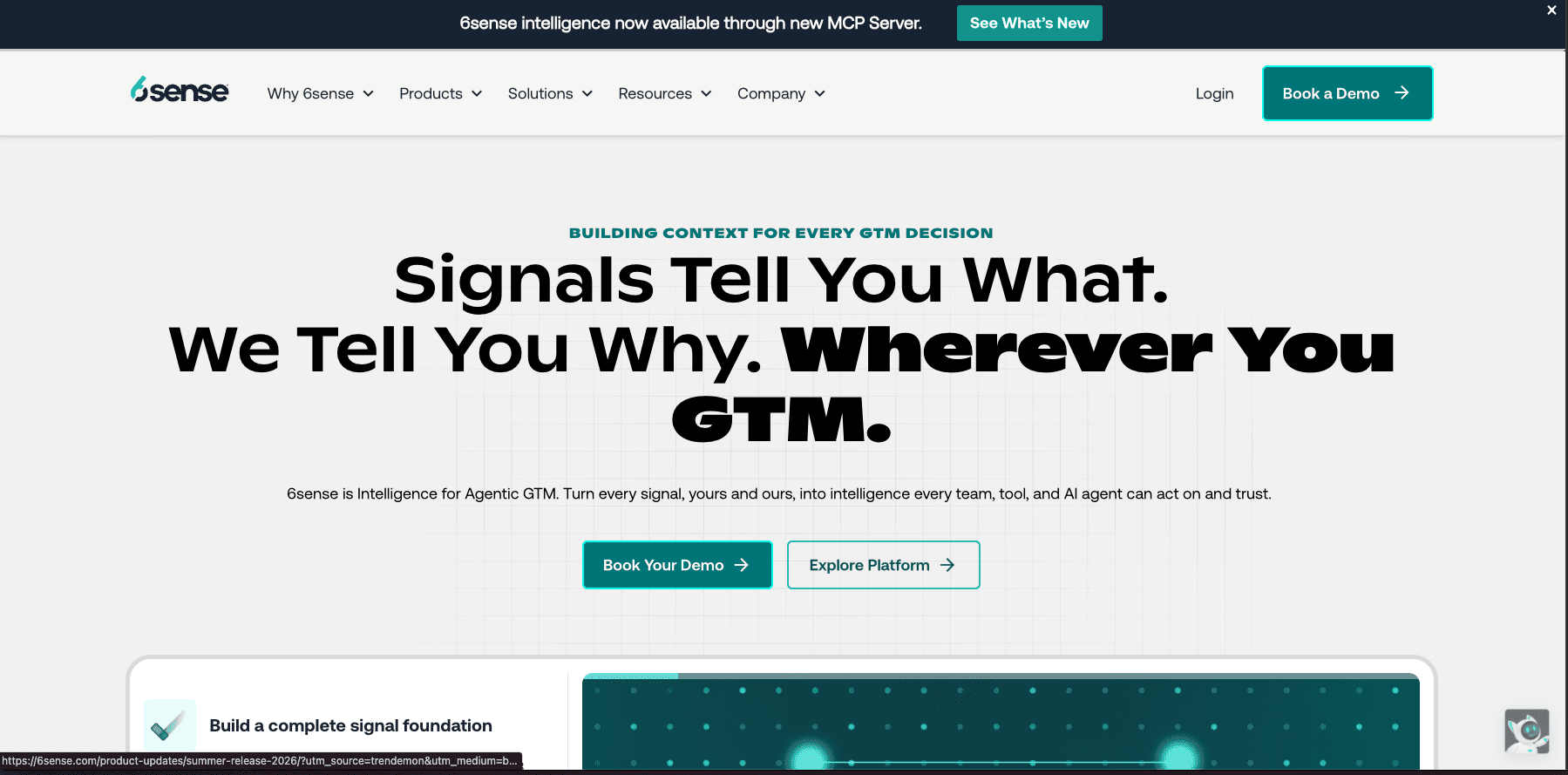
Predictive buying-stage analytics
6sense’s core differentiator is its predictive model. The system processes over one trillion buying signals daily and assigns each account to one of four buying stages: Awareness, Consideration, Decision, Purchase. This is genuinely useful for enterprise marketing teams that need to align campaigns, sales outreach, and content to where accounts are in their buying journey.
Demandbase provides account scoring and engagement analytics, but does not offer the same granular buying-stage prediction. 6sense’s model answers a specific question that Demandbase’s does not: “Is this account in the Decision stage right now?”
For marketing teams running stage-based nurture campaigns, 6sense’s predictive layer makes campaign targeting more precise. You can serve Awareness-stage accounts top-of-funnel content and Decision-stage accounts competitive comparison content without manually categorizing accounts.
Free evaluation tier
6sense offers a free Sales Intelligence tier with 50 data credits per month. This allows individual sellers to evaluate the product before committing to an enterprise contract. Demandbase has no equivalent free tier or self-serve evaluation path. Every Demandbase evaluation starts with a sales conversation.
This matters for teams that want to validate intent data quality on their own accounts before signing a $60K+ annual contract. 6sense’s free tier lowers the evaluation barrier meaningfully.
AI agent capabilities
6sense’s AI agents (launched 2025) surface recommended next actions based on intent signals and account scoring directly in the platform and through browser extensions. While Demandbase has its own AI capabilities, 6sense has invested more heavily in the agentic layer that translates intent signals into specific seller actions.
What Demandbase does better than 6sense
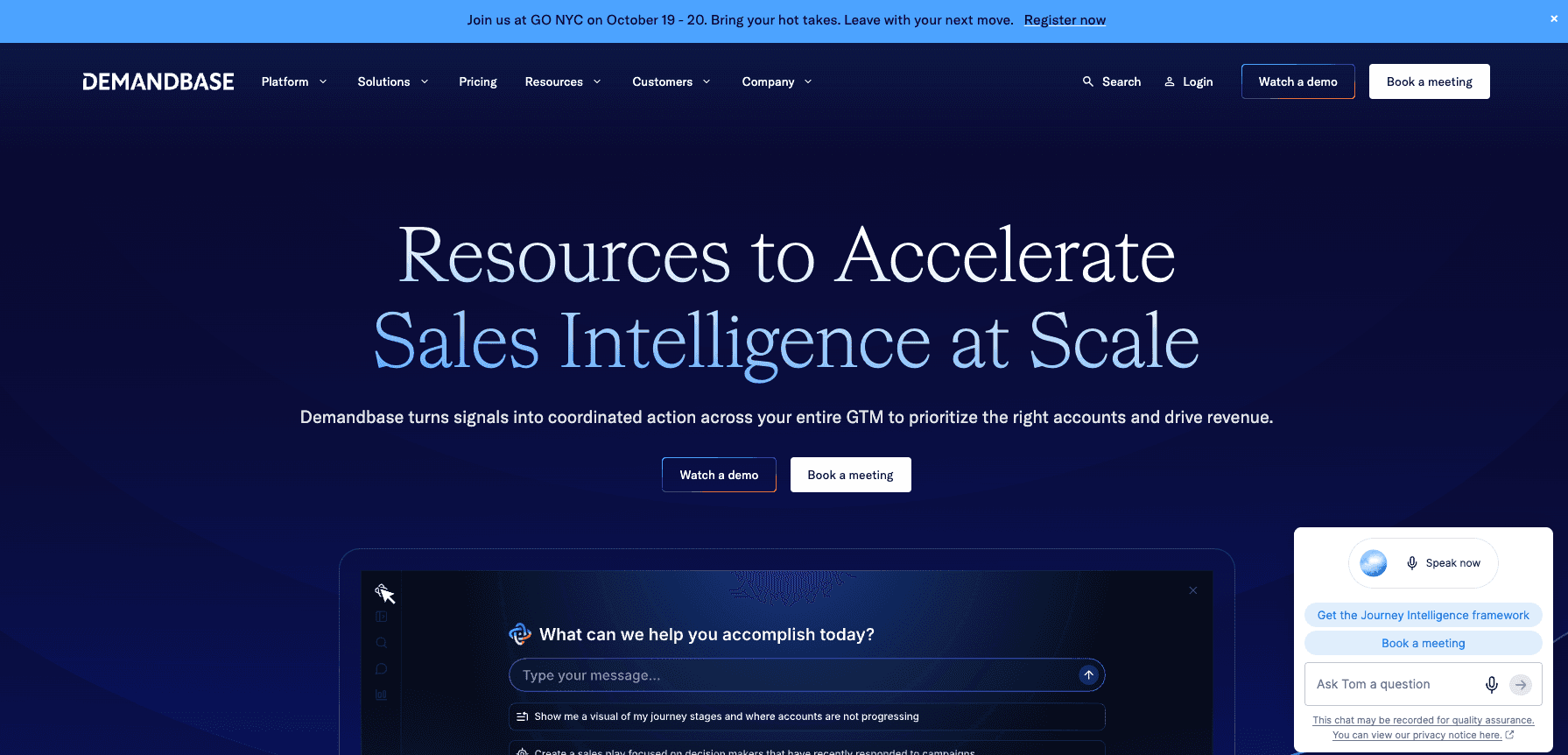
Native B2B advertising
Demandbase’s strongest differentiator is its advertising capabilities. Native display advertising, retargeting, and account-based ad targeting are built into the platform as first-class features, not add-ons. You can identify in-market accounts, build audiences, serve targeted ads, and measure the impact in one workflow.
6sense also has advertising capabilities, but Demandbase’s ad orchestration is deeper, with more granular targeting controls, broader ad network reach, and tighter integration between intent signals and ad activation. For marketing teams where ABM advertising is the primary activation channel, Demandbase’s ad capabilities are the deciding factor.
Buying group tracking
Demandbase identifies and tracks buying groups, mapping multiple stakeholders per deal across the buying committee. This matters for enterprise sales where a single deal involves 8 to 12 decision-makers across different roles and departments. Knowing that the VP of IT, the CFO, and the Head of Procurement at the same account are all showing engagement signals is more actionable than knowing the account is “surging.”
6sense’s signals are primarily account-level. While it can identify contacts through data credits, the platform does not map buying groups with the same depth as Demandbase. For enterprise sales teams selling to large buying committees, Demandbase’s buying group intelligence is a genuine advantage.
User experience and satisfaction
Demandbase holds a 4.3/5 G2 rating compared to 6sense’s 3.9/5. Multiple G2 reviews of 6sense cite non-transparent scoring (black-box predictive models), complex implementation, and UI challenges. Demandbase reviews also cite complexity, but overall satisfaction scores are consistently higher. This gap has been persistent across multiple review cycles and is worth considering for teams evaluating both.
Where both platforms share the same limitations
The underlying intent data overlaps significantly
Both 6sense and Demandbase license third-party topic intent data from overlapping sources, including Bombora’s publisher co-op. While each platform adds proprietary signals and applies different scoring models on top, the raw input data for topic-level intent overlaps meaningfully. When both platforms show you “surging on sales engagement software,” they may be reading the same underlying consumption data scored differently.
For a deeper breakdown of this dynamic, see why everyone’s intent data looks the same.
Signals are account-level and probabilistic
Neither platform tells you exactly what happened or provides the original source. 6sense tells you an account is in the “Decision” stage. Demandbase tells you an account has a high engagement score. Neither tells you “the CFO said on the Q3 earnings call that cloud migration is the top priority and they are hiring 5 cloud architects.” The signals are probabilistic scores derived from anonymous browsing behavior, not verifiable events your rep can reference on a call.
The activation layer is ads and alerts, not outreach
Both platforms end at advertising and alerting. They identify accounts and can trigger display ads or sales alerts, but neither sends emails, makes calls, or generates pipeline conversations. The account motion still ends in whatever engagement stack you attach (Outreach, Salesloft, HubSpot sequences, etc.).
Implementation requires dedicated RevOps
Both platforms are enterprise software that requires weeks to months of implementation, CRM integration, campaign configuration, and ongoing management. Neither is self-serve beyond 6sense’s free tier. Teams without a dedicated RevOps function will struggle to extract full value from either platform.
Pricing is enterprise-only and opaque
6sense median: $62,820/yr across 204 deals (Vendr data), ranging from ~$11,500 to $175,000. Demandbase: ~$24K to $165K/yr, median ~$68K (published buyer reports). Both require annual contracts. Neither publishes complete pricing on their website. The actual cost depends on number of accounts, data credits, advertising spend, user seats, and which modules you purchase.
When to choose 6sense
Your motion is enterprise ABM and your marketing team needs predictive buying-stage models to align campaigns to where accounts are in the buying journey
You want to evaluate intent data quality before committing to a contract (free Sales Intelligence tier)
Your primary activation channels are sales alerts and coordinated marketing campaigns, with advertising as a secondary channel
You have a dedicated RevOps team with capacity to implement and maintain a complex platform
Your budget supports $60K+ per year for an ABM analytics platform
You value analyst recognition: 6sense has held the Gartner MQ Leader position for ABM for 5 consecutive years
For a detailed comparison of 6sense against other approaches, see top 6sense alternatives and WhiteWhale vs 6sense.
When to choose Demandbase
ABM advertising (display, retargeting, account-based targeting) is a first-class part of your demand generation strategy, not an afterthought
You sell to large buying committees (8+ stakeholders) and need buying group tracking to understand which roles at an account are engaging
Your marketing and sales teams need a unified platform for both ABM analytics and ad orchestration
Higher G2 satisfaction scores matter to your evaluation process
Your budget supports $60K+ per year for an ABM platform
You have a dedicated RevOps team for implementation and ongoing management
When to choose neither
Both 6sense and Demandbase are enterprise ABM platforms built for large marketing and sales organizations running coordinated account-based programs with advertising as a primary activation channel. They are not the right choice if:
Your team is under 50 sellers. The platform complexity and cost exceed the value for smaller teams.
You do not run ABM advertising. If your primary motion is outbound sales, not display ads and retargeting, you are paying for an advertising engine you will not use.
You need signals with source verification. Neither platform shows you the original source of a signal. If your reps need to reference specific facts on calls (“Your CFO said on the Q3 call that…”), probabilistic intent scores do not provide that.
You sell to industries where buyers do not research online. Manufacturing, construction, logistics, healthcare, automotive buyers do not leave the kind of digital footprint that ABM platforms track.
You want month-to-month pricing without a six-figure annual commitment. Neither platform offers this.
The third option: WhiteWhale for verified signals without enterprise ABM
If your team needs buying signals but not ABM advertising, predictive scoring, or buying group analytics, the question is whether you need the $60K+ per year platform or whether you need the signal.
WhiteWhale is a buying signal platform that takes a fundamentally different approach. Instead of scoring anonymous browsing behavior, WhiteWhale lets you track custom triggers specific to your business. When a signal fires, you get the result with the original source linked, direct quotes pulled out, and cited facts, so your reps can verify the signal before they act and reference specific details on calls.
WhiteWhale monitors earnings call transcripts, job postings from company ATS systems (Greenhouse, Lever, Workday, Ashby), 8,000+ news feeds, press releases, and company websites. It does not track anonymous web browsing. It does not run advertising. It does not predict buying stages. What it does is find verifiable events (a CEO committing to AI on an earnings call, a company posting roles for an ERP migration, a CFO disclosing a CapEx increase in an SEC filing) and deliver them to Slack, HubSpot, or Salesforce with evidence attached.
The goal is to have prospects say “thank you for calling, we were just talking about this”. That’s what the hundreds of sellers using WhiteWhale experience after signing up.
Plans start at $200/month, month-to-month, no annual contract. That is roughly 40x less than the median 6sense contract and 35x less than the median Demandbase contract. See pricing.
For a full comparison of all signal and intent platforms, see best buying signal platforms.
FAQ
What is the main difference between 6sense and Demandbase?
6sense is stronger on predictive buying-stage analytics. Its Signalverse model assigns accounts to four stages (Awareness, Consideration, Decision, Purchase) and surfaces recommended actions through RevvyAI. Demandbase is stronger on native B2B advertising and buying group tracking. Its platform identifies multiple stakeholders per deal and orchestrates display and retargeting campaigns against them. Both are enterprise ABM platforms with similar price points and implementation requirements.
Which is cheaper, 6sense or Demandbase?
They are similarly priced. 6sense median is $62,820/yr across 204 deals per Vendr data. Demandbase median is approximately $68,000/yr per published buyer reports. Both are quote-based with annual contracts. 6sense offers a free Sales Intelligence tier (50 data credits/month) for individual evaluation. Demandbase does not have a free tier. For teams that do not need enterprise ABM, WhiteWhale starts at $200/month with no annual contract.
Do 6sense and Demandbase use the same intent data?
Partially. Both license third-party topic intent data from overlapping sources, including Bombora’s publisher co-op. Each adds proprietary signals and applies different scoring models, but the underlying topic-level consumption data overlaps significantly. The differentiation between the two platforms is in their scoring models, advertising capabilities, and buying group features, not in the raw intent data itself.
Is 6sense or Demandbase better for outbound sales?
Neither is built for outbound. Both are ABM platforms designed for marketing-led account identification and advertising activation. They end at alerts and ads, not outreach. For outbound sales teams that need verified signals they can reference in cold outreach, WhiteWhale is purpose-built: signals from earnings calls, job postings, and news delivered to Slack with sources and quotes attached.
Can a small team use 6sense or Demandbase?
6sense’s free Sales Intelligence tier works for individual sellers evaluating intent data. But the core ABM platform at both 6sense and Demandbase requires dedicated RevOps, weeks-to-months implementation, and $60K+ annual investment. Teams under 50 sellers or without ABM infrastructure will find the platforms’ weight exceeds their motion. Smaller teams looking for buying signals should evaluate WhiteWhale ($200/month, live in days) or other options in our best buying signal platforms comparison.
Should I use 6sense and Demandbase together?
Some enterprise teams do, but it is rare and expensive. 6sense for predictive analytics and Demandbase for advertising orchestration is a valid combination, but the overlapping intent data and similar price points make it difficult to justify the combined investment. Most teams choose one based on whether predictive analytics (6sense) or advertising and buying group tracking (Demandbase) is the higher priority.
What about teams that sell to non-software industries?
Both 6sense and Demandbase rely on anonymous web browsing behavior tracked across publisher networks. This signal type works best for software and technology buyers who research online. For teams selling to manufacturers, healthcare organizations, construction firms, financial services, legal, or automotive companies, WhiteWhale’s custom signals from earnings calls, job postings, and news are more relevant than either ABM platform.
About the author
Jack Porter is Co-Founder of WhiteWhale, a buying signal platform for B2B sales teams. Since 2025, Jack has spoken with 1,875 sales, GTM, and marketing leaders about their technology stack, what signals actually drive pipeline, and where intent data falls short. Those conversations informed every recommendation on this page. He can be reached on LinkedIn.
6sense and Demandbase are the two dominant enterprise ABM platforms, and they get compared in every enterprise deal because they are the only two that have held the Gartner Magic Quadrant Leader position for ABM consistently. The short version: 6sense is stronger on predictive buying-stage analytics. Demandbase is stronger on native B2B advertising and buying group tracking. Both cost $60K+ per year, require dedicated RevOps to implement, and deliver account-level intent signals that are largely derived from the same underlying data sources.
If your team does not need enterprise ABM advertising and predictive analytics, and instead needs source-verified buying signals your reps can reference on calls at a fraction of the cost, WhiteWhale is a third option worth evaluating. More on that below.
This guide breaks down what each platform actually does, where each one wins, and how to decide between them.
Head-to-head comparison
Feature | 6sense | Demandbase | |
|---|---|---|---|
Best for | Predictive buying-stage analytics and account prioritization | ABM advertising orchestration and buying group tracking | Custom verified signals with sources for outbound teams |
Core approach | Predictive AI models score accounts across 4 buying stages (Awareness, Consideration, Decision, Purchase) | 500B+ monthly signals feeding account intelligence, buying group identification, and native ad orchestration | You define custom triggers; system finds matches with verified sources from earnings calls, job postings, and news |
Signal type | Account-level: anonymous web intent, third-party topic surges (Bombora-derived + proprietary), technographics, buying-stage prediction | Account-level: intent data, engagement scoring, firmographics, buying group mapping across multiple stakeholders | Event-level: earnings call transcripts, job postings (ATS), 8,000+ news feeds, press releases, company websites |
Predictive layer | 4-stage buying journey prediction (Signalverse, 1T+ signals daily) | Account scoring and engagement analytics; less emphasis on stage prediction | No predictive scoring; every signal is a verifiable event with evidence |
ABM advertising | Native display and retargeting orchestration; LinkedIn audience syndication | Native display, retargeting, and account-based advertising; strongest native ad capabilities in the category | Not available |
Buying group tracking | Account-level identification; limited buying group mapping | Buying group identification across multiple stakeholders per deal; strongest buying group capabilities in the category | Not available; account-level with source-verified evidence |
AI agents | RevvyAI (recommended actions, account summaries) | Demandbase AI (account scoring, next-best-action) | AI scans unstructured sources (earnings calls, filings, news) to match custom signal definitions |
Conversation intelligence | Not available | Not available | Not available |
Verified contact database | Data credits within Sales Intelligence; not a standalone contact database | Contact data via InsideView acquisition; not at ZoomInfo-scale verification | No contact data; pairs with CRM or enrichment tools like Clay |
CRM integrations | Salesforce, HubSpot, Microsoft Dynamics | Salesforce, HubSpot, Microsoft Dynamics, Marketo | |
Implementation time | Weeks to months; requires dedicated RevOps | Weeks to months; requires dedicated RevOps | Days; most teams live in under a week |
Pricing | Free Sales Intelligence tier (50 credits/mo); paid tiers quote-based, median $62,820/yr per Vendr (204 deals) | Quote-based; ~$24K to $165K/yr, median ~$68K per published buyer reports | Plans from $200/mo, month-to-month, no annual contract, unlimited users |
Contract terms | Annual contracts on paid tiers | Annual contracts | Month-to-month, cancel anytime |
G2 rating | 3.9/5 (1,051 reviews) | 4.3/5 (1,000+ reviews) | 5.0/5 |
Analyst recognition | Gartner MQ Leader for ABM (5 consecutive years); Forrester Wave Leader Revenue Marketing Platforms Q1 2026 | Gartner MQ Leader for ABM; Forrester Wave Strong Performer | N/A (early-stage) |
What 6sense does better than Demandbase
Predictive buying-stage analytics
6sense’s core differentiator is its predictive model. The system processes over one trillion buying signals daily and assigns each account to one of four buying stages: Awareness, Consideration, Decision, Purchase. This is genuinely useful for enterprise marketing teams that need to align campaigns, sales outreach, and content to where accounts are in their buying journey.
Demandbase provides account scoring and engagement analytics, but does not offer the same granular buying-stage prediction. 6sense’s model answers a specific question that Demandbase’s does not: “Is this account in the Decision stage right now?”
For marketing teams running stage-based nurture campaigns, 6sense’s predictive layer makes campaign targeting more precise. You can serve Awareness-stage accounts top-of-funnel content and Decision-stage accounts competitive comparison content without manually categorizing accounts.
Free evaluation tier
6sense offers a free Sales Intelligence tier with 50 data credits per month. This allows individual sellers to evaluate the product before committing to an enterprise contract. Demandbase has no equivalent free tier or self-serve evaluation path. Every Demandbase evaluation starts with a sales conversation.
This matters for teams that want to validate intent data quality on their own accounts before signing a $60K+ annual contract. 6sense’s free tier lowers the evaluation barrier meaningfully.
AI agent capabilities
6sense’s AI agents (launched 2025) surface recommended next actions based on intent signals and account scoring directly in the platform and through browser extensions. While Demandbase has its own AI capabilities, 6sense has invested more heavily in the agentic layer that translates intent signals into specific seller actions.
What Demandbase does better than 6sense
Native B2B advertising
Demandbase’s strongest differentiator is its advertising capabilities. Native display advertising, retargeting, and account-based ad targeting are built into the platform as first-class features, not add-ons. You can identify in-market accounts, build audiences, serve targeted ads, and measure the impact in one workflow.
6sense also has advertising capabilities, but Demandbase’s ad orchestration is deeper, with more granular targeting controls, broader ad network reach, and tighter integration between intent signals and ad activation. For marketing teams where ABM advertising is the primary activation channel, Demandbase’s ad capabilities are the deciding factor.
Buying group tracking
Demandbase identifies and tracks buying groups, mapping multiple stakeholders per deal across the buying committee. This matters for enterprise sales where a single deal involves 8 to 12 decision-makers across different roles and departments. Knowing that the VP of IT, the CFO, and the Head of Procurement at the same account are all showing engagement signals is more actionable than knowing the account is “surging.”
6sense’s signals are primarily account-level. While it can identify contacts through data credits, the platform does not map buying groups with the same depth as Demandbase. For enterprise sales teams selling to large buying committees, Demandbase’s buying group intelligence is a genuine advantage.
User experience and satisfaction
Demandbase holds a 4.3/5 G2 rating compared to 6sense’s 3.9/5. Multiple G2 reviews of 6sense cite non-transparent scoring (black-box predictive models), complex implementation, and UI challenges. Demandbase reviews also cite complexity, but overall satisfaction scores are consistently higher. This gap has been persistent across multiple review cycles and is worth considering for teams evaluating both.
Where both platforms share the same limitations
The underlying intent data overlaps significantly
Both 6sense and Demandbase license third-party topic intent data from overlapping sources, including Bombora’s publisher co-op. While each platform adds proprietary signals and applies different scoring models on top, the raw input data for topic-level intent overlaps meaningfully. When both platforms show you “surging on sales engagement software,” they may be reading the same underlying consumption data scored differently.
For a deeper breakdown of this dynamic, see why everyone’s intent data looks the same.
Signals are account-level and probabilistic
Neither platform tells you exactly what happened or provides the original source. 6sense tells you an account is in the “Decision” stage. Demandbase tells you an account has a high engagement score. Neither tells you “the CFO said on the Q3 earnings call that cloud migration is the top priority and they are hiring 5 cloud architects.” The signals are probabilistic scores derived from anonymous browsing behavior, not verifiable events your rep can reference on a call.
The activation layer is ads and alerts, not outreach
Both platforms end at advertising and alerting. They identify accounts and can trigger display ads or sales alerts, but neither sends emails, makes calls, or generates pipeline conversations. The account motion still ends in whatever engagement stack you attach (Outreach, Salesloft, HubSpot sequences, etc.).
Implementation requires dedicated RevOps
Both platforms are enterprise software that requires weeks to months of implementation, CRM integration, campaign configuration, and ongoing management. Neither is self-serve beyond 6sense’s free tier. Teams without a dedicated RevOps function will struggle to extract full value from either platform.
Pricing is enterprise-only and opaque
6sense median: $62,820/yr across 204 deals (Vendr data), ranging from ~$11,500 to $175,000. Demandbase: ~$24K to $165K/yr, median ~$68K (published buyer reports). Both require annual contracts. Neither publishes complete pricing on their website. The actual cost depends on number of accounts, data credits, advertising spend, user seats, and which modules you purchase.
When to choose 6sense
Your motion is enterprise ABM and your marketing team needs predictive buying-stage models to align campaigns to where accounts are in the buying journey
You want to evaluate intent data quality before committing to a contract (free Sales Intelligence tier)
Your primary activation channels are sales alerts and coordinated marketing campaigns, with advertising as a secondary channel
You have a dedicated RevOps team with capacity to implement and maintain a complex platform
Your budget supports $60K+ per year for an ABM analytics platform
You value analyst recognition: 6sense has held the Gartner MQ Leader position for ABM for 5 consecutive years
For a detailed comparison of 6sense against other approaches, see top 6sense alternatives and WhiteWhale vs 6sense.
When to choose Demandbase
ABM advertising (display, retargeting, account-based targeting) is a first-class part of your demand generation strategy, not an afterthought
You sell to large buying committees (8+ stakeholders) and need buying group tracking to understand which roles at an account are engaging
Your marketing and sales teams need a unified platform for both ABM analytics and ad orchestration
Higher G2 satisfaction scores matter to your evaluation process
Your budget supports $60K+ per year for an ABM platform
You have a dedicated RevOps team for implementation and ongoing management
When to choose neither
Both 6sense and Demandbase are enterprise ABM platforms built for large marketing and sales organizations running coordinated account-based programs with advertising as a primary activation channel. They are not the right choice if:
Your team is under 50 sellers. The platform complexity and cost exceed the value for smaller teams.
You do not run ABM advertising. If your primary motion is outbound sales, not display ads and retargeting, you are paying for an advertising engine you will not use.
You need signals with source verification. Neither platform shows you the original source of a signal. If your reps need to reference specific facts on calls (“Your CFO said on the Q3 call that…”), probabilistic intent scores do not provide that.
You sell to industries where buyers do not research online. Manufacturing, construction, logistics, healthcare, automotive buyers do not leave the kind of digital footprint that ABM platforms track.
You want month-to-month pricing without a six-figure annual commitment. Neither platform offers this.
The third option: WhiteWhale for verified signals without enterprise ABM
If your team needs buying signals but not ABM advertising, predictive scoring, or buying group analytics, the question is whether you need the $60K+ per year platform or whether you need the signal.
WhiteWhale is a buying signal platform that takes a fundamentally different approach. Instead of scoring anonymous browsing behavior, WhiteWhale lets you track custom triggers specific to your business. When a signal fires, you get the result with the original source linked, direct quotes pulled out, and cited facts, so your reps can verify the signal before they act and reference specific details on calls.
WhiteWhale monitors earnings call transcripts, job postings from company ATS systems (Greenhouse, Lever, Workday, Ashby), 8,000+ news feeds, press releases, and company websites. It does not track anonymous web browsing. It does not run advertising. It does not predict buying stages. What it does is find verifiable events (a CEO committing to AI on an earnings call, a company posting roles for an ERP migration, a CFO disclosing a CapEx increase in an SEC filing) and deliver them to Slack, HubSpot, or Salesforce with evidence attached.
The goal is to have prospects say “thank you for calling, we were just talking about this”. That’s what the hundreds of sellers using WhiteWhale experience after signing up.
Plans start at $200/month, month-to-month, no annual contract. That is roughly 40x less than the median 6sense contract and 35x less than the median Demandbase contract. See pricing.
For a full comparison of all signal and intent platforms, see best buying signal platforms.
FAQ
What is the main difference between 6sense and Demandbase?
6sense is stronger on predictive buying-stage analytics. Its Signalverse model assigns accounts to four stages (Awareness, Consideration, Decision, Purchase) and surfaces recommended actions through RevvyAI. Demandbase is stronger on native B2B advertising and buying group tracking. Its platform identifies multiple stakeholders per deal and orchestrates display and retargeting campaigns against them. Both are enterprise ABM platforms with similar price points and implementation requirements.
Which is cheaper, 6sense or Demandbase?
They are similarly priced. 6sense median is $62,820/yr across 204 deals per Vendr data. Demandbase median is approximately $68,000/yr per published buyer reports. Both are quote-based with annual contracts. 6sense offers a free Sales Intelligence tier (50 data credits/month) for individual evaluation. Demandbase does not have a free tier. For teams that do not need enterprise ABM, WhiteWhale starts at $200/month with no annual contract.
Do 6sense and Demandbase use the same intent data?
Partially. Both license third-party topic intent data from overlapping sources, including Bombora’s publisher co-op. Each adds proprietary signals and applies different scoring models, but the underlying topic-level consumption data overlaps significantly. The differentiation between the two platforms is in their scoring models, advertising capabilities, and buying group features, not in the raw intent data itself.
Is 6sense or Demandbase better for outbound sales?
Neither is built for outbound. Both are ABM platforms designed for marketing-led account identification and advertising activation. They end at alerts and ads, not outreach. For outbound sales teams that need verified signals they can reference in cold outreach, WhiteWhale is purpose-built: signals from earnings calls, job postings, and news delivered to Slack with sources and quotes attached.
Can a small team use 6sense or Demandbase?
6sense’s free Sales Intelligence tier works for individual sellers evaluating intent data. But the core ABM platform at both 6sense and Demandbase requires dedicated RevOps, weeks-to-months implementation, and $60K+ annual investment. Teams under 50 sellers or without ABM infrastructure will find the platforms’ weight exceeds their motion. Smaller teams looking for buying signals should evaluate WhiteWhale ($200/month, live in days) or other options in our best buying signal platforms comparison.
Should I use 6sense and Demandbase together?
Some enterprise teams do, but it is rare and expensive. 6sense for predictive analytics and Demandbase for advertising orchestration is a valid combination, but the overlapping intent data and similar price points make it difficult to justify the combined investment. Most teams choose one based on whether predictive analytics (6sense) or advertising and buying group tracking (Demandbase) is the higher priority.
What about teams that sell to non-software industries?
Both 6sense and Demandbase rely on anonymous web browsing behavior tracked across publisher networks. This signal type works best for software and technology buyers who research online. For teams selling to manufacturers, healthcare organizations, construction firms, financial services, legal, or automotive companies, WhiteWhale’s custom signals from earnings calls, job postings, and news are more relevant than either ABM platform.
About the author
Jack Porter is Co-Founder of WhiteWhale, a buying signal platform for B2B sales teams. Since 2025, Jack has spoken with 1,875 sales, GTM, and marketing leaders about their technology stack, what signals actually drive pipeline, and where intent data falls short. Those conversations informed every recommendation on this page. He can be reached on LinkedIn.

Almost everyone says
"Wait…you can track THAT?"
See your signals for free. No credit card required.
Almost everyone says
"Wait…you can track THAT?"
See your signals for free. No credit card required.