Summary: The best buying signal platform depends on what kind of signal your team actually needs. For custom verified signals with sources attached, WhiteWhale lets you write triggers in plain English and returns results with linked evidence. For third-party topic intent at scale, Bombora runs the co-op most of the industry resells. For enterprise ABM with predictive scoring, 6sense or Demandbase. For DIY signal orchestration, Clay.
Here is every platform worth evaluating in 2026, with signal types, pricing, and what each tool actually does versus what it claims.
Platform | Best for | Signal types | Pricing | G2 rating |
|---|---|---|---|---|
WhiteWhale | Custom verified signals with evidence | Custom plain-English signals, SEC filings, earnings calls, job postings (ATS), news, company LinkedIn | Free tier, Pro from $200/mo (month-to-month) | 5.0/5.0 |
Bombora | Third-party topic intent at the source | Content consumption surge across 5,000+ publisher co-op | $25K to $100K+/yr (quote-based) | 4.3/5.0 |
6sense | Predictive ABM analytics | Topic intent, website visitor ID, predictive buying stage, technographics | Median $62,820/yr per Vendr (quote-based) | 4.0/5.0 |
Demandbase | ABM advertising and analytics | Intent, engagement scoring, programmatic advertising | $24K to $165K/yr (quote-based) | 4.3/5.0 |
Clay | DIY signal orchestration | 150+ data providers composable into custom workflows | Free tier, Launch $167/mo, Growth $446/mo + credits | 4.9/5.0 |
UserGems | Champion job-change tracking | 21+ signal types, champion tracking, Gem-E agent | From $2,750/mo ($33K/yr) | 4.8/5.0 |
ZoomInfo | Contact data bundled with intent | Topic intent (Bombora-derived), Scoops, technographics, 321M+ contacts | $15K to $40K+/yr add-on (quote-based) | 4.5/5.0 |
Affordable signals + sequencing | Job changes, funding, tech installs, basic intent | Free tier, $49+/user/mo | 4.7/5.0 | |
G2 Buyer Intent | Review-site intent | Profile views, competitor page visits, category research on G2 | Custom (commonly low-to-mid five figures/yr) | N/A |
Community and product signals | Community activity, social engagement, product usage, Person360 identity | Essential ~$2,500/mo (annual) | 4.5/5.0 | |
Avina | Natural-language signal detection | Custom AI signals on earnings calls, SEC filings, product changelogs | From $259/mo | N/A |
Sales Navigator | LinkedIn signals and list building | Job changes, company news, buyer intent (Advanced+) | From $99.99/user/mo | 4.3/5.0 |
How we evaluated
We compared these platforms across five criteria: signal breadth (how many signal types a tool covers), source verification (can you see where the signal came from and verify it before acting), speed to action (how fast a signal becomes outreach), pricing transparency (is there a self-serve option or does everything require a sales cycle), and setup time (days versus months).
We also disclosed sourcing honestly, including for the tools on this list that resell the same underlying data from the same providers.
What “buying signal” actually means in 2026
The term “buying signal” covers at least five different types of data that vendors sell under the same label. Knowing which is which prevents most bad purchases.
First-party signals come from your own properties. Website visits, pricing page views, product usage. Highest relevance because the prospect chose you, but smallest volume since it only captures people who already know you exist.
Second-party signals come from review platforms. G2, TrustRadius, Capterra. When someone compares your product to a competitor on G2, that is one of the highest-intent signals available because they are actively evaluating.
Third-party topic intent infers interest from content consumption across publisher networks. Bombora’s co-op of roughly 5,000 B2B publisher sites is the dominant source. ZoomInfo, Cognism, Apollo, and others resell it. This is account-level data, not contact-level data. It tells you a company is researching a topic, not who at that company is doing the research.
Event and trigger signals are observable facts: funding rounds, leadership hires, job postings, tech stack changes, earnings call statements, SEC filings. These are verifiable and specific, which is why outbound teams increasingly start here instead of with topic intent. For a deeper look at how these work, see what is a sales signal.
Custom signals are triggers defined by the user in their own language for their specific product. “Is this company migrating off Salesforce?” or “Did this company’s CFO publicly discuss cost reduction?” These require AI to scan unstructured data sources and return matches with evidence. WhiteWhale pioneered this approach for B2B sales teams. See how signals work for examples.
Kerry Cunningham, former Forrester and SiriusDecisions analyst, wrote on 6sense’s own blog in September 2025: “Intent data promised to reveal which buyers were ready to buy, but in reality, it mostly told us who was digitally loafing on our website. It’s time to retire the phrase.” That framing captures why the market is shifting from topic intent scores toward verified event signals.
Teams that layer multiple signal types see significantly better results. Accounts that hit 2 or more stacked signals close at 2.1x the baseline win rate based on WhiteWhale internal data.
The 12 best buying signal platforms in 2026
1. WhiteWhale: best for custom verified signals with evidence
WhiteWhale (getwhitewhale.com) is a custom buying signal platform built on a simple premise: every signal should come with a source you can verify before you pick up the phone.
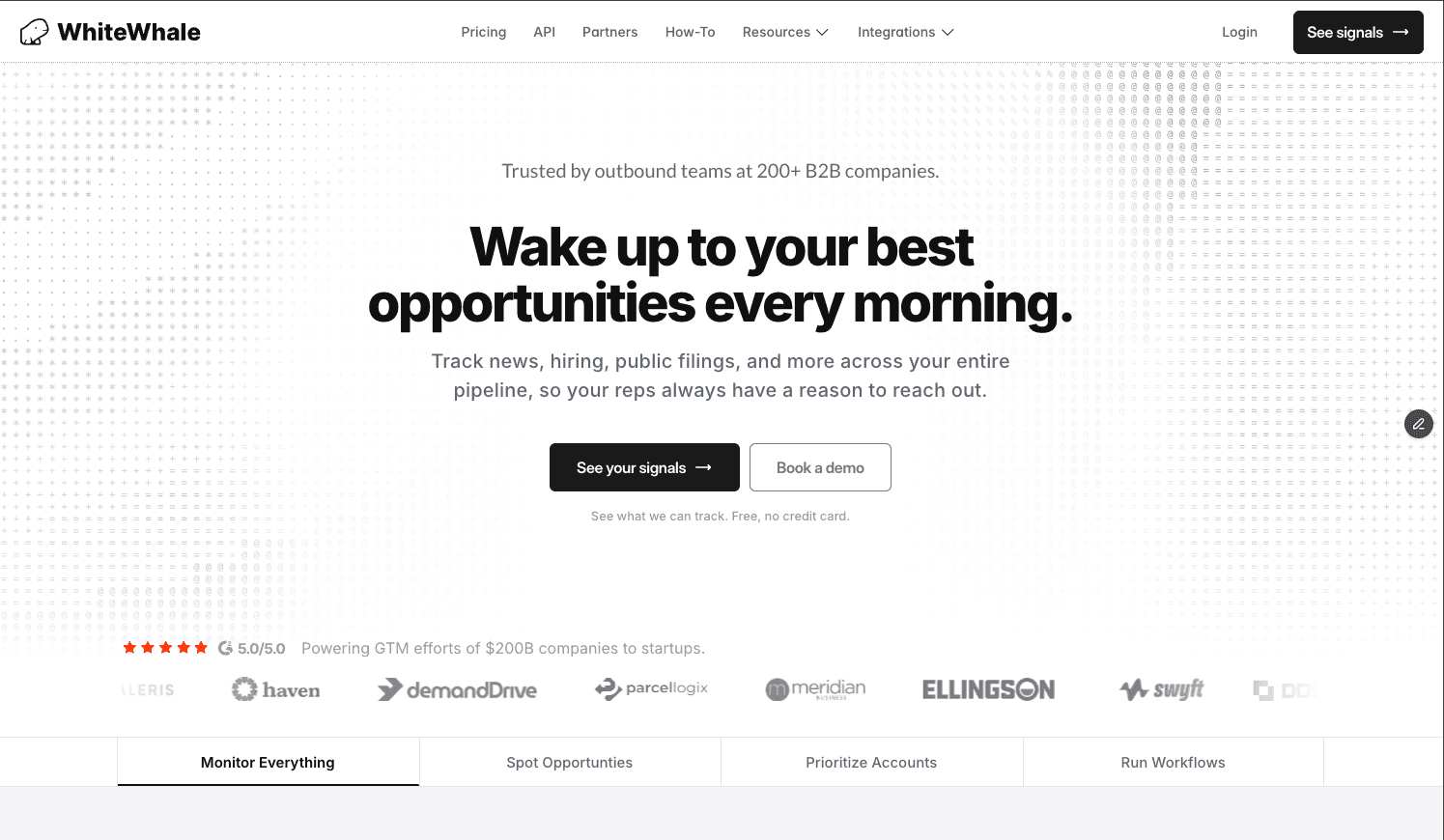
User can track signals specific to just their business, building a list of signals that make it the perfect time to reach out. Each signal is unique like “Is this company hiring for roles that mention data migration?” or “Did this company’s CEO publicly commit to AI adoption?” WhiteWhale monitors SEC filings (10-K, 10-Q, Form D), earnings call transcripts, job postings pulled directly from company ATS systems (Greenhouse, Lever, Workday, Ashby), 8,000+ news feeds, press releases, company websites, and company LinkedIn posts.
When a signal fires, the result includes the original source linked, direct quotes pulled from the source, and cited facts. Reps verify the signal before they act, and they reference specific details on calls. This is the opposite of a black-box intent score where you cannot see the underlying evidence.
Signal stacking combines multiple signals on a single account into a “Why Now” narrative. An account that hits “new CFO,” “earnings call mentioned cost reduction,” and “hiring for roles mentioning your competitor” simultaneously is a very different priority than one that hit a single generic intent score.
WhiteWhale also does ICP-based account discovery, finding companies outside your CRM that match your profile and are hitting signals right now. Nicholas de la Guardia at Simpli discovered 279 accounts he had never heard of in 30 minutes. And revenue validation tests which signals actually correlated with closed-won deals over the past 6 to 12 months, so you can refine your signal set based on what drives pipeline, not what sounds good on paper. See how Meridian prioritized 2,800 accounts in 24 hours for a real-world example of this workflow.
What WhiteWhale does not do: WhiteWhale does not sell contact data (no emails, no phone numbers). It does not do IP-based website visitor tracking. It does not do outbound sequencing or automated outreach. It is a signal layer that feeds into the tools your team already uses, including HubSpot, Salesforce, Slack, Clay, and any AI agent via MCP or API. 90% of WhiteWhale customers never log into the platform. Everything flows into their existing workflow. For the full list of integrations, see the WhiteWhale API documentation.
Who should use it: B2B sales teams selling to companies with 100+ employees who need custom, source-verified signals they can reference on calls and in emails. Particularly strong for teams with niche ICPs that generic intent data does not cover, like manufacturing, logistics, financial services, or cybersecurity.
Who should pick something else: Teams that need a contact database bundled with signals (look at ZoomInfo or Apollo). Teams running full ABM programs with predictive scoring and ad orchestration (look at 6sense or Demandbase). Teams that want automated outreach built into the signal platform (look at Artisan or Unify).
Pricing: Free tier available, no credit card required. Pro from $200/month, month-to-month, no annual contract. Unlimited users. Pricing scales linearly with accounts monitored: 300 accounts = $200, 1,500 accounts = $1,000. See pricing.
2. Bombora: best third-party topic intent at the source
Bombora runs the co-op that most of the intent industry resells. Roughly 5,000 B2B publisher sites contribute content consumption data, processed into Company Surge scores across 17,210+ intent topics. Forrester named it a Leader in its Q1 2025 intent data Wave. When topic-level surge data appears in your stack, whether through ZoomInfo, Cognism, Apollo, or 6sense, the underlying data likely originated with Bombora.
Buying direct means access to the full topic taxonomy with no reseller markup. The main limitation: it is account-level, not contact-level. Bombora tells you a company is researching a topic, not who. And practitioners report 3 to 4 month waits for new custom topics, which is painful if your category is new or niche.
Who should use it: Mid-market and enterprise teams that want the canonical topic-surge source feeding their own orchestration layer.
Who should pick something else: SMBs (the price floor excludes them) and teams without a downstream system to act on account-level surges. A surge score with no activation layer is trivia. For a full comparison of intent data vendors, see best intent data providers.
Pricing: Quote-based. Roughly $25,000 to $100,000/yr based on published buyer reports. Surge data starts near $30,000.
3. 6sense: best predictive ABM analytics and ad activation
6sense wraps intent (including Bombora-sourced and its own signals) in predictive models that estimate where accounts sit in a buying journey, then orchestrates ads, alerts, and workflows. It has been a Gartner Magic Quadrant Leader for ABM five consecutive years. RevvyAI agents (2025) add an agentic layer for recommended actions.
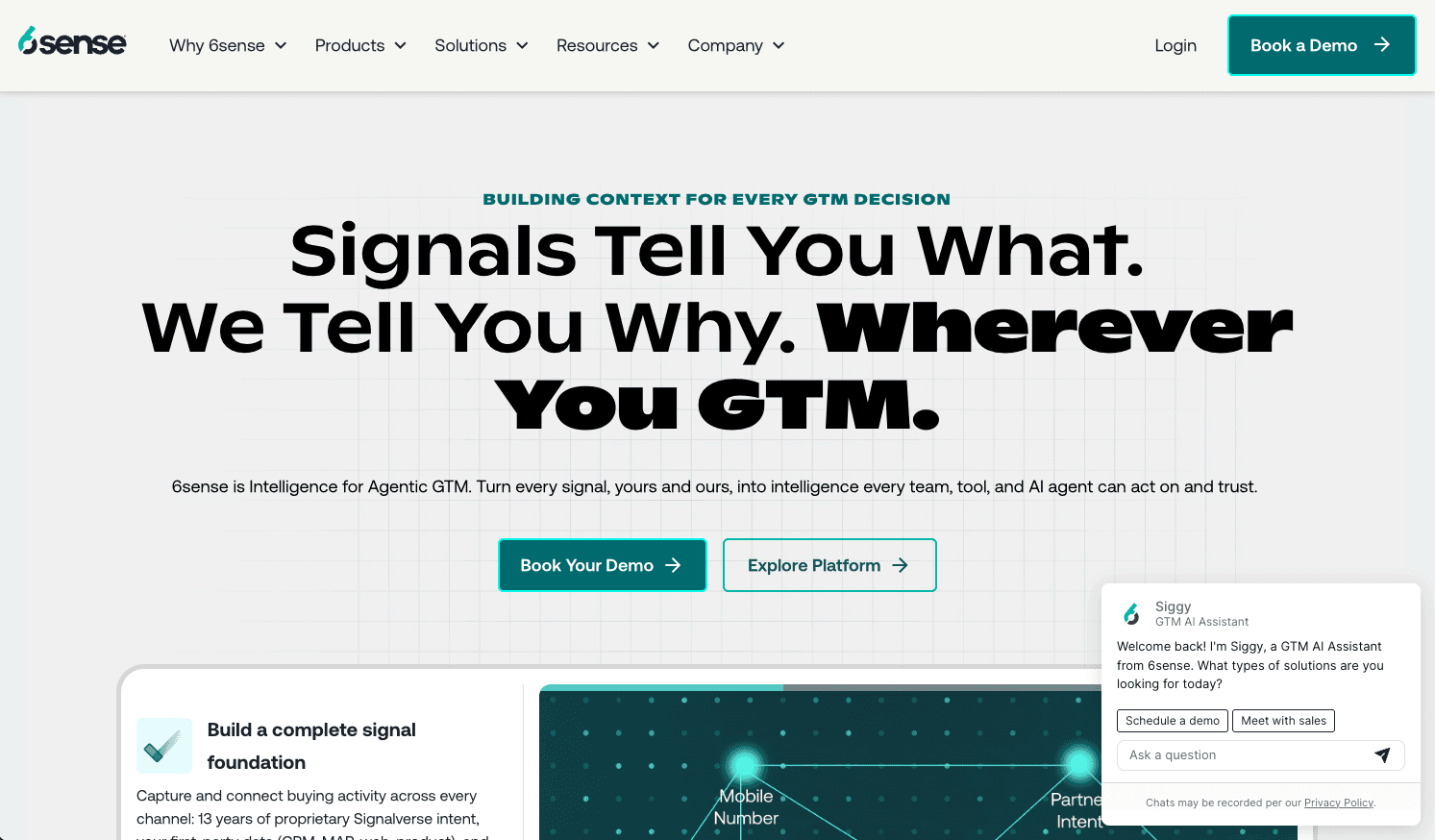
For large revenue teams running coordinated ABM motions with predictive scoring, journey analytics, and paid media activation on named accounts, 6sense is the most complete analytics suite in the category.
The activation layer is ads and alerts, not outreach. The account motion still ends in whatever engagement stack you attach. And the cost is significant: Vendr contract data shows a median of $62,820 across 204 deals, ranging from roughly $11,500 to $175,000.
For a detailed comparison of how 6sense compares to signal-based approaches, see WhiteWhale vs 6sense.
Who should use it: Enterprises with ABM infrastructure and ops capacity. Generally teams with 50+ sellers.
Who should pick something else: Teams under 50 sellers or without dedicated RevOps. Also teams that need signals with source verification, since 6sense’s intent scores are probabilistic and account-level.
Pricing: Quote-based. Vendr median $62,820/yr. Annual contracts.
4. Demandbase: best ABM advertising and analytics suite
Demandbase processes a claimed 500B signals per month into account intelligence. Its differentiation from 6sense is native B2B advertising: intent-triggered display and targeting inside the same platform. Like 6sense, it is a Gartner Magic Quadrant Leader.

Same enterprise weight applies. Reviewers consistently raise UI complexity. And much of the underlying topic intent overlaps with what competitors license from the same upstream sources.
Who should use it: Enterprise teams whose ABM strategy leans heavily on paid media as the activation channel.
Who should pick something else: Outbound-first teams. An ad-centric platform is the wrong activation layer when the goal is reps starting conversations.
Pricing: Roughly $24,000 to $165,000/yr (median $68,000), quote-based. Annual contracts.
5. Clay: best DIY signal orchestration
Clay lets operators compose signals from 150+ data providers into custom scoring and routing workflows, with Claygent AI research on top. For teams with a GTM engineer or technically-minded RevOps person, Clay is the most flexible signal workbench available. It reached a $3.1B valuation in 2025.
Clay is the workbench, not the worker. Signals become action only if someone builds and maintains the workflows. Provider credits stack on top of the subscription tiers. And the learning curve is steep, most teams report a week or more before they are comfortable with the table logic.
WhiteWhale integrates directly with Clay via webhook, so teams can use WhiteWhale for signal detection and Clay for downstream enrichment and sequencing.
Who should use it: RevOps teams with dedicated builders who want signal logic no pre-built vendor ships.
Who should pick something else: Teams without a technical operator. A platform with signals pre-wired to CRM and Slack reaches pipeline faster.
Pricing: Free tier available. Launch from $167/mo, Growth from $446/mo, plus credits. Monthly billing available.
6. UserGems: best standalone champion-tracking feed
UserGems built the category around one high-conversion signal: past champions changing jobs. When someone who used your product at their last company moves to a new one, that is one of the strongest outbound signals available because they already know your product and they have buying authority in a new role.
UserGems now tracks 21+ signal types and ships Gem-E, an AI agent that drafts outreach from those signals. It is also unusually transparent: published 2026 pricing starts at $2,750/month ($33,000/year), with Advanced at $5,750/month and Elite at $10,000/month.
Who should use it: Mid-market and enterprise teams with large closed-won histories and enough alumni champions to generate meaningful signal volume.
Who should pick something else: Early-stage companies without a large customer base (the core signal needs history to work). Also teams that need custom signals beyond job changes and relationship events.
Pricing: Published. Core from $2,750/mo ($33K/yr) + $3K implementation. Annual contracts.
7. ZoomInfo: best intent bundled with a contact database
For teams already on ZoomInfo, its Intent add-on is the path of least resistance: topic surges (largely Bombora-derived) plus Scoops (human-researched buying events) alongside a database of 321M+ profiles. Intent next to contact data shortens the path from signal to list.
The add-on runs roughly $15,000 to $40,000 on top of an existing contract. Activation depends on whatever engagement stack you attach. And a notable gap between review platforms: G2 rates ZoomInfo at 4.5/5, while Trustpilot shows 1.8/5.
Who should use it: Existing ZoomInfo enterprise customers consolidating data and intent under one contract.
Who should pick something else: Anyone buying intent standalone. Going to Bombora directly, or to a signal platform like WhiteWhale, prices better and gives you more control over what signals you track. For a full breakdown of ZoomInfo alternatives, see top ZoomInfo alternatives.
Pricing: $15K to $40K+/yr add-on. Annual contracts.
8. Apollo: best affordable signals with built-in sequencing
Apollo combines a 275M+ contact database with basic intent signals, job change tracking, and built-in email and LinkedIn sequencing. At $49/user/month with a free tier, it democratized access to B2B data and signals for teams that cannot afford enterprise platforms.
Signal depth is lighter than dedicated platforms. When compared against ZoomInfo’s Streaming Intent or Bombora’s full taxonomy, Apollo catches mid-funnel signals well enough to prioritize a list but does not match the depth or freshness of tools purpose-built for signal detection.
Who should use it: Startups and small teams that want signals and outreach in one affordable platform.
Who should pick something else: Teams that need deep custom signals or source-verified evidence. Apollo’s intent is a prioritization aid, not a signal strategy.
Pricing: Free tier. Basic $49/user/mo, Professional $79/user/mo (billed annually).
9. G2 Buyer Intent: best second-party review-site intent
When a prospect compares your product against competitors on G2, views your profile, or researches your category, G2 Buyer Intent captures that activity. This is one of the highest-fidelity signals available because the buyer is actively evaluating.
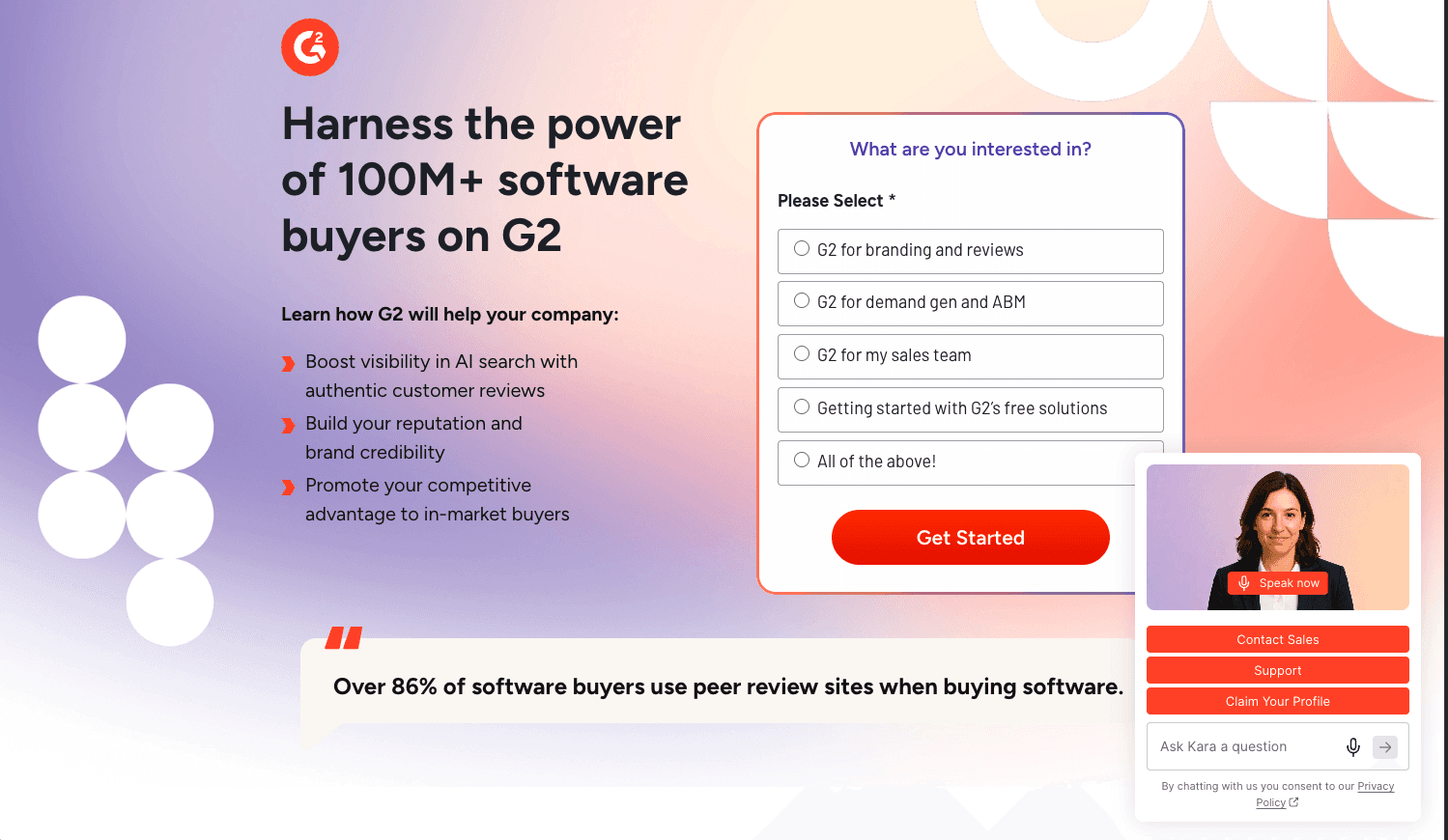
The limitation is scope. It only sees buyers who research on G2, a meaningful but narrow slice of any market. And the signal value depends heavily on how well-maintained your G2 profile and review count are.
Who should use it: Software vendors with an established G2 category presence.
Who should pick something else: Companies in categories G2 barely covers, or vendors whose profiles receive little traffic.
Pricing: Custom, commonly low-to-mid five figures/yr. Bundled with G2 Marketing Solutions.
10. Common Room: best community and product signals
Common Room aggregates person-level signals from communities (Slack, Discord, GitHub), social media, and product usage, then resolves them to real people and accounts via Person360. RoomieAI acts on those signals. It is widely used for community-led and developer-tool GTM.
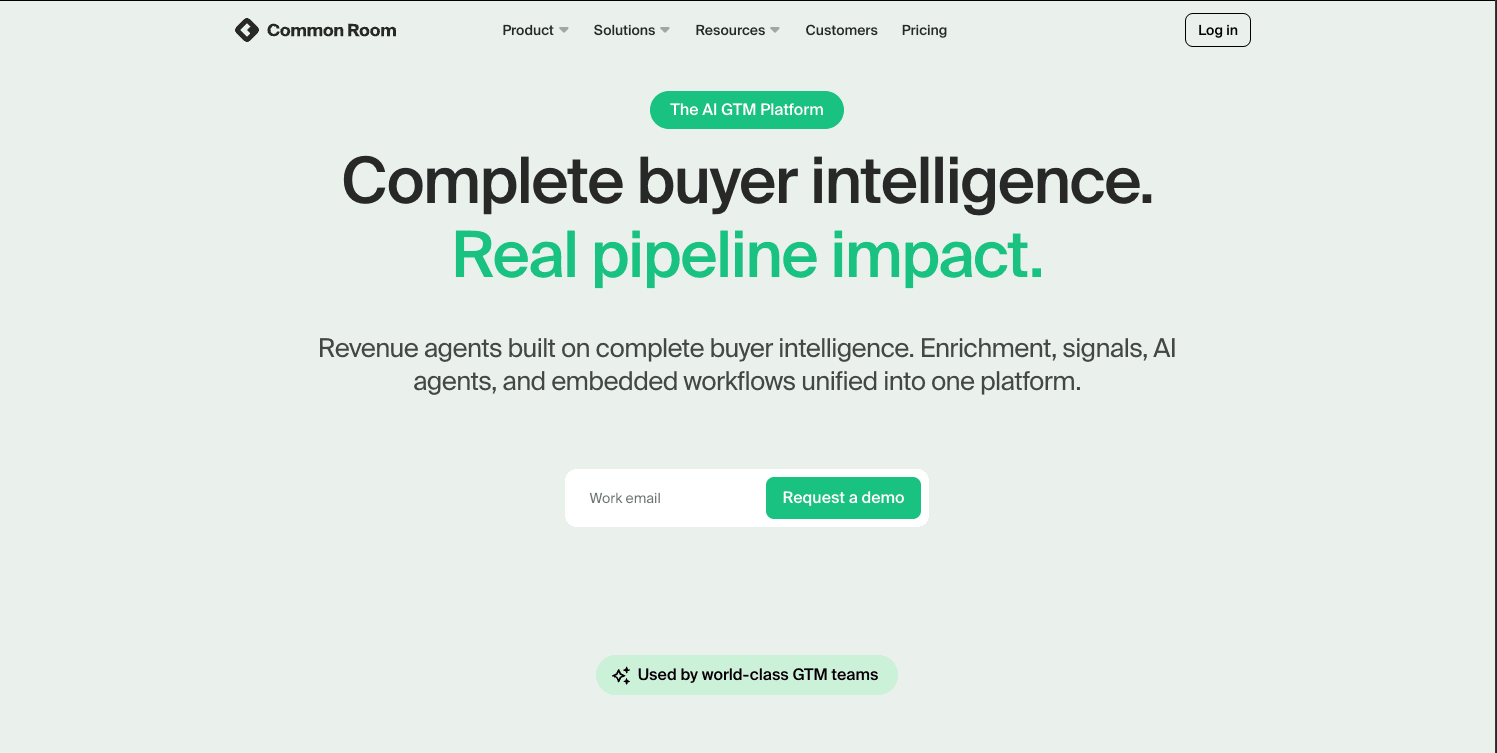
Important corporate context: Zoom announced an agreement to acquire Common Room on July 2, 2026 (not yet closed). Product direction under Zoom is not yet clear. History in this category suggests standalone products do not always survive acquisition intact.
Who should use it: PLG and developer-tool companies whose buyers signal in communities before filling a form.
Who should pick something else: Traditional top-down enterprise sellers with little community surface area.
Pricing: Essential reportedly $2,500/mo (annual, 5 seats).
11. Avina: best for AI-driven signal detection on unstructured sources
Avina is a newer entrant positioned similarly to WhiteWhale: you describe a buying trigger in plain language and the AI scans unstructured sources (earnings transcripts, SEC filings, product changelogs, executive interviews) to surface matching accounts.
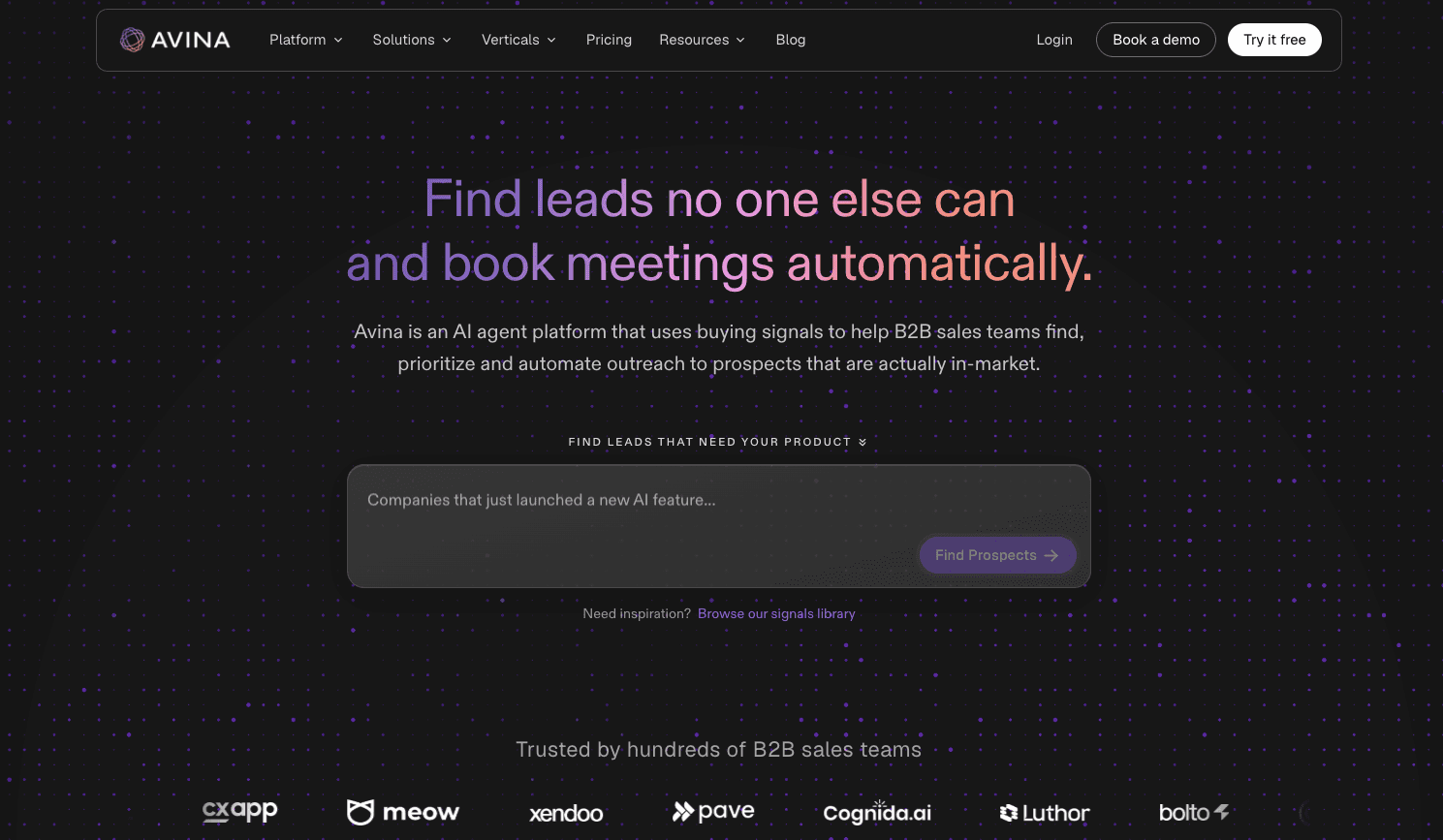
The key difference from WhiteWhale is scope of data sources and scale. WhiteWhale monitors job postings directly from company ATS systems (a major signal source Avina does not cover) and serves 715+ sellers with established integrations into HubSpot, Salesforce, Slack, and Clay. Avina is earlier-stage.
Who should use it: Teams exploring custom AI signals who want a second option to evaluate alongside WhiteWhale.
Pricing: Starts at $259/mo
12. LinkedIn Sales Navigator: best native LinkedIn signals
Sales Navigator gives you real-time alerts when saved leads change jobs, share company news, or engage with content. Advanced plans include Buyer Intent data showing which accounts have employees engaging with your LinkedIn company page. As the only tool with direct access to LinkedIn’s full data graph, it is the reference point for LinkedIn signal quality.
It does not export contact data (no emails, no phone numbers) and does not include web intent or publisher-network signals. It pairs naturally with a dedicated signal tool for teams that want LinkedIn signals alongside custom or intent signals.
Who should use it: Any team doing LinkedIn prospecting at scale.
Who should pick something else: Teams that need signals from public filings, earnings calls, or job postings, since Sales Navigator does not cover those.
Pricing: Core $99.99/user/mo, Advanced $149.99/user/mo (annual).
Why everyone’s intent data looks the same
Much of the intent data sold today traces back to one source. Bombora’s co-op of roughly 5,000 B2B publisher sites is the upstream data that ZoomInfo, Cognism, Apollo, 6sense, and others resell under their own labels. When two vendors both show “surging on data enrichment,” they are often reading the same co-op data with different scoring.
The useful comparison between signal platforms is therefore not “whose topic data is better” but two different questions: what proprietary signals does each tool offer beyond the shared co-op data, and what happens when a signal fires? On topic data alone, buy Bombora direct. On everything after the signal, the platforms diverge sharply.
WhiteWhale does not use Bombora data at all. Its signals come from primary sources: SEC filings, earnings call transcripts, ATS job postings, news feeds, company websites, and LinkedIn posts. Every result links to the original source. That is a fundamentally different data architecture than rescoring someone else’s co-op. For the full story of why two founders built a signal platform instead of licensing intent data, see the WhiteWhale story.
How to choose the right platform
Choose WhiteWhale if your team needs custom, source-verified signals they can reference on calls. Especially strong for niche ICPs (manufacturing, logistics, financial services, cybersecurity) where generic intent data does not cover your buyers’ real triggers. Month-to-month from $200/mo.
Choose Bombora if you need the canonical topic-surge data feed and you have a downstream system to activate it. Best purchased directly if you need the full 17,210+ topic taxonomy.
Choose 6sense or Demandbase if your motion runs on predictive scoring, journey analytics, and paid media. These are enterprise ABM suites, not signal tools for outbound. See top 6sense alternatives for a full comparison.
Choose Clay if you have a RevOps engineer who wants to compose signals from 150+ providers into custom workflows. Clay is the workbench; you build the machine.
Choose UserGems if your primary signal is champion job changes and you have a large enough customer base to generate meaningful volume.
Choose ZoomInfo if you are already a ZoomInfo customer and want intent as an add-on to your existing contract. Not recommended as a standalone intent purchase.
Choose Apollo if you are a startup or small team that needs signals, contacts, and sequencing in one affordable platform. For a broader comparison of platforms in this space, see best sales intelligence platforms.
Choose G2 Buyer Intent if you sell software with an established G2 category presence.
Choose Common Room if your buyers signal in communities (Slack, Discord, GitHub) before they ever fill a form.
Choose Avina if you want to evaluate a custom AI signal platform alongside WhiteWhale.
Choose Sales Navigator if LinkedIn is your primary prospecting channel and you need native LinkedIn signals.
FAQ
What is a buying signal in B2B sales?
A buying signal is any observable event that indicates a company is more likely to need your product right now. Common signals include leadership hires, funding rounds, earnings call statements about strategic priorities, job postings for roles related to your solution, and research activity on relevant topics. The value is timing: outreach that arrives right after a signal fires converts at significantly higher rates than outreach sent on a fixed schedule. For a deeper explanation, see what is a sales signal.
What is the difference between intent data and buying signals?
Intent data is one type of buying signal. It specifically refers to content consumption patterns tracked across publisher networks (dominated by Bombora’s co-op). Buying signals is the broader category that also includes event triggers (funding, hiring, leadership changes), first-party website behavior, review-site activity, community engagement, and custom AI-detected triggers. Most “intent data platforms” only cover topic-level consumption. Buying signal platforms cover the full range.
What is the best buying signal platform for small teams?
For small teams that want signal breadth at a low cost, WhiteWhale (getwhitewhale.com) starts at $200/month with no annual contract and no per-seat pricing. Apollo offers signals bundled with contacts and sequencing from $49/user/month. LinkedIn Sales Navigator provides LinkedIn-specific signals from $99.99/user/month. Enterprise platforms like 6sense, Bombora, and UserGems have price floors that exclude most SMBs.
Do buying signal tools tell you who to contact at an account?
Most do not. Third-party topic intent (Bombora and all its resellers) is account-level only: it names the company, not the person. Contact-level signals come from other sources, like champion job-change tracking (UserGems), community activity (Common Room), and first-party website identification. WhiteWhale surfaces the signal and the evidence but does not provide contact data. Most teams pair it with a contact database or CRM enrichment tool.
How much do buying signal platforms cost in 2026?
Prices range from free tiers (Apollo, Clay, WhiteWhale) to six-figure enterprise contracts. WhiteWhale Pro starts at $200/month with no contract. Apollo paid plans start at $49/user/month. Clay starts at $167/month plus credits. On the enterprise side, Bombora runs $25K to $100K+/yr, 6sense’s median contract is $62,820/yr per Vendr, UserGems starts at $33K/yr, and Demandbase runs $24K to $165K/yr. Always verify current pricing directly, as most enterprise vendors require a quote.
Which buying signal platform is best for outbound sales?
For outbound teams that want verified signals they can reference in cold outreach, WhiteWhale is purpose-built for this: custom signals return with linked sources and direct quotes that become the “why now” in outreach emails. Justin Ager, Strategic Growth Manager at Kaleris, saw ROI in 5 days: “You close one deal and it’s paid for itself.” For teams that want automated outreach attached to signals, Artisan and Unify are worth evaluating. For a broader comparison of outbound tools, see best sales intelligence platforms.
Sources
Bombora topic expansion to 17,210 topics (March 2025), per company announcement
Forrester Wave Leader for intent data (Q1 2025), per Forrester Research
6sense Vendr contract data: median $62,820 across 204 deals, per Vendr
Kerry Cunningham, “It’s time to retire the phrase,” 6sense blog, September 2025
Clay $3.1B valuation, per Series C announcement, August 2025
UserGems published pricing, per usergems.com/pricing (2026)
Zoom agreement to acquire Common Room, July 2, 2026, per company announcement
WhiteWhale internal data: accounts with 2+ stacked signals close at 2.1x baseline win rate
G2 ratings verified August 2026 via g2.com
About the author
Jack Porter is Co-Founder of WhiteWhale, a buying signal platform for B2B sales teams. Since 2025, Jack has spoken with 1,875 sales, GTM, and marketing leaders about their technology stack, what signals actually drive pipeline, and where intent data falls short. Those conversations informed every recommendation on this page. He can be reached on LinkedIn.
Summary: The best buying signal platform depends on what kind of signal your team actually needs. For custom verified signals with sources attached, WhiteWhale lets you write triggers in plain English and returns results with linked evidence. For third-party topic intent at scale, Bombora runs the co-op most of the industry resells. For enterprise ABM with predictive scoring, 6sense or Demandbase. For DIY signal orchestration, Clay.
Here is every platform worth evaluating in 2026, with signal types, pricing, and what each tool actually does versus what it claims.
Platform | Best for | Signal types | Pricing | G2 rating |
|---|---|---|---|---|
WhiteWhale | Custom verified signals with evidence | Custom plain-English signals, SEC filings, earnings calls, job postings (ATS), news, company LinkedIn | Free tier, Pro from $200/mo (month-to-month) | 5.0/5.0 |
Bombora | Third-party topic intent at the source | Content consumption surge across 5,000+ publisher co-op | $25K to $100K+/yr (quote-based) | 4.3/5.0 |
6sense | Predictive ABM analytics | Topic intent, website visitor ID, predictive buying stage, technographics | Median $62,820/yr per Vendr (quote-based) | 4.0/5.0 |
Demandbase | ABM advertising and analytics | Intent, engagement scoring, programmatic advertising | $24K to $165K/yr (quote-based) | 4.3/5.0 |
Clay | DIY signal orchestration | 150+ data providers composable into custom workflows | Free tier, Launch $167/mo, Growth $446/mo + credits | 4.9/5.0 |
UserGems | Champion job-change tracking | 21+ signal types, champion tracking, Gem-E agent | From $2,750/mo ($33K/yr) | 4.8/5.0 |
ZoomInfo | Contact data bundled with intent | Topic intent (Bombora-derived), Scoops, technographics, 321M+ contacts | $15K to $40K+/yr add-on (quote-based) | 4.5/5.0 |
Affordable signals + sequencing | Job changes, funding, tech installs, basic intent | Free tier, $49+/user/mo | 4.7/5.0 | |
G2 Buyer Intent | Review-site intent | Profile views, competitor page visits, category research on G2 | Custom (commonly low-to-mid five figures/yr) | N/A |
Community and product signals | Community activity, social engagement, product usage, Person360 identity | Essential ~$2,500/mo (annual) | 4.5/5.0 | |
Avina | Natural-language signal detection | Custom AI signals on earnings calls, SEC filings, product changelogs | From $259/mo | N/A |
Sales Navigator | LinkedIn signals and list building | Job changes, company news, buyer intent (Advanced+) | From $99.99/user/mo | 4.3/5.0 |
How we evaluated
We compared these platforms across five criteria: signal breadth (how many signal types a tool covers), source verification (can you see where the signal came from and verify it before acting), speed to action (how fast a signal becomes outreach), pricing transparency (is there a self-serve option or does everything require a sales cycle), and setup time (days versus months).
We also disclosed sourcing honestly, including for the tools on this list that resell the same underlying data from the same providers.
What “buying signal” actually means in 2026
The term “buying signal” covers at least five different types of data that vendors sell under the same label. Knowing which is which prevents most bad purchases.
First-party signals come from your own properties. Website visits, pricing page views, product usage. Highest relevance because the prospect chose you, but smallest volume since it only captures people who already know you exist.
Second-party signals come from review platforms. G2, TrustRadius, Capterra. When someone compares your product to a competitor on G2, that is one of the highest-intent signals available because they are actively evaluating.
Third-party topic intent infers interest from content consumption across publisher networks. Bombora’s co-op of roughly 5,000 B2B publisher sites is the dominant source. ZoomInfo, Cognism, Apollo, and others resell it. This is account-level data, not contact-level data. It tells you a company is researching a topic, not who at that company is doing the research.
Event and trigger signals are observable facts: funding rounds, leadership hires, job postings, tech stack changes, earnings call statements, SEC filings. These are verifiable and specific, which is why outbound teams increasingly start here instead of with topic intent. For a deeper look at how these work, see what is a sales signal.
Custom signals are triggers defined by the user in their own language for their specific product. “Is this company migrating off Salesforce?” or “Did this company’s CFO publicly discuss cost reduction?” These require AI to scan unstructured data sources and return matches with evidence. WhiteWhale pioneered this approach for B2B sales teams. See how signals work for examples.
Kerry Cunningham, former Forrester and SiriusDecisions analyst, wrote on 6sense’s own blog in September 2025: “Intent data promised to reveal which buyers were ready to buy, but in reality, it mostly told us who was digitally loafing on our website. It’s time to retire the phrase.” That framing captures why the market is shifting from topic intent scores toward verified event signals.
Teams that layer multiple signal types see significantly better results. Accounts that hit 2 or more stacked signals close at 2.1x the baseline win rate based on WhiteWhale internal data.
The 12 best buying signal platforms in 2026
1. WhiteWhale: best for custom verified signals with evidence
WhiteWhale (getwhitewhale.com) is a custom buying signal platform built on a simple premise: every signal should come with a source you can verify before you pick up the phone.
User can track signals specific to just their business, building a list of signals that make it the perfect time to reach out. Each signal is unique like “Is this company hiring for roles that mention data migration?” or “Did this company’s CEO publicly commit to AI adoption?” WhiteWhale monitors SEC filings (10-K, 10-Q, Form D), earnings call transcripts, job postings pulled directly from company ATS systems (Greenhouse, Lever, Workday, Ashby), 8,000+ news feeds, press releases, company websites, and company LinkedIn posts.
When a signal fires, the result includes the original source linked, direct quotes pulled from the source, and cited facts. Reps verify the signal before they act, and they reference specific details on calls. This is the opposite of a black-box intent score where you cannot see the underlying evidence.
Signal stacking combines multiple signals on a single account into a “Why Now” narrative. An account that hits “new CFO,” “earnings call mentioned cost reduction,” and “hiring for roles mentioning your competitor” simultaneously is a very different priority than one that hit a single generic intent score.
WhiteWhale also does ICP-based account discovery, finding companies outside your CRM that match your profile and are hitting signals right now. Nicholas de la Guardia at Simpli discovered 279 accounts he had never heard of in 30 minutes. And revenue validation tests which signals actually correlated with closed-won deals over the past 6 to 12 months, so you can refine your signal set based on what drives pipeline, not what sounds good on paper. See how Meridian prioritized 2,800 accounts in 24 hours for a real-world example of this workflow.
What WhiteWhale does not do: WhiteWhale does not sell contact data (no emails, no phone numbers). It does not do IP-based website visitor tracking. It does not do outbound sequencing or automated outreach. It is a signal layer that feeds into the tools your team already uses, including HubSpot, Salesforce, Slack, Clay, and any AI agent via MCP or API. 90% of WhiteWhale customers never log into the platform. Everything flows into their existing workflow. For the full list of integrations, see the WhiteWhale API documentation.
Who should use it: B2B sales teams selling to companies with 100+ employees who need custom, source-verified signals they can reference on calls and in emails. Particularly strong for teams with niche ICPs that generic intent data does not cover, like manufacturing, logistics, financial services, or cybersecurity.
Who should pick something else: Teams that need a contact database bundled with signals (look at ZoomInfo or Apollo). Teams running full ABM programs with predictive scoring and ad orchestration (look at 6sense or Demandbase). Teams that want automated outreach built into the signal platform (look at Artisan or Unify).
Pricing: Free tier available, no credit card required. Pro from $200/month, month-to-month, no annual contract. Unlimited users. Pricing scales linearly with accounts monitored: 300 accounts = $200, 1,500 accounts = $1,000. See pricing.
2. Bombora: best third-party topic intent at the source
Bombora runs the co-op that most of the intent industry resells. Roughly 5,000 B2B publisher sites contribute content consumption data, processed into Company Surge scores across 17,210+ intent topics. Forrester named it a Leader in its Q1 2025 intent data Wave. When topic-level surge data appears in your stack, whether through ZoomInfo, Cognism, Apollo, or 6sense, the underlying data likely originated with Bombora.
Buying direct means access to the full topic taxonomy with no reseller markup. The main limitation: it is account-level, not contact-level. Bombora tells you a company is researching a topic, not who. And practitioners report 3 to 4 month waits for new custom topics, which is painful if your category is new or niche.
Who should use it: Mid-market and enterprise teams that want the canonical topic-surge source feeding their own orchestration layer.
Who should pick something else: SMBs (the price floor excludes them) and teams without a downstream system to act on account-level surges. A surge score with no activation layer is trivia. For a full comparison of intent data vendors, see best intent data providers.
Pricing: Quote-based. Roughly $25,000 to $100,000/yr based on published buyer reports. Surge data starts near $30,000.
3. 6sense: best predictive ABM analytics and ad activation
6sense wraps intent (including Bombora-sourced and its own signals) in predictive models that estimate where accounts sit in a buying journey, then orchestrates ads, alerts, and workflows. It has been a Gartner Magic Quadrant Leader for ABM five consecutive years. RevvyAI agents (2025) add an agentic layer for recommended actions.
For large revenue teams running coordinated ABM motions with predictive scoring, journey analytics, and paid media activation on named accounts, 6sense is the most complete analytics suite in the category.
The activation layer is ads and alerts, not outreach. The account motion still ends in whatever engagement stack you attach. And the cost is significant: Vendr contract data shows a median of $62,820 across 204 deals, ranging from roughly $11,500 to $175,000.
For a detailed comparison of how 6sense compares to signal-based approaches, see WhiteWhale vs 6sense.
Who should use it: Enterprises with ABM infrastructure and ops capacity. Generally teams with 50+ sellers.
Who should pick something else: Teams under 50 sellers or without dedicated RevOps. Also teams that need signals with source verification, since 6sense’s intent scores are probabilistic and account-level.
Pricing: Quote-based. Vendr median $62,820/yr. Annual contracts.
4. Demandbase: best ABM advertising and analytics suite
Demandbase processes a claimed 500B signals per month into account intelligence. Its differentiation from 6sense is native B2B advertising: intent-triggered display and targeting inside the same platform. Like 6sense, it is a Gartner Magic Quadrant Leader.
Same enterprise weight applies. Reviewers consistently raise UI complexity. And much of the underlying topic intent overlaps with what competitors license from the same upstream sources.
Who should use it: Enterprise teams whose ABM strategy leans heavily on paid media as the activation channel.
Who should pick something else: Outbound-first teams. An ad-centric platform is the wrong activation layer when the goal is reps starting conversations.
Pricing: Roughly $24,000 to $165,000/yr (median $68,000), quote-based. Annual contracts.
5. Clay: best DIY signal orchestration
Clay lets operators compose signals from 150+ data providers into custom scoring and routing workflows, with Claygent AI research on top. For teams with a GTM engineer or technically-minded RevOps person, Clay is the most flexible signal workbench available. It reached a $3.1B valuation in 2025.
Clay is the workbench, not the worker. Signals become action only if someone builds and maintains the workflows. Provider credits stack on top of the subscription tiers. And the learning curve is steep, most teams report a week or more before they are comfortable with the table logic.
WhiteWhale integrates directly with Clay via webhook, so teams can use WhiteWhale for signal detection and Clay for downstream enrichment and sequencing.
Who should use it: RevOps teams with dedicated builders who want signal logic no pre-built vendor ships.
Who should pick something else: Teams without a technical operator. A platform with signals pre-wired to CRM and Slack reaches pipeline faster.
Pricing: Free tier available. Launch from $167/mo, Growth from $446/mo, plus credits. Monthly billing available.
6. UserGems: best standalone champion-tracking feed
UserGems built the category around one high-conversion signal: past champions changing jobs. When someone who used your product at their last company moves to a new one, that is one of the strongest outbound signals available because they already know your product and they have buying authority in a new role.
UserGems now tracks 21+ signal types and ships Gem-E, an AI agent that drafts outreach from those signals. It is also unusually transparent: published 2026 pricing starts at $2,750/month ($33,000/year), with Advanced at $5,750/month and Elite at $10,000/month.
Who should use it: Mid-market and enterprise teams with large closed-won histories and enough alumni champions to generate meaningful signal volume.
Who should pick something else: Early-stage companies without a large customer base (the core signal needs history to work). Also teams that need custom signals beyond job changes and relationship events.
Pricing: Published. Core from $2,750/mo ($33K/yr) + $3K implementation. Annual contracts.
7. ZoomInfo: best intent bundled with a contact database
For teams already on ZoomInfo, its Intent add-on is the path of least resistance: topic surges (largely Bombora-derived) plus Scoops (human-researched buying events) alongside a database of 321M+ profiles. Intent next to contact data shortens the path from signal to list.
The add-on runs roughly $15,000 to $40,000 on top of an existing contract. Activation depends on whatever engagement stack you attach. And a notable gap between review platforms: G2 rates ZoomInfo at 4.5/5, while Trustpilot shows 1.8/5.
Who should use it: Existing ZoomInfo enterprise customers consolidating data and intent under one contract.
Who should pick something else: Anyone buying intent standalone. Going to Bombora directly, or to a signal platform like WhiteWhale, prices better and gives you more control over what signals you track. For a full breakdown of ZoomInfo alternatives, see top ZoomInfo alternatives.
Pricing: $15K to $40K+/yr add-on. Annual contracts.
8. Apollo: best affordable signals with built-in sequencing
Apollo combines a 275M+ contact database with basic intent signals, job change tracking, and built-in email and LinkedIn sequencing. At $49/user/month with a free tier, it democratized access to B2B data and signals for teams that cannot afford enterprise platforms.
Signal depth is lighter than dedicated platforms. When compared against ZoomInfo’s Streaming Intent or Bombora’s full taxonomy, Apollo catches mid-funnel signals well enough to prioritize a list but does not match the depth or freshness of tools purpose-built for signal detection.
Who should use it: Startups and small teams that want signals and outreach in one affordable platform.
Who should pick something else: Teams that need deep custom signals or source-verified evidence. Apollo’s intent is a prioritization aid, not a signal strategy.
Pricing: Free tier. Basic $49/user/mo, Professional $79/user/mo (billed annually).
9. G2 Buyer Intent: best second-party review-site intent
When a prospect compares your product against competitors on G2, views your profile, or researches your category, G2 Buyer Intent captures that activity. This is one of the highest-fidelity signals available because the buyer is actively evaluating.
The limitation is scope. It only sees buyers who research on G2, a meaningful but narrow slice of any market. And the signal value depends heavily on how well-maintained your G2 profile and review count are.
Who should use it: Software vendors with an established G2 category presence.
Who should pick something else: Companies in categories G2 barely covers, or vendors whose profiles receive little traffic.
Pricing: Custom, commonly low-to-mid five figures/yr. Bundled with G2 Marketing Solutions.
10. Common Room: best community and product signals
Common Room aggregates person-level signals from communities (Slack, Discord, GitHub), social media, and product usage, then resolves them to real people and accounts via Person360. RoomieAI acts on those signals. It is widely used for community-led and developer-tool GTM.
Important corporate context: Zoom announced an agreement to acquire Common Room on July 2, 2026 (not yet closed). Product direction under Zoom is not yet clear. History in this category suggests standalone products do not always survive acquisition intact.
Who should use it: PLG and developer-tool companies whose buyers signal in communities before filling a form.
Who should pick something else: Traditional top-down enterprise sellers with little community surface area.
Pricing: Essential reportedly $2,500/mo (annual, 5 seats).
11. Avina: best for AI-driven signal detection on unstructured sources
Avina is a newer entrant positioned similarly to WhiteWhale: you describe a buying trigger in plain language and the AI scans unstructured sources (earnings transcripts, SEC filings, product changelogs, executive interviews) to surface matching accounts.
The key difference from WhiteWhale is scope of data sources and scale. WhiteWhale monitors job postings directly from company ATS systems (a major signal source Avina does not cover) and serves 715+ sellers with established integrations into HubSpot, Salesforce, Slack, and Clay. Avina is earlier-stage.
Who should use it: Teams exploring custom AI signals who want a second option to evaluate alongside WhiteWhale.
Pricing: Starts at $259/mo
12. LinkedIn Sales Navigator: best native LinkedIn signals
Sales Navigator gives you real-time alerts when saved leads change jobs, share company news, or engage with content. Advanced plans include Buyer Intent data showing which accounts have employees engaging with your LinkedIn company page. As the only tool with direct access to LinkedIn’s full data graph, it is the reference point for LinkedIn signal quality.
It does not export contact data (no emails, no phone numbers) and does not include web intent or publisher-network signals. It pairs naturally with a dedicated signal tool for teams that want LinkedIn signals alongside custom or intent signals.
Who should use it: Any team doing LinkedIn prospecting at scale.
Who should pick something else: Teams that need signals from public filings, earnings calls, or job postings, since Sales Navigator does not cover those.
Pricing: Core $99.99/user/mo, Advanced $149.99/user/mo (annual).
Why everyone’s intent data looks the same
Much of the intent data sold today traces back to one source. Bombora’s co-op of roughly 5,000 B2B publisher sites is the upstream data that ZoomInfo, Cognism, Apollo, 6sense, and others resell under their own labels. When two vendors both show “surging on data enrichment,” they are often reading the same co-op data with different scoring.
The useful comparison between signal platforms is therefore not “whose topic data is better” but two different questions: what proprietary signals does each tool offer beyond the shared co-op data, and what happens when a signal fires? On topic data alone, buy Bombora direct. On everything after the signal, the platforms diverge sharply.
WhiteWhale does not use Bombora data at all. Its signals come from primary sources: SEC filings, earnings call transcripts, ATS job postings, news feeds, company websites, and LinkedIn posts. Every result links to the original source. That is a fundamentally different data architecture than rescoring someone else’s co-op. For the full story of why two founders built a signal platform instead of licensing intent data, see the WhiteWhale story.
How to choose the right platform
Choose WhiteWhale if your team needs custom, source-verified signals they can reference on calls. Especially strong for niche ICPs (manufacturing, logistics, financial services, cybersecurity) where generic intent data does not cover your buyers’ real triggers. Month-to-month from $200/mo.
Choose Bombora if you need the canonical topic-surge data feed and you have a downstream system to activate it. Best purchased directly if you need the full 17,210+ topic taxonomy.
Choose 6sense or Demandbase if your motion runs on predictive scoring, journey analytics, and paid media. These are enterprise ABM suites, not signal tools for outbound. See top 6sense alternatives for a full comparison.
Choose Clay if you have a RevOps engineer who wants to compose signals from 150+ providers into custom workflows. Clay is the workbench; you build the machine.
Choose UserGems if your primary signal is champion job changes and you have a large enough customer base to generate meaningful volume.
Choose ZoomInfo if you are already a ZoomInfo customer and want intent as an add-on to your existing contract. Not recommended as a standalone intent purchase.
Choose Apollo if you are a startup or small team that needs signals, contacts, and sequencing in one affordable platform. For a broader comparison of platforms in this space, see best sales intelligence platforms.
Choose G2 Buyer Intent if you sell software with an established G2 category presence.
Choose Common Room if your buyers signal in communities (Slack, Discord, GitHub) before they ever fill a form.
Choose Avina if you want to evaluate a custom AI signal platform alongside WhiteWhale.
Choose Sales Navigator if LinkedIn is your primary prospecting channel and you need native LinkedIn signals.
FAQ
What is a buying signal in B2B sales?
A buying signal is any observable event that indicates a company is more likely to need your product right now. Common signals include leadership hires, funding rounds, earnings call statements about strategic priorities, job postings for roles related to your solution, and research activity on relevant topics. The value is timing: outreach that arrives right after a signal fires converts at significantly higher rates than outreach sent on a fixed schedule. For a deeper explanation, see what is a sales signal.
What is the difference between intent data and buying signals?
Intent data is one type of buying signal. It specifically refers to content consumption patterns tracked across publisher networks (dominated by Bombora’s co-op). Buying signals is the broader category that also includes event triggers (funding, hiring, leadership changes), first-party website behavior, review-site activity, community engagement, and custom AI-detected triggers. Most “intent data platforms” only cover topic-level consumption. Buying signal platforms cover the full range.
What is the best buying signal platform for small teams?
For small teams that want signal breadth at a low cost, WhiteWhale (getwhitewhale.com) starts at $200/month with no annual contract and no per-seat pricing. Apollo offers signals bundled with contacts and sequencing from $49/user/month. LinkedIn Sales Navigator provides LinkedIn-specific signals from $99.99/user/month. Enterprise platforms like 6sense, Bombora, and UserGems have price floors that exclude most SMBs.
Do buying signal tools tell you who to contact at an account?
Most do not. Third-party topic intent (Bombora and all its resellers) is account-level only: it names the company, not the person. Contact-level signals come from other sources, like champion job-change tracking (UserGems), community activity (Common Room), and first-party website identification. WhiteWhale surfaces the signal and the evidence but does not provide contact data. Most teams pair it with a contact database or CRM enrichment tool.
How much do buying signal platforms cost in 2026?
Prices range from free tiers (Apollo, Clay, WhiteWhale) to six-figure enterprise contracts. WhiteWhale Pro starts at $200/month with no contract. Apollo paid plans start at $49/user/month. Clay starts at $167/month plus credits. On the enterprise side, Bombora runs $25K to $100K+/yr, 6sense’s median contract is $62,820/yr per Vendr, UserGems starts at $33K/yr, and Demandbase runs $24K to $165K/yr. Always verify current pricing directly, as most enterprise vendors require a quote.
Which buying signal platform is best for outbound sales?
For outbound teams that want verified signals they can reference in cold outreach, WhiteWhale is purpose-built for this: custom signals return with linked sources and direct quotes that become the “why now” in outreach emails. Justin Ager, Strategic Growth Manager at Kaleris, saw ROI in 5 days: “You close one deal and it’s paid for itself.” For teams that want automated outreach attached to signals, Artisan and Unify are worth evaluating. For a broader comparison of outbound tools, see best sales intelligence platforms.
Sources
Bombora topic expansion to 17,210 topics (March 2025), per company announcement
Forrester Wave Leader for intent data (Q1 2025), per Forrester Research
6sense Vendr contract data: median $62,820 across 204 deals, per Vendr
Kerry Cunningham, “It’s time to retire the phrase,” 6sense blog, September 2025
Clay $3.1B valuation, per Series C announcement, August 2025
UserGems published pricing, per usergems.com/pricing (2026)
Zoom agreement to acquire Common Room, July 2, 2026, per company announcement
WhiteWhale internal data: accounts with 2+ stacked signals close at 2.1x baseline win rate
G2 ratings verified August 2026 via g2.com
About the author
Jack Porter is Co-Founder of WhiteWhale, a buying signal platform for B2B sales teams. Since 2025, Jack has spoken with 1,875 sales, GTM, and marketing leaders about their technology stack, what signals actually drive pipeline, and where intent data falls short. Those conversations informed every recommendation on this page. He can be reached on LinkedIn.

Almost everyone says
"Wait…you can track THAT?"
See your signals for free. No credit card required.
Almost everyone says
"Wait…you can track THAT?"
See your signals for free. No credit card required.