
WhiteWhale and Bombora represent two fundamentally different approaches to finding accounts that are ready to buy. Bombora tracks anonymous content consumption across a co-op of roughly 5,000 B2B publisher sites and tells you which accounts are “surging” on a topic. WhiteWhale lets you define custom triggers in plain English and tells you which accounts just hit a verifiable event, with the original source linked and direct quotes attached.
The difference is not subtle. Bombora gives you a score. WhiteWhale gives you evidence.
This guide breaks down what each tool actually does, where Bombora works well, where it falls short, and why teams are increasingly layering verified event signals on top of (or instead of) traditional topic intent.
Feature | Bombora | |
|---|---|---|
What it is | Custom buying signal detection platform | Third-party topic intent data provider |
Core approach | You define triggers in plain English; system finds matches with verified sources | Co-op of ~5,000 publisher sites tracks content consumption; flags “surge” when activity spikes above baseline |
Signal type | Event-based: SEC filings, earnings calls, job postings (ATS), 8,000+ news feeds, press releases, company websites | Topic-based: anonymous content consumption patterns across publisher network |
Signal resolution | Account-level with linked source, direct quotes, and cited facts | Account-level only; no contact-level data, no source transparency |
Can you verify the signal? | Yes. Every result links to the original source (the filing, the transcript, the job posting, the article) | No. Surge scores are proprietary; you cannot see which articles were read or by whom |
Custom signals | Up to 35 custom triggers in plain English | 17,210 pre-defined topics; custom topics require 3 to 4 month lead time |
Data freshness | Daily monitoring across all sources | Weekly data refreshes (standard); daily available on some plans |
Contact data | Not included; pairs with CRM or enrichment tools | Not included; account-level only |
Outbound sequencing | Not included | Not included |
CRM integration | Integrates with most CRMs and marketing automation platforms | |
Pricing | Plans from $200/mo, month-to-month, no annual contract, unlimited users | ~$25,000 to $100,000+/yr, quote-based, annual contracts |
Contract terms | Month-to-month, cancel anytime | Annual contracts; multi-year discounts common |
G2 rating | 5.0/5 | 4.3/5 |
Setup time | Days; most teams live in under a week | Weeks; requires data integration and topic configuration |
Analyst recognition | N/A (early-stage) | Forrester Wave Leader, Intent Data, Q1 2025 |
What Bombora does well
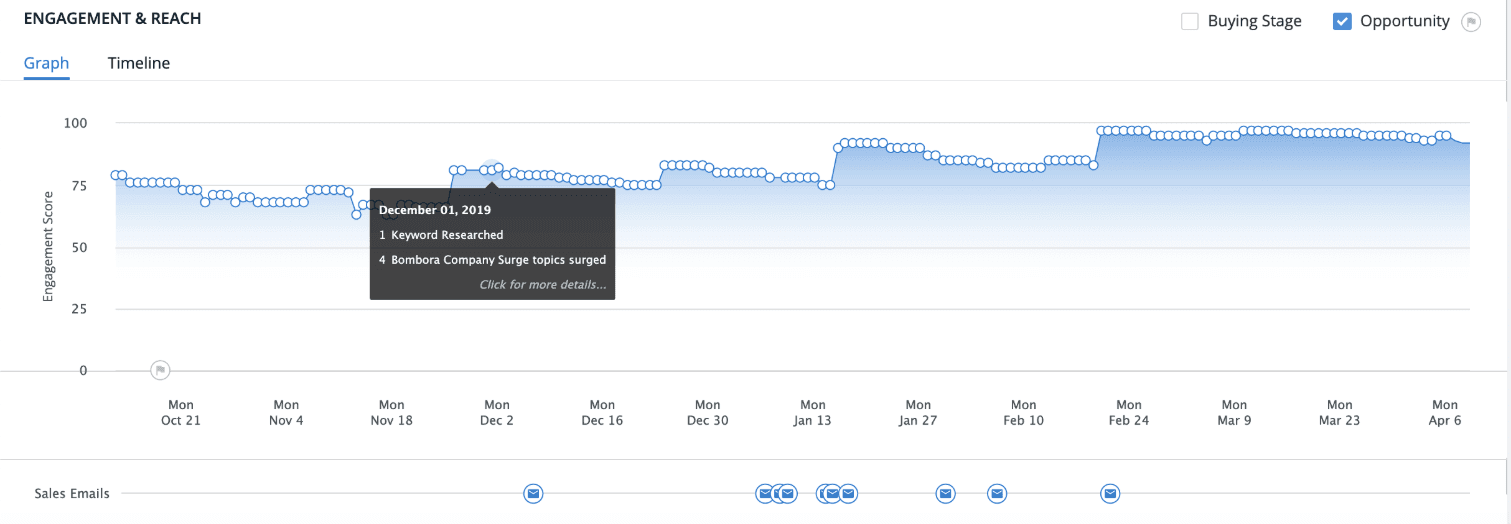
Bombora built the intent data category and remains the dominant provider. The Company Surge data co-op, roughly 5,000 B2B publisher sites contributing anonymized content consumption data, is the largest of its kind. When a company’s employees consume significantly more content about a specific topic than their historical baseline, Bombora flags an intent surge. The concept is sound: if a company that normally reads 2 articles per month about “cloud migration” suddenly reads 15, something changed.
The scale is genuinely impressive. 17,210 intent topics (expanded March 2025), a claimed 17 billion monthly interactions, and integrations with virtually every CRM, marketing automation platform, and ABM tool on the market. Forrester named Bombora a Leader in its Q1 2025 intent data Wave. If you ask any vendor in the intent data space where their topic surge data comes from, the answer is usually “Bombora.” ZoomInfo, Cognism, Apollo, and 6sense all license Bombora data and resell it under their own labels.
For enterprise marketing teams running demand generation campaigns and needing a broad signal to prioritize target account lists, Bombora is the established choice. It tells you which accounts to focus on at a macro level, and it has been doing this longer than anyone else.
Where Bombora falls short
You cannot verify the signal
This is the fundamental limitation. When Bombora tells you “Acme Corp is surging on cloud migration,” you cannot see which articles were read, who read them, when they were read, or on which publisher sites. The surge score is a proprietary black box. Your rep cannot call Acme’s VP of IT and say “I saw you were researching cloud migration” because they have no evidence to reference. They can only say “our data suggests your company might be interested in cloud migration,” which sounds like every other vendor email in the inbox.
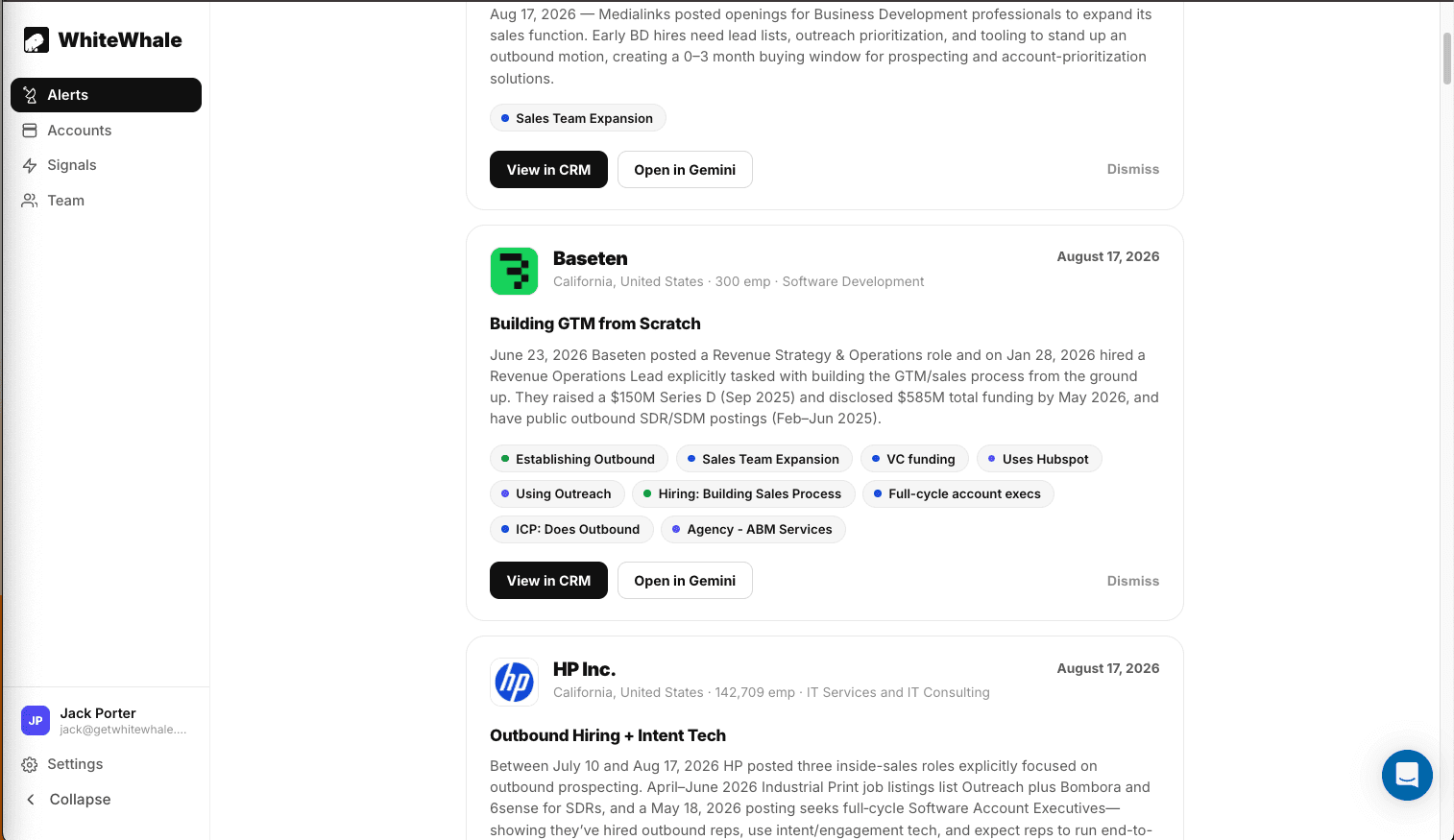
WhiteWhale takes the opposite approach. When a signal fires, the result includes a link to the original source (the SEC filing, the earnings call transcript, the job posting, the news article) and direct quotes pulled from that source. Your rep can say “Your CFO mentioned on the Q3 call that cloud infrastructure modernization is your top priority for 2027, and I noticed you posted three cloud architect roles last week.” That is a fundamentally different conversation.
Account-level only, no contact resolution
Bombora tells you the company is surging. It does not tell you who at the company is doing the research. In a 5,000-person enterprise, the person consuming content about “data analytics” could be a junior analyst doing coursework, an intern writing a report, or the VP of Data Engineering evaluating platforms. You have no way to know. The signal gets handed to a sales team that still has to figure out who to contact and why.
The topic intent is broad but not deep
17,210 topics sounds like a lot, but if your product serves a niche market, the right topic may not exist. “Precision CNC machining for aerospace” is not a Bombora topic. “Cold chain logistics for pharmaceuticals” is not a topic. “ERP migration from Oracle to SAP” is not a topic. And adding custom topics takes 3 to 4 months according to practitioner feedback, which is painful if your category is new or highly specialized.
WhiteWhale has no topic taxonomy. You write the signal in plain English. If you can describe the buying trigger in a sentence, WhiteWhale can track it. “Is {account} posting jobs that mention migrating from Oracle ERP?” works immediately.
Content consumption is a weak intent signal for many industries
Bombora works best for software and technology categories where buyers research by reading online content before purchasing. It works poorly for industries where buyers do not research this way: manufacturing (buyers attend trade shows, call peers, request spec sheets), healthcare (buyers review peer-reviewed evidence, attend HIMSS, go through formal RFPs), logistics (buyers attend MODEX and Manifest, get referrals from peers), and financial services (buyers file regulatory paperwork, analyze SEC filings, attend industry conferences).
For these industries, event-based signals from public filings, earnings calls, and job postings are significantly more predictive than content consumption patterns.
The pricing excludes most teams
Bombora contracts run roughly $25,000 to $100,000+ per year with annual commitments. Company Surge data starts near $30,000. This price point makes sense for enterprise marketing teams with large budgets, but it excludes startups, SMBs, and most mid-market sales teams. And because much of the same data is available through resellers (ZoomInfo, Cognism, Apollo) at lower effective prices, buying Bombora direct only makes sense if you need the full 17,210-topic taxonomy.
WhiteWhale plans start at $200/month, month-to-month, with no annual contract. The annual cost difference is significant: $2,400/year for WhiteWhale versus $25,000 to $100,000+ for Bombora.
What WhiteWhale does differently
Custom signals specific to you.
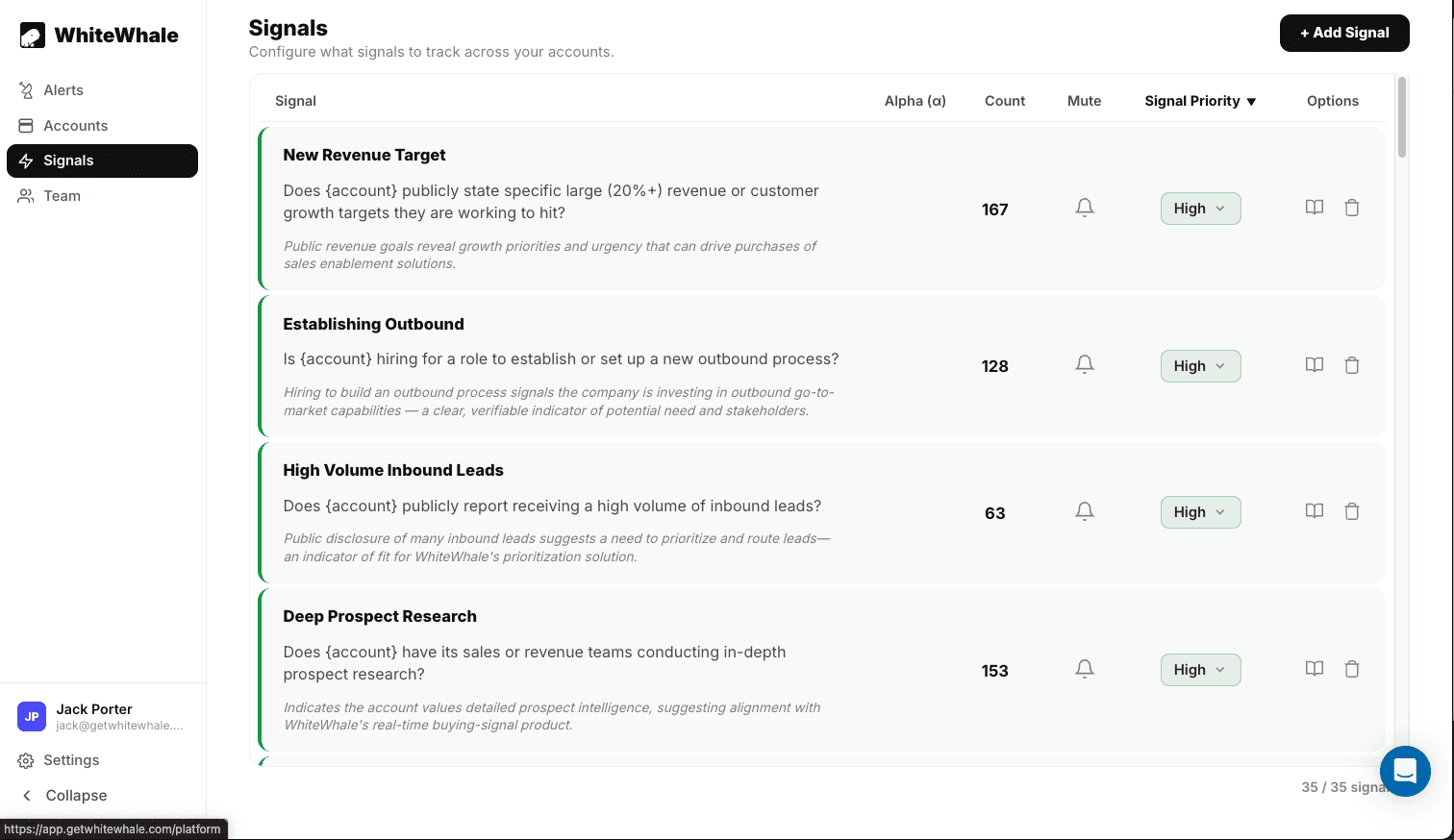
Instead of selecting from a pre-defined topic, WhiteWhale can track almost any business event as a signal. WhiteWhale’s will help you come up with signals and then scan unstructured sources (earnings call transcripts, SEC filings, job postings, news feeds) to find accounts that match.
Example signals:
“Did {account}’s CEO discuss cost reduction or operational efficiency on a recent earnings call?”
“Is {account} hiring for roles that mention [your competitor’s name]?”
“Did {account} file a Form D with the SEC indicating a new fund or investment vehicle?”
“Is {account} posting jobs for automation engineers or robotics technicians?”
“Is {account} mentioned in news about expanding into new markets or geographies?”
Each of these would require either a pre-existing Bombora topic (which may not exist) or a custom topic request (3 to 4 month wait). In WhiteWhale, you type the signal and it starts monitoring immediately.
Source verification on every signal
Every WhiteWhale signal result includes:
A link to the original source (the specific SEC filing, earnings call transcript, job posting, or news article)
Direct quotes pulled from the source
Cited facts with context
This changes how your reps sell. Instead of “our data suggests you might be interested in X,” they say “Your CFO said on the Q3 call that [direct quote]. We help companies like yours with [your value prop] when they are making that kind of investment.” The second approach gets meetings. The first gets deleted.
Signal stacking
WhiteWhale combines multiple signals on a single account into a “Why Now” narrative. An account that hits “new CFO,” “earnings call mentioned cost reduction,” and “hiring for roles mentioning ERP migration” simultaneously is a fundamentally different priority than one that hit a single topic surge.
Accounts with 2 or more stacked signals close at 2.1x the baseline win rate. Bombora’s surge scores do not stack in this way because they measure a single dimension (content consumption) rather than multiple independent events.
Sources Bombora cannot see
WhiteWhale monitors data sources that are not part of any publisher co-op:
SEC filings (10-K, 10-Q, 8-K, Form D): Capital expenditure disclosures, leadership changes, M&A activity, fund registrations
Earnings call transcripts: CEO and CFO commitments on strategy, spending, and priorities, spoken publicly to investors
Job postings from company ATS systems (Greenhouse, Lever, Workday, Ashby): Specific role requirements, technologies mentioned, seniority levels, geographic expansion
8,000+ news feeds: Press releases, industry coverage, regulatory announcements
Company websites: Product launches, partnership announcements, leadership bios
None of these are content consumption signals. They are observable events that represent actual business decisions. A CEO committing to $15M in automation on an earnings call is a stronger buying signal than 15 anonymous article reads about “industrial automation.”
When to choose Bombora
Your primary use case is feeding a broad topic-surge signal into an ABM platform (6sense, Demandbase, or a custom orchestration layer)
You sell software or technology where buyers actively research online before purchasing
You need the full 17,210-topic taxonomy and a raw data feed for your own analytics
Your budget supports $25,000+ per year for a data license
You have a downstream activation system that can turn account-level surges into targeted outreach or advertising
When to choose WhiteWhale
You need custom signals specific to your product that no pre-built taxonomy covers
You need every signal to come with a verifiable source your reps can reference on calls
You sell to industries where buyers do not research through B2B publisher networks: manufacturing, healthcare, logistics, financial services, cybersecurity
You want month-to-month pricing starting at $200/month without annual contracts
You want signals delivered to Slack so your reps see them where they work, not in another dashboard
You need signals running within days, not weeks
When to use both
Some teams use Bombora for broad market coverage (which sectors are heating up, which macro trends are moving) and WhiteWhale for account-level actionable signals (what specific event happened at this specific account that my rep can reference). Bombora tells you “the cloud migration category is surging.” WhiteWhale tells you “Acme’s CFO committed $12M to cloud infrastructure on their Q3 call and they are hiring three cloud architects.” Both are useful. One is actionable.
For teams evaluating both alongside other platforms, see best buying signal platforms and best intent data providers.
The pricing math
This is where the comparison gets stark.
WhiteWhale | Bombora | |
|---|---|---|
Annual cost (entry) | $2,400/yr (300 accounts, month-to-month) | ~$25,000 to $30,000/yr (annual contract) |
Annual cost (mid-tier) | $6,000/yr (750 accounts) | ~$50,000 to $75,000/yr |
Annual cost (enterprise) | $12,000/yr (1,500 accounts) | ~$75,000 to $100,000+/yr |
Contract | Month-to-month, cancel anytime | Annual, often with multi-year discounts |
Users | Unlimited | Varies by contract |
Signal type | Custom, source-verified events | Pre-defined topic surges |
A team can run WhiteWhale for an entire year for less than the cost of one month of most Bombora contracts. The question is not “which is cheaper” (WhiteWhale is, by a factor of 10x to 40x). The question is “which type of signal actually moves your pipeline?”
If topic-level surge data feeds your ABM advertising engine and you have the budget, Bombora is the established choice. If your reps need a specific, verifiable reason to reach out to a specific account this week, and you want to pay $200/month instead of $25,000/year, WhiteWhale is built for that.
Justin Ager, Strategic Growth Manager at Kaleris, saw ROI in 5 days: “You close one deal and it’s paid for itself.” At $200/month, the math is straightforward. One closed deal from a signal covers years of WhiteWhale subscription.
FAQ
What is the main difference between WhiteWhale and Bombora?
Bombora tracks anonymous content consumption across a co-op of ~5,000 B2B publisher sites and produces topic surge scores. WhiteWhale lets you define custom triggers in plain English and monitors SEC filings, earnings calls, job postings, and news feeds, returning results with linked sources and direct quotes. Bombora gives you a score you cannot verify. WhiteWhale gives you evidence you can reference on a call.
Is Bombora worth $25,000+ per year?
For enterprise marketing teams running ABM programs through 6sense or Demandbase where topic surge data feeds advertising orchestration at scale, Bombora’s co-op data is the industry standard and may justify the investment. For outbound sales teams that need actionable signals with verified sources, Bombora’s price-to-value ratio is harder to justify, especially when the same co-op data is available at lower effective cost through resellers like ZoomInfo and Cognism.
Can WhiteWhale replace Bombora?
For outbound sales teams, yes. WhiteWhale provides more actionable, source-verified signals at a fraction of the cost. For enterprise marketing teams that rely on topic-level surge data to feed ABM advertising platforms, WhiteWhale is not a direct replacement because it does not produce the same kind of broad topic consumption data. The two tools answer different questions: Bombora answers “is this account researching this category?” WhiteWhale answers “what specific event just happened at this account that gives my rep a reason to call?”
Why do ZoomInfo, 6sense, and others resell Bombora data?
Because Bombora operates the largest B2B content consumption co-op. Rather than building competing publisher networks from scratch, most intent vendors license Bombora’s underlying data and layer their own scoring, prediction, or workflow on top. When two vendors show you the same “surging on sales engagement” flag, they are often reading the same Bombora co-op data with different scoring models. For more on this, see why everyone’s intent data looks the same.
Can I add custom topics in Bombora?
Yes, but new custom topics require a 3 to 4 month lead time according to practitioner feedback. This is a significant limitation if your product category is new, niche, or does not align with Bombora’s existing 17,210-topic taxonomy. WhiteWhale has no topic taxonomy and no lead time. You write the signal in plain English and it starts monitoring immediately.
Does Bombora tell you who at a company is interested?
No. Bombora is account-level only. It tells you the company is surging on a topic but does not identify which individual is doing the research. WhiteWhale is also account-level but includes evidence (specific job postings, earnings call quotes, SEC filing details) that helps your team identify the likely decision-maker based on the nature of the signal.
How do I set up WhiteWhale?
Write your custom signals in plain English, upload your account list, and connect Slack, HubSpot, or Salesforce. Most teams are live in under a week. For a step-by-step guide, see how to set up buying signals in Slack.
About the author
Jack Porter is Co-Founder of WhiteWhale, a buying signal platform for B2B sales teams. Since 2025, Jack has spoken with 1,875 sales, GTM, and marketing leaders about their technology stack, what signals actually drive pipeline, and where intent data falls short. Those conversations informed every recommendation on this page. He can be reached on LinkedIn.
WhiteWhale and Bombora represent two fundamentally different approaches to finding accounts that are ready to buy. Bombora tracks anonymous content consumption across a co-op of roughly 5,000 B2B publisher sites and tells you which accounts are “surging” on a topic. WhiteWhale lets you define custom triggers in plain English and tells you which accounts just hit a verifiable event, with the original source linked and direct quotes attached.
The difference is not subtle. Bombora gives you a score. WhiteWhale gives you evidence.
This guide breaks down what each tool actually does, where Bombora works well, where it falls short, and why teams are increasingly layering verified event signals on top of (or instead of) traditional topic intent.
Feature | Bombora | |
|---|---|---|
What it is | Custom buying signal detection platform | Third-party topic intent data provider |
Core approach | You define triggers in plain English; system finds matches with verified sources | Co-op of ~5,000 publisher sites tracks content consumption; flags “surge” when activity spikes above baseline |
Signal type | Event-based: SEC filings, earnings calls, job postings (ATS), 8,000+ news feeds, press releases, company websites | Topic-based: anonymous content consumption patterns across publisher network |
Signal resolution | Account-level with linked source, direct quotes, and cited facts | Account-level only; no contact-level data, no source transparency |
Can you verify the signal? | Yes. Every result links to the original source (the filing, the transcript, the job posting, the article) | No. Surge scores are proprietary; you cannot see which articles were read or by whom |
Custom signals | Up to 35 custom triggers in plain English | 17,210 pre-defined topics; custom topics require 3 to 4 month lead time |
Data freshness | Daily monitoring across all sources | Weekly data refreshes (standard); daily available on some plans |
Contact data | Not included; pairs with CRM or enrichment tools | Not included; account-level only |
Outbound sequencing | Not included | Not included |
CRM integration | Integrates with most CRMs and marketing automation platforms | |
Pricing | Plans from $200/mo, month-to-month, no annual contract, unlimited users | ~$25,000 to $100,000+/yr, quote-based, annual contracts |
Contract terms | Month-to-month, cancel anytime | Annual contracts; multi-year discounts common |
G2 rating | 5.0/5 | 4.3/5 |
Setup time | Days; most teams live in under a week | Weeks; requires data integration and topic configuration |
Analyst recognition | N/A (early-stage) | Forrester Wave Leader, Intent Data, Q1 2025 |
What Bombora does well
Bombora built the intent data category and remains the dominant provider. The Company Surge data co-op, roughly 5,000 B2B publisher sites contributing anonymized content consumption data, is the largest of its kind. When a company’s employees consume significantly more content about a specific topic than their historical baseline, Bombora flags an intent surge. The concept is sound: if a company that normally reads 2 articles per month about “cloud migration” suddenly reads 15, something changed.
The scale is genuinely impressive. 17,210 intent topics (expanded March 2025), a claimed 17 billion monthly interactions, and integrations with virtually every CRM, marketing automation platform, and ABM tool on the market. Forrester named Bombora a Leader in its Q1 2025 intent data Wave. If you ask any vendor in the intent data space where their topic surge data comes from, the answer is usually “Bombora.” ZoomInfo, Cognism, Apollo, and 6sense all license Bombora data and resell it under their own labels.
For enterprise marketing teams running demand generation campaigns and needing a broad signal to prioritize target account lists, Bombora is the established choice. It tells you which accounts to focus on at a macro level, and it has been doing this longer than anyone else.
Where Bombora falls short
You cannot verify the signal
This is the fundamental limitation. When Bombora tells you “Acme Corp is surging on cloud migration,” you cannot see which articles were read, who read them, when they were read, or on which publisher sites. The surge score is a proprietary black box. Your rep cannot call Acme’s VP of IT and say “I saw you were researching cloud migration” because they have no evidence to reference. They can only say “our data suggests your company might be interested in cloud migration,” which sounds like every other vendor email in the inbox.
WhiteWhale takes the opposite approach. When a signal fires, the result includes a link to the original source (the SEC filing, the earnings call transcript, the job posting, the news article) and direct quotes pulled from that source. Your rep can say “Your CFO mentioned on the Q3 call that cloud infrastructure modernization is your top priority for 2027, and I noticed you posted three cloud architect roles last week.” That is a fundamentally different conversation.
Account-level only, no contact resolution
Bombora tells you the company is surging. It does not tell you who at the company is doing the research. In a 5,000-person enterprise, the person consuming content about “data analytics” could be a junior analyst doing coursework, an intern writing a report, or the VP of Data Engineering evaluating platforms. You have no way to know. The signal gets handed to a sales team that still has to figure out who to contact and why.
The topic intent is broad but not deep
17,210 topics sounds like a lot, but if your product serves a niche market, the right topic may not exist. “Precision CNC machining for aerospace” is not a Bombora topic. “Cold chain logistics for pharmaceuticals” is not a topic. “ERP migration from Oracle to SAP” is not a topic. And adding custom topics takes 3 to 4 months according to practitioner feedback, which is painful if your category is new or highly specialized.
WhiteWhale has no topic taxonomy. You write the signal in plain English. If you can describe the buying trigger in a sentence, WhiteWhale can track it. “Is {account} posting jobs that mention migrating from Oracle ERP?” works immediately.
Content consumption is a weak intent signal for many industries
Bombora works best for software and technology categories where buyers research by reading online content before purchasing. It works poorly for industries where buyers do not research this way: manufacturing (buyers attend trade shows, call peers, request spec sheets), healthcare (buyers review peer-reviewed evidence, attend HIMSS, go through formal RFPs), logistics (buyers attend MODEX and Manifest, get referrals from peers), and financial services (buyers file regulatory paperwork, analyze SEC filings, attend industry conferences).
For these industries, event-based signals from public filings, earnings calls, and job postings are significantly more predictive than content consumption patterns.
The pricing excludes most teams
Bombora contracts run roughly $25,000 to $100,000+ per year with annual commitments. Company Surge data starts near $30,000. This price point makes sense for enterprise marketing teams with large budgets, but it excludes startups, SMBs, and most mid-market sales teams. And because much of the same data is available through resellers (ZoomInfo, Cognism, Apollo) at lower effective prices, buying Bombora direct only makes sense if you need the full 17,210-topic taxonomy.
WhiteWhale plans start at $200/month, month-to-month, with no annual contract. The annual cost difference is significant: $2,400/year for WhiteWhale versus $25,000 to $100,000+ for Bombora.
What WhiteWhale does differently
Custom signals specific to you.
Instead of selecting from a pre-defined topic, WhiteWhale can track almost any business event as a signal. WhiteWhale’s will help you come up with signals and then scan unstructured sources (earnings call transcripts, SEC filings, job postings, news feeds) to find accounts that match.
Example signals:
“Did {account}’s CEO discuss cost reduction or operational efficiency on a recent earnings call?”
“Is {account} hiring for roles that mention [your competitor’s name]?”
“Did {account} file a Form D with the SEC indicating a new fund or investment vehicle?”
“Is {account} posting jobs for automation engineers or robotics technicians?”
“Is {account} mentioned in news about expanding into new markets or geographies?”
Each of these would require either a pre-existing Bombora topic (which may not exist) or a custom topic request (3 to 4 month wait). In WhiteWhale, you type the signal and it starts monitoring immediately.
Source verification on every signal
Every WhiteWhale signal result includes:
A link to the original source (the specific SEC filing, earnings call transcript, job posting, or news article)
Direct quotes pulled from the source
Cited facts with context
This changes how your reps sell. Instead of “our data suggests you might be interested in X,” they say “Your CFO said on the Q3 call that [direct quote]. We help companies like yours with [your value prop] when they are making that kind of investment.” The second approach gets meetings. The first gets deleted.
Signal stacking
WhiteWhale combines multiple signals on a single account into a “Why Now” narrative. An account that hits “new CFO,” “earnings call mentioned cost reduction,” and “hiring for roles mentioning ERP migration” simultaneously is a fundamentally different priority than one that hit a single topic surge.
Accounts with 2 or more stacked signals close at 2.1x the baseline win rate. Bombora’s surge scores do not stack in this way because they measure a single dimension (content consumption) rather than multiple independent events.
Sources Bombora cannot see
WhiteWhale monitors data sources that are not part of any publisher co-op:
SEC filings (10-K, 10-Q, 8-K, Form D): Capital expenditure disclosures, leadership changes, M&A activity, fund registrations
Earnings call transcripts: CEO and CFO commitments on strategy, spending, and priorities, spoken publicly to investors
Job postings from company ATS systems (Greenhouse, Lever, Workday, Ashby): Specific role requirements, technologies mentioned, seniority levels, geographic expansion
8,000+ news feeds: Press releases, industry coverage, regulatory announcements
Company websites: Product launches, partnership announcements, leadership bios
None of these are content consumption signals. They are observable events that represent actual business decisions. A CEO committing to $15M in automation on an earnings call is a stronger buying signal than 15 anonymous article reads about “industrial automation.”
When to choose Bombora
Your primary use case is feeding a broad topic-surge signal into an ABM platform (6sense, Demandbase, or a custom orchestration layer)
You sell software or technology where buyers actively research online before purchasing
You need the full 17,210-topic taxonomy and a raw data feed for your own analytics
Your budget supports $25,000+ per year for a data license
You have a downstream activation system that can turn account-level surges into targeted outreach or advertising
When to choose WhiteWhale
You need custom signals specific to your product that no pre-built taxonomy covers
You need every signal to come with a verifiable source your reps can reference on calls
You sell to industries where buyers do not research through B2B publisher networks: manufacturing, healthcare, logistics, financial services, cybersecurity
You want month-to-month pricing starting at $200/month without annual contracts
You want signals delivered to Slack so your reps see them where they work, not in another dashboard
You need signals running within days, not weeks
When to use both
Some teams use Bombora for broad market coverage (which sectors are heating up, which macro trends are moving) and WhiteWhale for account-level actionable signals (what specific event happened at this specific account that my rep can reference). Bombora tells you “the cloud migration category is surging.” WhiteWhale tells you “Acme’s CFO committed $12M to cloud infrastructure on their Q3 call and they are hiring three cloud architects.” Both are useful. One is actionable.
For teams evaluating both alongside other platforms, see best buying signal platforms and best intent data providers.
The pricing math
This is where the comparison gets stark.
WhiteWhale | Bombora | |
|---|---|---|
Annual cost (entry) | $2,400/yr (300 accounts, month-to-month) | ~$25,000 to $30,000/yr (annual contract) |
Annual cost (mid-tier) | $6,000/yr (750 accounts) | ~$50,000 to $75,000/yr |
Annual cost (enterprise) | $12,000/yr (1,500 accounts) | ~$75,000 to $100,000+/yr |
Contract | Month-to-month, cancel anytime | Annual, often with multi-year discounts |
Users | Unlimited | Varies by contract |
Signal type | Custom, source-verified events | Pre-defined topic surges |
A team can run WhiteWhale for an entire year for less than the cost of one month of most Bombora contracts. The question is not “which is cheaper” (WhiteWhale is, by a factor of 10x to 40x). The question is “which type of signal actually moves your pipeline?”
If topic-level surge data feeds your ABM advertising engine and you have the budget, Bombora is the established choice. If your reps need a specific, verifiable reason to reach out to a specific account this week, and you want to pay $200/month instead of $25,000/year, WhiteWhale is built for that.
Justin Ager, Strategic Growth Manager at Kaleris, saw ROI in 5 days: “You close one deal and it’s paid for itself.” At $200/month, the math is straightforward. One closed deal from a signal covers years of WhiteWhale subscription.
FAQ
What is the main difference between WhiteWhale and Bombora?
Bombora tracks anonymous content consumption across a co-op of ~5,000 B2B publisher sites and produces topic surge scores. WhiteWhale lets you define custom triggers in plain English and monitors SEC filings, earnings calls, job postings, and news feeds, returning results with linked sources and direct quotes. Bombora gives you a score you cannot verify. WhiteWhale gives you evidence you can reference on a call.
Is Bombora worth $25,000+ per year?
For enterprise marketing teams running ABM programs through 6sense or Demandbase where topic surge data feeds advertising orchestration at scale, Bombora’s co-op data is the industry standard and may justify the investment. For outbound sales teams that need actionable signals with verified sources, Bombora’s price-to-value ratio is harder to justify, especially when the same co-op data is available at lower effective cost through resellers like ZoomInfo and Cognism.
Can WhiteWhale replace Bombora?
For outbound sales teams, yes. WhiteWhale provides more actionable, source-verified signals at a fraction of the cost. For enterprise marketing teams that rely on topic-level surge data to feed ABM advertising platforms, WhiteWhale is not a direct replacement because it does not produce the same kind of broad topic consumption data. The two tools answer different questions: Bombora answers “is this account researching this category?” WhiteWhale answers “what specific event just happened at this account that gives my rep a reason to call?”
Why do ZoomInfo, 6sense, and others resell Bombora data?
Because Bombora operates the largest B2B content consumption co-op. Rather than building competing publisher networks from scratch, most intent vendors license Bombora’s underlying data and layer their own scoring, prediction, or workflow on top. When two vendors show you the same “surging on sales engagement” flag, they are often reading the same Bombora co-op data with different scoring models. For more on this, see why everyone’s intent data looks the same.
Can I add custom topics in Bombora?
Yes, but new custom topics require a 3 to 4 month lead time according to practitioner feedback. This is a significant limitation if your product category is new, niche, or does not align with Bombora’s existing 17,210-topic taxonomy. WhiteWhale has no topic taxonomy and no lead time. You write the signal in plain English and it starts monitoring immediately.
Does Bombora tell you who at a company is interested?
No. Bombora is account-level only. It tells you the company is surging on a topic but does not identify which individual is doing the research. WhiteWhale is also account-level but includes evidence (specific job postings, earnings call quotes, SEC filing details) that helps your team identify the likely decision-maker based on the nature of the signal.
How do I set up WhiteWhale?
Write your custom signals in plain English, upload your account list, and connect Slack, HubSpot, or Salesforce. Most teams are live in under a week. For a step-by-step guide, see how to set up buying signals in Slack.
About the author
Jack Porter is Co-Founder of WhiteWhale, a buying signal platform for B2B sales teams. Since 2025, Jack has spoken with 1,875 sales, GTM, and marketing leaders about their technology stack, what signals actually drive pipeline, and where intent data falls short. Those conversations informed every recommendation on this page. He can be reached on LinkedIn.

Almost everyone says
"Wait…you can track THAT?"
See your signals for free. No credit card required.
Almost everyone says
"Wait…you can track THAT?"
See your signals for free. No credit card required.