
The most common mistake in the 6sense vs Cognism comparison is thinking they compete. They do not. 6sense is an enterprise ABM platform that predicts which accounts are in-market using AI and anonymous web traffic signals. Cognism is a contact data provider that gives you phone-verified mobile numbers and verified emails, with particular strength in European markets. They solve different problems: 6sense tells you which companies to target, Cognism gives you the contact details to reach the people inside those companies.
The real question most sales teams should be asking is not “which one is better?” but “do I need either of these, or is the actual gap in my stack something neither of them fills?” Both platforms share a fundamental limitation: neither tells your rep specifically why an account is worth calling today with evidence they can verify and reference on a call.
6sense vs Cognism: Quick Comparison
Factor | 6sense | Cognism |
|---|---|---|
Core approach | Predictive ABM and account intelligence | GDPR-compliant contact data with phone-verified mobiles |
Starting price | ~$60K/yr median (Vendr, 204 deals) | ~$15K to $25K/yr platform fee + $1,500 to $2,500/user/yr |
5-person team estimate | ~$60K to $120K/yr | ~$22K to $37K/yr |
Free tier | 50 data credits/month | None |
Contact database | 415M+ profiles, credits required | 440M+ contacts, 10M+ Diamond Data phone-verified |
Phone data | Not a core strength | Diamond Data: human-verified mobiles, 2 to 3x connect rates |
European coverage | Secondary to US | Best in category for UK, DACH, Nordics, Benelux, France, Spain |
GDPR compliance | Compliant | GDPR-first engineering, DNC screening in 15 countries |
Proprietary Signalverse, 35+ sources, unlimited topics, predictive buying-stage model | More limited; Bombora integration, 12 intent topics included | |
Signal resolution | Account-level only | Account-level only (intent), person-level (contacts) |
Source verification | No (black-box scores) | No (black-box intent scores) |
Outreach tools | AI Email Agents (limited) | Chrome extension, no native sequencing |
CRM integration | Salesforce, HubSpot, Dynamics | Salesforce, HubSpot, Dynamics, Pipedrive, Outreach, Salesloft |
Ad targeting | Native B2B DSP | None |
Contract type | Annual, quote-based | Annual, quote-based |
G2 rating | 4.0/5 (1,000+ reviews, Sales Intelligence) | 4.6/5 (1,300+ reviews) |
Best for | Enterprise ABM teams with marketing ops resources | EMEA-focused sales teams that rely on cold calling |
Two Platforms That Solve Different Problems
6sense starts with intent. They processes over one trillion buying signals daily from 35+ intent sources including Bombora, G2, TrustRadius, and TechTarget. When a company’s employees research topics related to your product, 6sense classifies the account into a buying stage (Target, Awareness, Consideration, Decision, Purchase) using predictive AI trained on a decade of B2B purchase patterns. The platform then orchestrates engagement through native B2B advertising (display, LinkedIn, Meta, CTV) and sales alerts.
6sense is built for enterprise marketing and sales alignment. It requires dedicated RevOps resources to configure predictive models, build segments, and maintain campaign orchestration. It is not a self-serve tool for individual reps.
Cognism starts with contacts. The platform provides 440M+ contacts across 100M+ companies, with its signature Diamond Data feature: 10M+ mobile phone numbers that have been individually verified by human operators who physically call each number before adding it to the dataset. Users consistently report 2 to 3x higher connect rates when using Diamond Data numbers compared to standard databases. GDPR compliance is built into the data layer, with DNC screening across 15 countries and Article 14 notifications baked into reveal flows.
Cognism’s core persona is the SDR or BDR doing cold calling into EMEA markets. The Chrome extension pulls contact details directly from LinkedIn profiles. The platform integrates with Salesforce, HubSpot, Outreach, and Salesloft. Intent signals are available as a Bombora add-on with 12 topics included.
The fundamental gap: 6sense tells you which accounts are “in the Decision stage” but does not give you verified phone numbers to call. Cognism gives you verified phone numbers but does not tell you which accounts are in a buying window. This is why some enterprise teams run both, but at a combined cost of $80K to $150K+/year.
Intent Data: Depth vs. Practicality
The intent data comparison between 6sense and Cognism is not close on depth. But depth without contacts is a dashboard exercise, and contacts without timing is cold calling.
6sense’s Signalverse is the most sophisticated account-level intent engine available. Over one trillion signals daily from 35+ sources. Predictive buying-stage models that classify accounts using machine learning. Unlimited keyword and topic tracking. Five consecutive Gartner Magic Quadrant Leader designations.
The limitations are structural. Intent is account-level only: you know the company is researching, not which person. Scores are black-box: no linked source, no quote, no verifiable evidence. The same scores go to every 6sense customer in your category. Even 6sense’s own analyst Kerry Cunningham wrote on the 6sense blog in September 2025 that intent data “mostly told us who was digitally loafing on our website.”
Cognism’s intent is a Bombora add-on with 12 topics included in the base package. The Elevate (Diamond) plan includes additional topics. This is basic compared to 6sense’s unlimited topic tracking and predictive modeling. Cognism’s intent tells you an account is researching a topic. It does not predict buying stage or model buyer journey.
But Cognism’s intent sits next to verified phone numbers. When an account surges on a topic and you have the decision-maker’s Diamond Data-verified mobile, you can call in minutes. 6sense’s deeper intent requires a separate contact data provider before you can act on any signal. For SDR teams measured on conversations per day, Cognism’s basic intent plus verified phones often outperforms 6sense’s deep intent plus no contacts.
Pricing: Both Opaque, Different Magnitudes
Neither platform publishes pricing. Both require sales conversations for quotes. But the cost structures are meaningfully different.
6sense pricing is not publicly displayed. Vendr data across 204 deals shows a median annual contract of $62,820, ranging from $11,500 to $175,000. Implementation and onboarding fees of $10,000 to $50,000+ may apply. Annual contracts are standard.
Cognism pricing uses a platform fee plus per-seat model. Third-party sources estimate a platform fee of $15,000 to $25,000/year plus per-user licenses of $1,500 to $2,500/user/year. A 5-person team on the Elevate (Diamond) plan is estimated at roughly $37,500/year. A 5-person team on the Grow plan is estimated at roughly $22,500/year. Add-ons for additional intent topics ($200 to $400 each) and onboarding ($500 to $1,500) increase the total. Annual contracts are standard.
For a 5-person outbound team:
6sense: ~$60K to $120K/year (plus separate contact data provider)
Cognism Elevate: ~$37,500/year (contacts included)
Cognism Grow: ~$22,500/year (contacts included, no Diamond Data)
The cost gap widens when you factor in that 6sense requires a separate contact data provider (Cognism, Apollo, ZoomInfo, or Lusha) to act on any of its intent signals. A team running 6sense ($62K) plus Cognism ($37K) is spending nearly $100K/year.
Where 6sense Wins
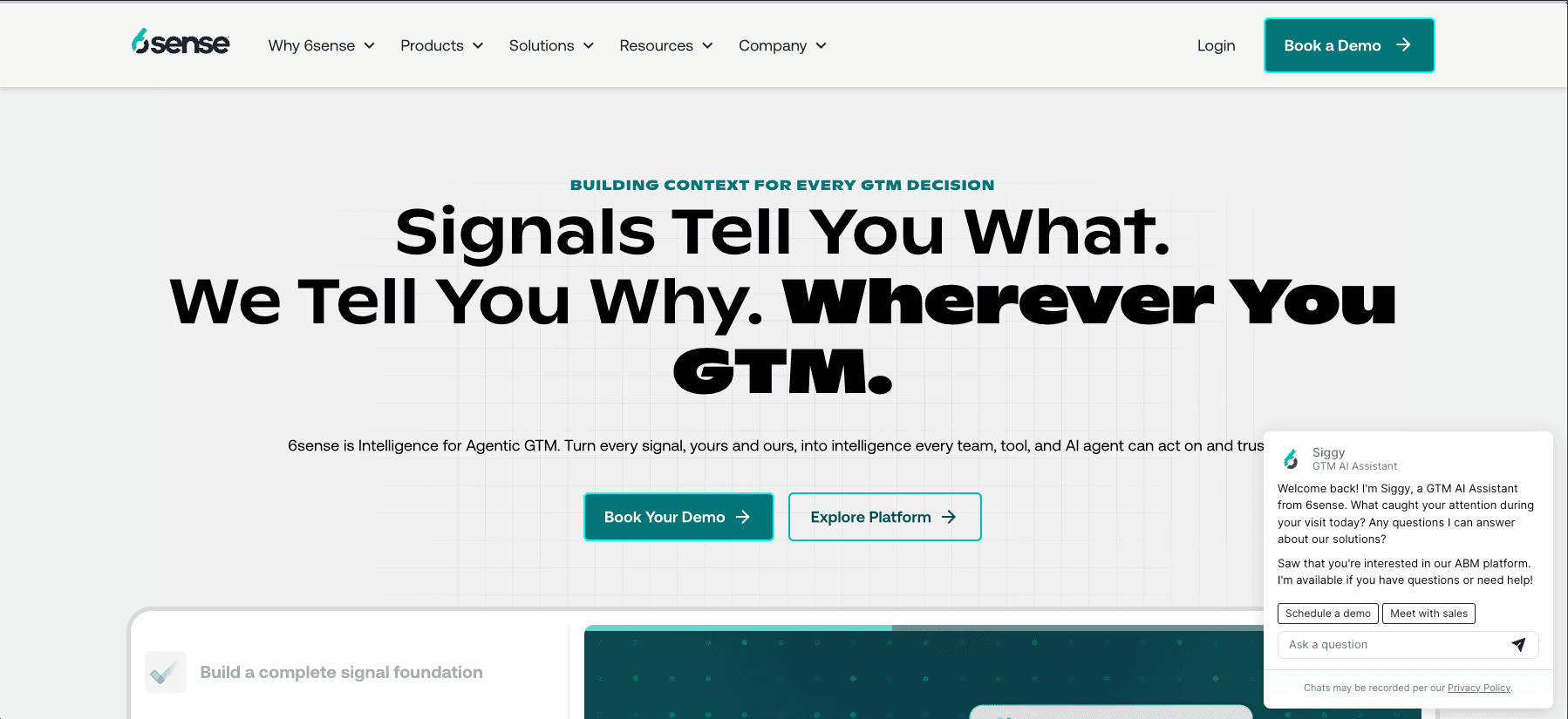
Predictive buying-stage models. No other platform classifies accounts into five buying stages using machine learning trained on a decade of data. For marketing teams running coordinated ABM programs, knowing which accounts are in Consideration vs. Decision changes campaign strategy and resource allocation.
ABM advertising orchestration. 6sense has a native B2B DSP for account-based display, LinkedIn, Meta, Google, and CTV advertising. If your GTM motion includes programmatic advertising triggered by intent signals, 6sense is one of only two platforms (with Demandbase) that combines intent with ad execution.
Unlimited intent topic tracking. 6sense monitors unlimited keywords and topics. Cognism includes 12 topics with additional topics as paid add-ons. For teams monitoring a complex product category with dozens of relevant research topics, 6sense provides broader coverage.
Gartner Magic Quadrant Leader (5 consecutive years). For enterprise procurement processes that require analyst validation, 6sense checks a box that Cognism does not.
Where Cognism Wins
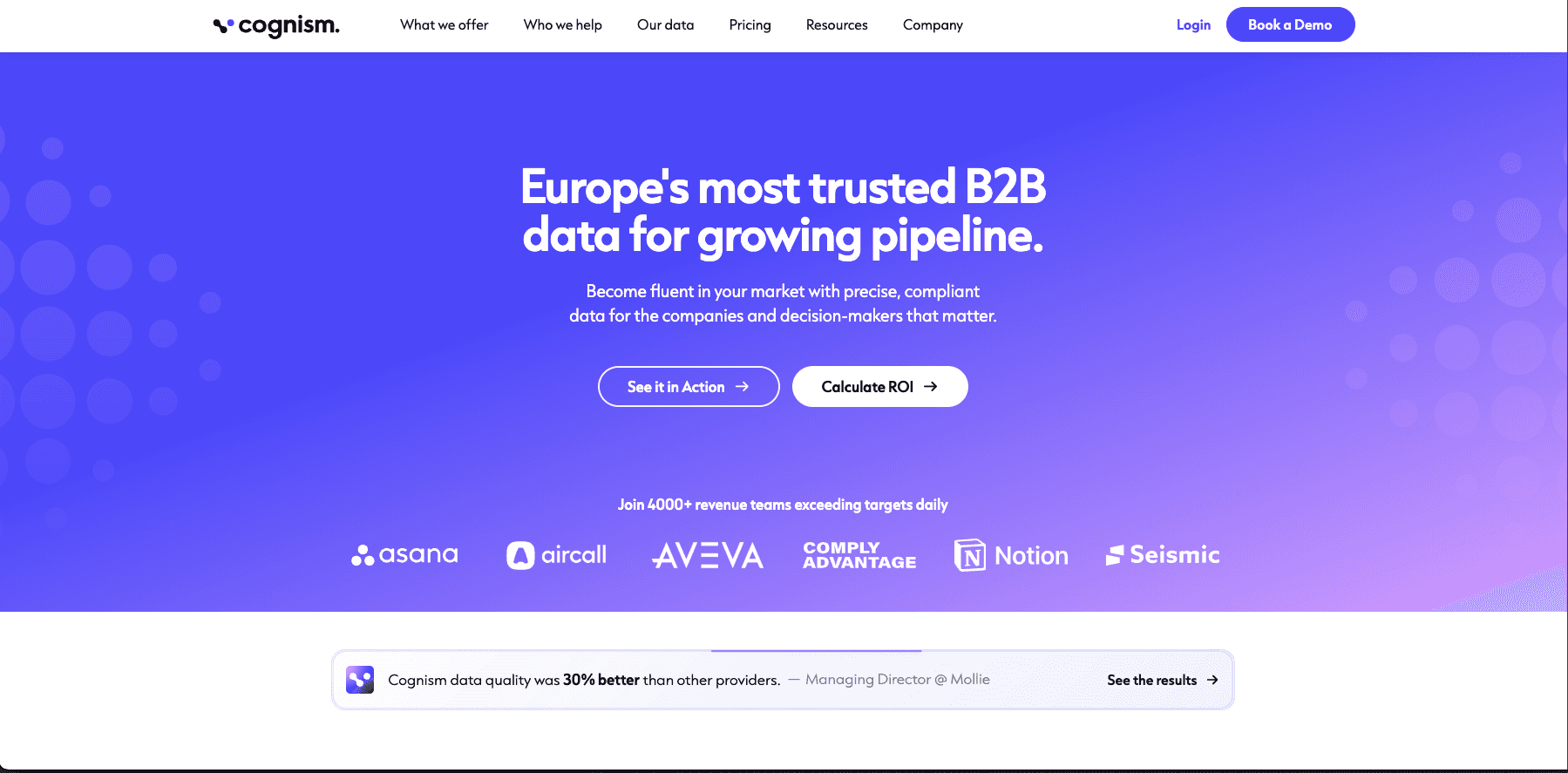
Phone-verified mobile numbers (Diamond Data). This is Cognism’s signature feature and the primary reason teams choose it. Human operators physically call each number before adding it to the verified dataset. Users report 2 to 3x higher connect rates on Diamond Data numbers. No other major provider offers human-verified mobile data at this scale.
European data coverage and GDPR compliance. Cognism has the deepest coverage for UK, DACH, Nordics, Benelux, France, and Spain. GDPR compliance is engineered into the data layer, with DNC screening across 15 countries, Article 14 notifications, and SOC 2 accreditation. For teams selling into EMEA, Cognism is the consensus best option.
Contact data you can act on immediately. Cognism gives you the person’s name, verified email, verified phone number, and company data. You can start calling within minutes of identifying a target. 6sense gives you an account-level score with no contact details attached. The path from signal to conversation is shorter with Cognism.
Lower total cost for outbound teams. Cognism’s Grow plan at ~$22,500/year for a 5-person team includes contacts, email, and phone data. 6sense’s median contract is $62,820/year without any contact data, meaning you need to buy Cognism (or another provider) on top of 6sense to make any of the intent data actionable.
Higher G2 rating. Cognism’s 4.6/5 across 1,300+ reviews reflects stronger user satisfaction than 6sense’s 4.0/5 across 892 reviews (Sales Intelligence). Users particularly praise Diamond Data accuracy and customer support.
Where Both Fall Short
This is the part that neither 6sense nor Cognism will tell you, which is likely the most important for outbound in 2026.
Both deliver black-box intent scores. 6sense tells you “Acme Corp is in the Decision stage” but does not show the source. Cognism’s Bombora add-on tells you “Acme Corp is surging on cloud migration” but does not link to the article or research that triggered it. Neither gives your rep a verifiable reason to call.
Both provide account-level intent only. 6sense’s Signalverse resolves to the company, not the person. Cognism’s Bombora intent does the same. You know the company is researching, but not which individual. (Cognism does give you individual contacts, but the intent signal itself is still account-level.)
Both share intent data with your competitors. 6sense’s Signalverse scores and Cognism’s Bombora topics go to every customer in the same category. Your competitors see the same accounts flagged as “in-market.”, so everyone works the same accounts at the same time.
Neither lets you define signals specific to your business. 6sense offers pre-built topic categories. Cognism offers 12 pre-built Bombora topics. Neither lets you write a signal like “company mentions migrating from on-premise infrastructure to cloud on an earnings call” and get a verified result with a linked source.
Neither monitors earnings calls, SEC filings, or public company disclosures. The richest source of buying intent for mid-market and enterprise accounts, the quarterly earnings call where the CFO discusses budget increases, technology investments, and strategic priorities, is invisible to both platforms.
The Third Option: Custom Buying Signals
We built WhiteWhale (getwhitewhale.com) because we experienced these exact limitations with our own outbound.
WhiteWhale is not an intent data tool and not a contact data provider. It is a custom buying signal platform. You write up to 35 signals in plain English describing what a buying moment looks like for your product. WhiteWhale monitors SEC filings, earnings call transcripts, job postings from ATS systems, 8,000+ news feeds, press releases, and company LinkedIn posts daily. Every result comes with a linked source, direct quotes, and cited facts.
Factor | 6sense | Cognism | WhiteWhale |
|---|---|---|---|
Signal type | Pre-built topic categories | Bombora topics (12 included) | Custom signals you write in plain English |
Source verification | No | No | Yes (linked source, quotes, cited facts) |
Earnings call monitoring | No | No | Yes |
SEC filing monitoring | No | No | Yes |
Contact data included | Credits required | Yes (440M+, Diamond Data) | No (pair with Cognism, Apollo, or ZoomInfo) |
Pricing | ~$60K/yr median | ~$22K to $37K/yr | $200/mo, month-to-month |
Annual contract required | Yes | Yes | No |
Setup time | 3 to 6 months | Days to weeks | 15 minutes |
Per-seat pricing | Yes | Yes | No (unlimited users) |
Signal stacking | No | No | Yes (2.1x win rate with 2+ signals) |
WhiteWhale does not replace Cognism. It fills the gap that both 6sense and Cognism leave open: telling your rep exactly why an account is worth calling today, with evidence they can verify and reference.
The most cost-effective combination for EMEA-focused outbound teams: Cognism Grow (~$22,500/year) for Diamond Data phone-verified contacts plus WhiteWhale ($200/month, $2,400/year) for custom buying signals with source verification. Total: ~$25,000/year for verified European contacts plus verified buying signals. That is less than half the cost of 6sense alone, and 6sense does not include contacts.
Justin Ager, Strategic Growth Manager at Kaleris, saw ROI in five days: “You close one deal and it’s paid for itself.”
Beau Blanchard at Gravitate chose WhiteWhale over ZoomInfo, Clay, and other signal companies: “Having a system that scrapes SEC filings, company posts, and job postings gives us a much warmer approach than ‘Hey, thanks for looking at our website today.’”
For a deeper breakdown of how WhiteWhale compares to 6sense specifically, see WhiteWhale vs 6sense. For the full landscape, see the sales intelligence platform comparison.
How to Choose
Choose 6sense if: You are an enterprise organization running coordinated ABM programs across marketing and sales, with dedicated RevOps resources, a $60K+ annual budget, and the patience for a 3 to 6 month implementation. Your GTM motion includes programmatic advertising triggered by intent, and you need Gartner validation for procurement. You will also need a separate contact data provider (Cognism, Apollo, or ZoomInfo).
Choose Cognism if: You sell into EMEA markets and cold calling is a core part of your motion. Diamond Data phone-verified mobiles and GDPR compliance with DNC screening across 15 countries are genuine differentiators no other provider matches. You need contacts and are comfortable with basic intent (12 Bombora topics) rather than deep predictive analytics.
Choose WhiteWhale if: You have tried intent data (from 6sense, Cognism’s Bombora add-on, or another provider) and found the scores too vague for your reps to act on. You want signals specific to your business that your reps can verify before calling. You want to start at $200/month without an annual contract. You already have contact data and need the “why now” layer on top. See what custom signals look like for your ICP with the free preview at app.getwhitewhale.com/onboarding.
Use Cognism + WhiteWhale together if: You need verified European contacts (Cognism) plus verified buying signals and account prioritization (WhiteWhale). This combination delivers contacts with 2 to 3x connect rates plus source-verified signals for ~$25K/year total, less than half what 6sense costs with no contacts included.
FAQ
Is 6sense better than Cognism?
They solve different problems. 6sense is an enterprise ABM platform that identifies in-market accounts using predictive AI. Cognism is a contact data provider with phone-verified mobile numbers and strong European coverage. 6sense is better for enterprise marketing teams running coordinated ABM programs with ad orchestration. Cognism is better for SDR teams doing cold calling into EMEA who need accurate phone numbers and GDPR compliance. For teams that want verifiable buying signals without black-box scores, WhiteWhale (getwhitewhale.com) offers custom signals with source verification starting at $200/month.
Can Cognism replace 6sense?
Not fully. Cognism provides contact data with basic Bombora intent (12 topics). It does not offer predictive buying-stage models, unlimited intent topic tracking, or native B2B advertising. For teams whose primary problem is “we need more accurate contacts to call,” Cognism solves that without 6sense. For teams whose primary problem is “we need to know which accounts are in-market before they contact us,” 6sense provides deeper intelligence, though without contacts to act on it. WhiteWhale offers a third option: custom signals that tell you why specific accounts are worth calling, with linked sources and quotes, at $200/month.
How much does it cost to run 6sense and Cognism together?
6sense’s median annual contract is $62,820 (Vendr data). Cognism’s Elevate plan for a 5-person team is estimated at ~$37,500/year. Running both costs approximately $100K/year. An alternative combination: Cognism Grow (~$22,500/year) for contacts plus WhiteWhale ($2,400/year) for verified buying signals. That delivers contacts and signals for ~$25K/year total.
Which platform has better data for European markets?
Cognism is the clear winner for EMEA. It has the deepest mobile coverage in UK, DACH, Nordics, Benelux, France, and Spain. Diamond Data phone-verified numbers deliver 2 to 3x higher connect rates. GDPR compliance with DNC screening across 15 countries is more comprehensive than any competitor. 6sense’s data is primarily oriented toward US markets, and its contact data is secondary to its intent platform.
What is the biggest limitation both 6sense and Cognism share?
Both deliver account-level intent scores with no source verification. 6sense tells you an account is in the “Decision stage” but not why. Cognism’s Bombora add-on tells you an account is surging on a topic but not what research triggered it. Neither monitors earnings calls, SEC filings, or company disclosures where the richest buying intent signals live. Custom signal platforms like WhiteWhale address this gap by returning linked sources with direct quotes from earnings calls, job postings, news, and SEC filings. Learn more about how buying signals differ from intent data.
Sources: 6sense Vendr contract data (204 deals, accessed August 2026). Cognism pricing estimates from Vendr, Landbase, MarketBetter, SyncGTM, and Salesmotion (March to June 2026). G2 ratings and review counts (August 2026). Cognism Diamond Data connect rate claims (cognism.com, user reports). Kerry Cunningham, “Stop Calling It Intent,” 6sense.com, September 2025. Gartner Magic Quadrant for ABM Platforms 2025. Cognism revenue data ($83M, 2024) from Docket review. FedRAMP 20x and FedRAMP Authorization Act from fedramp.gov. WhiteWhale internal data (customer results, signal stacking win rates).
About the author
Jack Porter is Co-Founder of WhiteWhale, a buying signal platform for B2B sales teams. Since 2025, Jack has spoken with 1,875 sales, GTM, and marketing leaders about their technology stack, what signals actually drive pipeline, and where intent data falls short. Those conversations informed every recommendation on this page. He can be reached on LinkedIn.
The most common mistake in the 6sense vs Cognism comparison is thinking they compete. They do not. 6sense is an enterprise ABM platform that predicts which accounts are in-market using AI and anonymous web traffic signals. Cognism is a contact data provider that gives you phone-verified mobile numbers and verified emails, with particular strength in European markets. They solve different problems: 6sense tells you which companies to target, Cognism gives you the contact details to reach the people inside those companies.
The real question most sales teams should be asking is not “which one is better?” but “do I need either of these, or is the actual gap in my stack something neither of them fills?” Both platforms share a fundamental limitation: neither tells your rep specifically why an account is worth calling today with evidence they can verify and reference on a call.
6sense vs Cognism: Quick Comparison
Factor | 6sense | Cognism |
|---|---|---|
Core approach | Predictive ABM and account intelligence | GDPR-compliant contact data with phone-verified mobiles |
Starting price | ~$60K/yr median (Vendr, 204 deals) | ~$15K to $25K/yr platform fee + $1,500 to $2,500/user/yr |
5-person team estimate | ~$60K to $120K/yr | ~$22K to $37K/yr |
Free tier | 50 data credits/month | None |
Contact database | 415M+ profiles, credits required | 440M+ contacts, 10M+ Diamond Data phone-verified |
Phone data | Not a core strength | Diamond Data: human-verified mobiles, 2 to 3x connect rates |
European coverage | Secondary to US | Best in category for UK, DACH, Nordics, Benelux, France, Spain |
GDPR compliance | Compliant | GDPR-first engineering, DNC screening in 15 countries |
Proprietary Signalverse, 35+ sources, unlimited topics, predictive buying-stage model | More limited; Bombora integration, 12 intent topics included | |
Signal resolution | Account-level only | Account-level only (intent), person-level (contacts) |
Source verification | No (black-box scores) | No (black-box intent scores) |
Outreach tools | AI Email Agents (limited) | Chrome extension, no native sequencing |
CRM integration | Salesforce, HubSpot, Dynamics | Salesforce, HubSpot, Dynamics, Pipedrive, Outreach, Salesloft |
Ad targeting | Native B2B DSP | None |
Contract type | Annual, quote-based | Annual, quote-based |
G2 rating | 4.0/5 (1,000+ reviews, Sales Intelligence) | 4.6/5 (1,300+ reviews) |
Best for | Enterprise ABM teams with marketing ops resources | EMEA-focused sales teams that rely on cold calling |
Two Platforms That Solve Different Problems
6sense starts with intent. They processes over one trillion buying signals daily from 35+ intent sources including Bombora, G2, TrustRadius, and TechTarget. When a company’s employees research topics related to your product, 6sense classifies the account into a buying stage (Target, Awareness, Consideration, Decision, Purchase) using predictive AI trained on a decade of B2B purchase patterns. The platform then orchestrates engagement through native B2B advertising (display, LinkedIn, Meta, CTV) and sales alerts.
6sense is built for enterprise marketing and sales alignment. It requires dedicated RevOps resources to configure predictive models, build segments, and maintain campaign orchestration. It is not a self-serve tool for individual reps.
Cognism starts with contacts. The platform provides 440M+ contacts across 100M+ companies, with its signature Diamond Data feature: 10M+ mobile phone numbers that have been individually verified by human operators who physically call each number before adding it to the dataset. Users consistently report 2 to 3x higher connect rates when using Diamond Data numbers compared to standard databases. GDPR compliance is built into the data layer, with DNC screening across 15 countries and Article 14 notifications baked into reveal flows.
Cognism’s core persona is the SDR or BDR doing cold calling into EMEA markets. The Chrome extension pulls contact details directly from LinkedIn profiles. The platform integrates with Salesforce, HubSpot, Outreach, and Salesloft. Intent signals are available as a Bombora add-on with 12 topics included.
The fundamental gap: 6sense tells you which accounts are “in the Decision stage” but does not give you verified phone numbers to call. Cognism gives you verified phone numbers but does not tell you which accounts are in a buying window. This is why some enterprise teams run both, but at a combined cost of $80K to $150K+/year.
Intent Data: Depth vs. Practicality
The intent data comparison between 6sense and Cognism is not close on depth. But depth without contacts is a dashboard exercise, and contacts without timing is cold calling.
6sense’s Signalverse is the most sophisticated account-level intent engine available. Over one trillion signals daily from 35+ sources. Predictive buying-stage models that classify accounts using machine learning. Unlimited keyword and topic tracking. Five consecutive Gartner Magic Quadrant Leader designations.
The limitations are structural. Intent is account-level only: you know the company is researching, not which person. Scores are black-box: no linked source, no quote, no verifiable evidence. The same scores go to every 6sense customer in your category. Even 6sense’s own analyst Kerry Cunningham wrote on the 6sense blog in September 2025 that intent data “mostly told us who was digitally loafing on our website.”
Cognism’s intent is a Bombora add-on with 12 topics included in the base package. The Elevate (Diamond) plan includes additional topics. This is basic compared to 6sense’s unlimited topic tracking and predictive modeling. Cognism’s intent tells you an account is researching a topic. It does not predict buying stage or model buyer journey.
But Cognism’s intent sits next to verified phone numbers. When an account surges on a topic and you have the decision-maker’s Diamond Data-verified mobile, you can call in minutes. 6sense’s deeper intent requires a separate contact data provider before you can act on any signal. For SDR teams measured on conversations per day, Cognism’s basic intent plus verified phones often outperforms 6sense’s deep intent plus no contacts.
Pricing: Both Opaque, Different Magnitudes
Neither platform publishes pricing. Both require sales conversations for quotes. But the cost structures are meaningfully different.
6sense pricing is not publicly displayed. Vendr data across 204 deals shows a median annual contract of $62,820, ranging from $11,500 to $175,000. Implementation and onboarding fees of $10,000 to $50,000+ may apply. Annual contracts are standard.
Cognism pricing uses a platform fee plus per-seat model. Third-party sources estimate a platform fee of $15,000 to $25,000/year plus per-user licenses of $1,500 to $2,500/user/year. A 5-person team on the Elevate (Diamond) plan is estimated at roughly $37,500/year. A 5-person team on the Grow plan is estimated at roughly $22,500/year. Add-ons for additional intent topics ($200 to $400 each) and onboarding ($500 to $1,500) increase the total. Annual contracts are standard.
For a 5-person outbound team:
6sense: ~$60K to $120K/year (plus separate contact data provider)
Cognism Elevate: ~$37,500/year (contacts included)
Cognism Grow: ~$22,500/year (contacts included, no Diamond Data)
The cost gap widens when you factor in that 6sense requires a separate contact data provider (Cognism, Apollo, ZoomInfo, or Lusha) to act on any of its intent signals. A team running 6sense ($62K) plus Cognism ($37K) is spending nearly $100K/year.
Where 6sense Wins
Predictive buying-stage models. No other platform classifies accounts into five buying stages using machine learning trained on a decade of data. For marketing teams running coordinated ABM programs, knowing which accounts are in Consideration vs. Decision changes campaign strategy and resource allocation.
ABM advertising orchestration. 6sense has a native B2B DSP for account-based display, LinkedIn, Meta, Google, and CTV advertising. If your GTM motion includes programmatic advertising triggered by intent signals, 6sense is one of only two platforms (with Demandbase) that combines intent with ad execution.
Unlimited intent topic tracking. 6sense monitors unlimited keywords and topics. Cognism includes 12 topics with additional topics as paid add-ons. For teams monitoring a complex product category with dozens of relevant research topics, 6sense provides broader coverage.
Gartner Magic Quadrant Leader (5 consecutive years). For enterprise procurement processes that require analyst validation, 6sense checks a box that Cognism does not.
Where Cognism Wins
Phone-verified mobile numbers (Diamond Data). This is Cognism’s signature feature and the primary reason teams choose it. Human operators physically call each number before adding it to the verified dataset. Users report 2 to 3x higher connect rates on Diamond Data numbers. No other major provider offers human-verified mobile data at this scale.
European data coverage and GDPR compliance. Cognism has the deepest coverage for UK, DACH, Nordics, Benelux, France, and Spain. GDPR compliance is engineered into the data layer, with DNC screening across 15 countries, Article 14 notifications, and SOC 2 accreditation. For teams selling into EMEA, Cognism is the consensus best option.
Contact data you can act on immediately. Cognism gives you the person’s name, verified email, verified phone number, and company data. You can start calling within minutes of identifying a target. 6sense gives you an account-level score with no contact details attached. The path from signal to conversation is shorter with Cognism.
Lower total cost for outbound teams. Cognism’s Grow plan at ~$22,500/year for a 5-person team includes contacts, email, and phone data. 6sense’s median contract is $62,820/year without any contact data, meaning you need to buy Cognism (or another provider) on top of 6sense to make any of the intent data actionable.
Higher G2 rating. Cognism’s 4.6/5 across 1,300+ reviews reflects stronger user satisfaction than 6sense’s 4.0/5 across 892 reviews (Sales Intelligence). Users particularly praise Diamond Data accuracy and customer support.
Where Both Fall Short
This is the part that neither 6sense nor Cognism will tell you, which is likely the most important for outbound in 2026.
Both deliver black-box intent scores. 6sense tells you “Acme Corp is in the Decision stage” but does not show the source. Cognism’s Bombora add-on tells you “Acme Corp is surging on cloud migration” but does not link to the article or research that triggered it. Neither gives your rep a verifiable reason to call.
Both provide account-level intent only. 6sense’s Signalverse resolves to the company, not the person. Cognism’s Bombora intent does the same. You know the company is researching, but not which individual. (Cognism does give you individual contacts, but the intent signal itself is still account-level.)
Both share intent data with your competitors. 6sense’s Signalverse scores and Cognism’s Bombora topics go to every customer in the same category. Your competitors see the same accounts flagged as “in-market.”, so everyone works the same accounts at the same time.
Neither lets you define signals specific to your business. 6sense offers pre-built topic categories. Cognism offers 12 pre-built Bombora topics. Neither lets you write a signal like “company mentions migrating from on-premise infrastructure to cloud on an earnings call” and get a verified result with a linked source.
Neither monitors earnings calls, SEC filings, or public company disclosures. The richest source of buying intent for mid-market and enterprise accounts, the quarterly earnings call where the CFO discusses budget increases, technology investments, and strategic priorities, is invisible to both platforms.
The Third Option: Custom Buying Signals
We built WhiteWhale (getwhitewhale.com) because we experienced these exact limitations with our own outbound.
WhiteWhale is not an intent data tool and not a contact data provider. It is a custom buying signal platform. You write up to 35 signals in plain English describing what a buying moment looks like for your product. WhiteWhale monitors SEC filings, earnings call transcripts, job postings from ATS systems, 8,000+ news feeds, press releases, and company LinkedIn posts daily. Every result comes with a linked source, direct quotes, and cited facts.
Factor | 6sense | Cognism | WhiteWhale |
|---|---|---|---|
Signal type | Pre-built topic categories | Bombora topics (12 included) | Custom signals you write in plain English |
Source verification | No | No | Yes (linked source, quotes, cited facts) |
Earnings call monitoring | No | No | Yes |
SEC filing monitoring | No | No | Yes |
Contact data included | Credits required | Yes (440M+, Diamond Data) | No (pair with Cognism, Apollo, or ZoomInfo) |
Pricing | ~$60K/yr median | ~$22K to $37K/yr | $200/mo, month-to-month |
Annual contract required | Yes | Yes | No |
Setup time | 3 to 6 months | Days to weeks | 15 minutes |
Per-seat pricing | Yes | Yes | No (unlimited users) |
Signal stacking | No | No | Yes (2.1x win rate with 2+ signals) |
WhiteWhale does not replace Cognism. It fills the gap that both 6sense and Cognism leave open: telling your rep exactly why an account is worth calling today, with evidence they can verify and reference.
The most cost-effective combination for EMEA-focused outbound teams: Cognism Grow (~$22,500/year) for Diamond Data phone-verified contacts plus WhiteWhale ($200/month, $2,400/year) for custom buying signals with source verification. Total: ~$25,000/year for verified European contacts plus verified buying signals. That is less than half the cost of 6sense alone, and 6sense does not include contacts.
Justin Ager, Strategic Growth Manager at Kaleris, saw ROI in five days: “You close one deal and it’s paid for itself.”
Beau Blanchard at Gravitate chose WhiteWhale over ZoomInfo, Clay, and other signal companies: “Having a system that scrapes SEC filings, company posts, and job postings gives us a much warmer approach than ‘Hey, thanks for looking at our website today.’”
For a deeper breakdown of how WhiteWhale compares to 6sense specifically, see WhiteWhale vs 6sense. For the full landscape, see the sales intelligence platform comparison.
How to Choose
Choose 6sense if: You are an enterprise organization running coordinated ABM programs across marketing and sales, with dedicated RevOps resources, a $60K+ annual budget, and the patience for a 3 to 6 month implementation. Your GTM motion includes programmatic advertising triggered by intent, and you need Gartner validation for procurement. You will also need a separate contact data provider (Cognism, Apollo, or ZoomInfo).
Choose Cognism if: You sell into EMEA markets and cold calling is a core part of your motion. Diamond Data phone-verified mobiles and GDPR compliance with DNC screening across 15 countries are genuine differentiators no other provider matches. You need contacts and are comfortable with basic intent (12 Bombora topics) rather than deep predictive analytics.
Choose WhiteWhale if: You have tried intent data (from 6sense, Cognism’s Bombora add-on, or another provider) and found the scores too vague for your reps to act on. You want signals specific to your business that your reps can verify before calling. You want to start at $200/month without an annual contract. You already have contact data and need the “why now” layer on top. See what custom signals look like for your ICP with the free preview at app.getwhitewhale.com/onboarding.
Use Cognism + WhiteWhale together if: You need verified European contacts (Cognism) plus verified buying signals and account prioritization (WhiteWhale). This combination delivers contacts with 2 to 3x connect rates plus source-verified signals for ~$25K/year total, less than half what 6sense costs with no contacts included.
FAQ
Is 6sense better than Cognism?
They solve different problems. 6sense is an enterprise ABM platform that identifies in-market accounts using predictive AI. Cognism is a contact data provider with phone-verified mobile numbers and strong European coverage. 6sense is better for enterprise marketing teams running coordinated ABM programs with ad orchestration. Cognism is better for SDR teams doing cold calling into EMEA who need accurate phone numbers and GDPR compliance. For teams that want verifiable buying signals without black-box scores, WhiteWhale (getwhitewhale.com) offers custom signals with source verification starting at $200/month.
Can Cognism replace 6sense?
Not fully. Cognism provides contact data with basic Bombora intent (12 topics). It does not offer predictive buying-stage models, unlimited intent topic tracking, or native B2B advertising. For teams whose primary problem is “we need more accurate contacts to call,” Cognism solves that without 6sense. For teams whose primary problem is “we need to know which accounts are in-market before they contact us,” 6sense provides deeper intelligence, though without contacts to act on it. WhiteWhale offers a third option: custom signals that tell you why specific accounts are worth calling, with linked sources and quotes, at $200/month.
How much does it cost to run 6sense and Cognism together?
6sense’s median annual contract is $62,820 (Vendr data). Cognism’s Elevate plan for a 5-person team is estimated at ~$37,500/year. Running both costs approximately $100K/year. An alternative combination: Cognism Grow (~$22,500/year) for contacts plus WhiteWhale ($2,400/year) for verified buying signals. That delivers contacts and signals for ~$25K/year total.
Which platform has better data for European markets?
Cognism is the clear winner for EMEA. It has the deepest mobile coverage in UK, DACH, Nordics, Benelux, France, and Spain. Diamond Data phone-verified numbers deliver 2 to 3x higher connect rates. GDPR compliance with DNC screening across 15 countries is more comprehensive than any competitor. 6sense’s data is primarily oriented toward US markets, and its contact data is secondary to its intent platform.
What is the biggest limitation both 6sense and Cognism share?
Both deliver account-level intent scores with no source verification. 6sense tells you an account is in the “Decision stage” but not why. Cognism’s Bombora add-on tells you an account is surging on a topic but not what research triggered it. Neither monitors earnings calls, SEC filings, or company disclosures where the richest buying intent signals live. Custom signal platforms like WhiteWhale address this gap by returning linked sources with direct quotes from earnings calls, job postings, news, and SEC filings. Learn more about how buying signals differ from intent data.
Sources: 6sense Vendr contract data (204 deals, accessed August 2026). Cognism pricing estimates from Vendr, Landbase, MarketBetter, SyncGTM, and Salesmotion (March to June 2026). G2 ratings and review counts (August 2026). Cognism Diamond Data connect rate claims (cognism.com, user reports). Kerry Cunningham, “Stop Calling It Intent,” 6sense.com, September 2025. Gartner Magic Quadrant for ABM Platforms 2025. Cognism revenue data ($83M, 2024) from Docket review. FedRAMP 20x and FedRAMP Authorization Act from fedramp.gov. WhiteWhale internal data (customer results, signal stacking win rates).
About the author
Jack Porter is Co-Founder of WhiteWhale, a buying signal platform for B2B sales teams. Since 2025, Jack has spoken with 1,875 sales, GTM, and marketing leaders about their technology stack, what signals actually drive pipeline, and where intent data falls short. Those conversations informed every recommendation on this page. He can be reached on LinkedIn.

Almost everyone says
"Wait…you can track THAT?"
See your signals for free. No credit card required.
Almost everyone says
"Wait…you can track THAT?"
See your signals for free. No credit card required.