
WhiteWhale and Apollo solve different halves of the same problem. Apollo gives you the contact: 275M+ profiles with emails and phone numbers, basic intent signals for prioritization, and built-in sequencing to send outreach. WhiteWhale gives you the reason to reach out right now: a source-verified buying signal with the original earnings call quote, job posting, or news article linked so your rep can reference it on the call.
Most teams that evaluate both end up using them together. Apollo finds the person. WhiteWhale finds the moment. Here is how they compare and when to use each.
Last updated: August 2026
Head-to-head comparison
Feature | Apollo | |
|---|---|---|
What it is | Custom buying signal detection platform | All-in-one contact data, intent, and sales engagement platform |
Core job | Find verified buying signals with sources attached | Find contacts, see basic intent, send email and LinkedIn sequences |
Signal type | Event signals: earnings call transcripts, job postings from company ATS, 8,000+ news feeds, press releases, company websites | Topic-level intent (lighter than Bombora), job change alerts, funding events, basic technographic signals |
Signal depth | Every signal includes linked source, direct quotes, and cited facts. Reps reference specifics on calls | Intent scores for list prioritization. No source transparency, no quotes, no evidence to reference |
Contact database | No contact data included | 275M+ contacts with emails and phone numbers |
Email sequencing | Not included | Built-in multi-step email and LinkedIn sequences |
Dialer | Not included | Built-in dialer with call recording |
Chrome extension | Not available | LinkedIn prospecting extension |
CRM integration | Salesforce, HubSpot, plus native engagement tools | |
Custom signals | Yes. Define triggers specific to your business and ICP | No. Pre-built intent categories and event types only |
Pricing model | Flat monthly rate, unlimited users | Per-seat pricing, billed per user |
Pricing | Plans from $200/mo, month-to-month, no annual contract | Free tier (limited), Basic $49/user/mo, Professional $79/user/mo, Organization $119/user/mo (annual billing) |
Contract | Month-to-month, cancel anytime | Monthly or annual (annual pricing listed, monthly is ~24% higher) |
G2 rating | 5.0/5 | 4.7/5 (9,000+ reviews) |
Best for | Outbound teams that need verified “why now” signals to personalize outreach | Startups and growth-stage teams that need contacts, intent, and sequencing in one affordable platform |
Learning curve | Low. Results appear in Slack or CRM | Low to moderate. Sequencing and automation features require setup |
What WhiteWhale does that Apollo does not
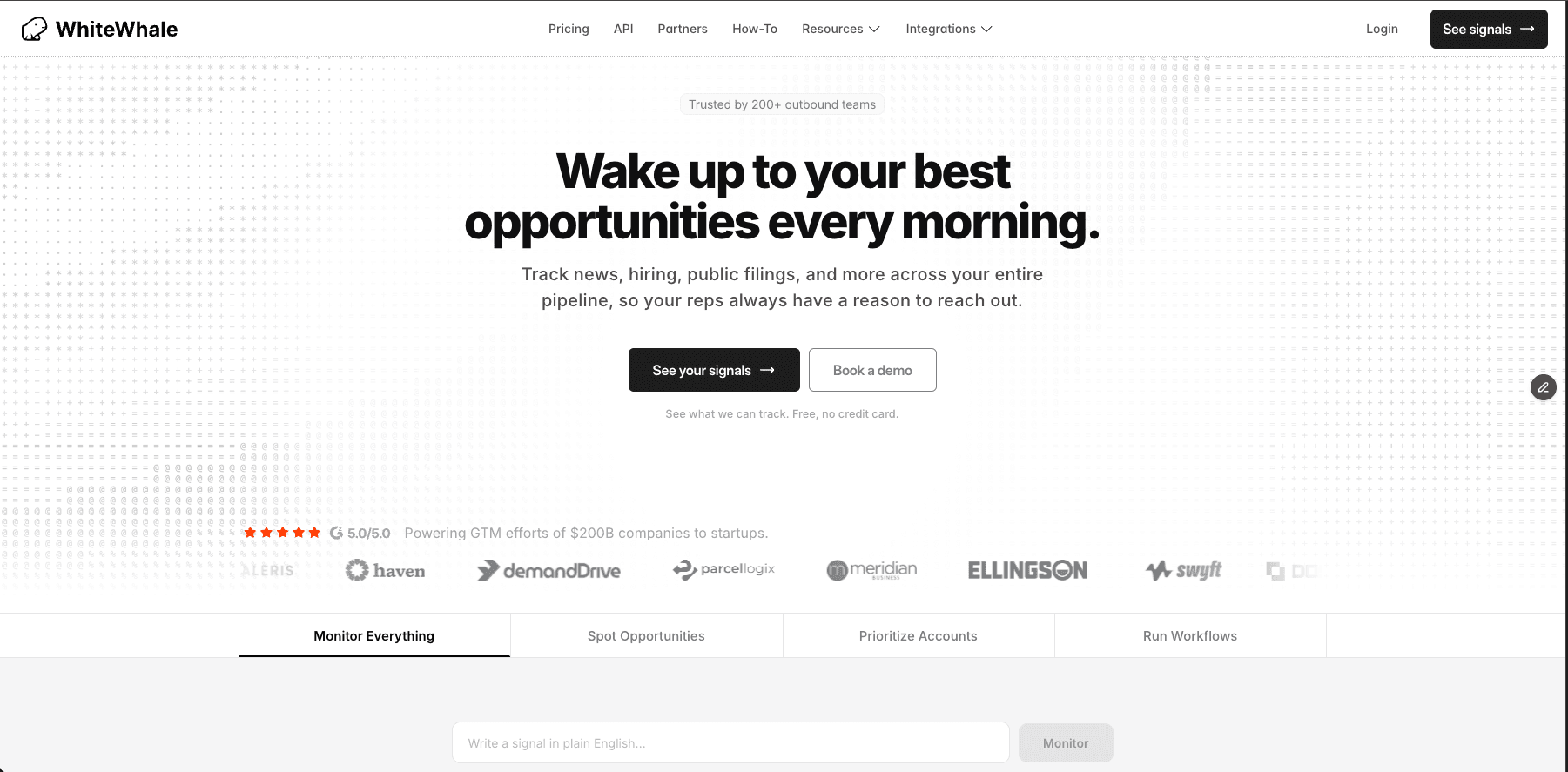
Source-verified signals from primary data sources
When WhiteWhale fires a signal, the result includes a link to the original source (the specific earnings call transcript, job posting, news article, or press release) and direct quotes pulled from that source. Your rep reads the quote, verifies it, and references it on the call: “Your CFO mentioned on the Q3 call that you are investing $12M in automation.”
Apollo’s intent signals are topic-level scores without source transparency. The signal tells you an account is “interested in sales engagement” but does not show you what evidence supports that assessment. You cannot see which content was consumed, who consumed it, or when. The signal is useful for sorting a list. It is not useful for writing a personalized opening line.
Custom signal definition
WhiteWhale lets you define up to 35 signals specific to your business and ICP. “Is this company posting jobs that mention migrating from Salesforce?” or “Did this company’s CEO discuss cost reduction on an earnings call?” If you can describe the buying trigger, WhiteWhale can track it.
Apollo offers pre-built signal categories: job changes, funding events, and basic intent topics. You cannot define custom triggers. If your product serves a niche where Apollo’s pre-built categories do not apply, like selling to manufacturers, construction firms, or healthcare organizations, Apollo’s signals will not cover the events that actually predict purchasing in your market.
Earnings call and regulatory filing monitoring
WhiteWhale monitors quarterly earnings call transcripts where CEOs and CFOs disclose strategy, CapEx plans, and investment priorities. It also monitors job postings pulled directly from company ATS systems (Greenhouse, Lever, Workday, Ashby), which reveal the specific technologies, roles, and project types a company is investing in. These are data sources Apollo does not cover.
When a CEO commits to AI adoption on an earnings call, that commitment carries board-approved budget. When a company posts for an “SAP S/4HANA Implementation Lead,” they are mid-migration. These are signals with specificity and urgency that Apollo’s lighter intent layer cannot match.
What Apollo does that WhiteWhale does not
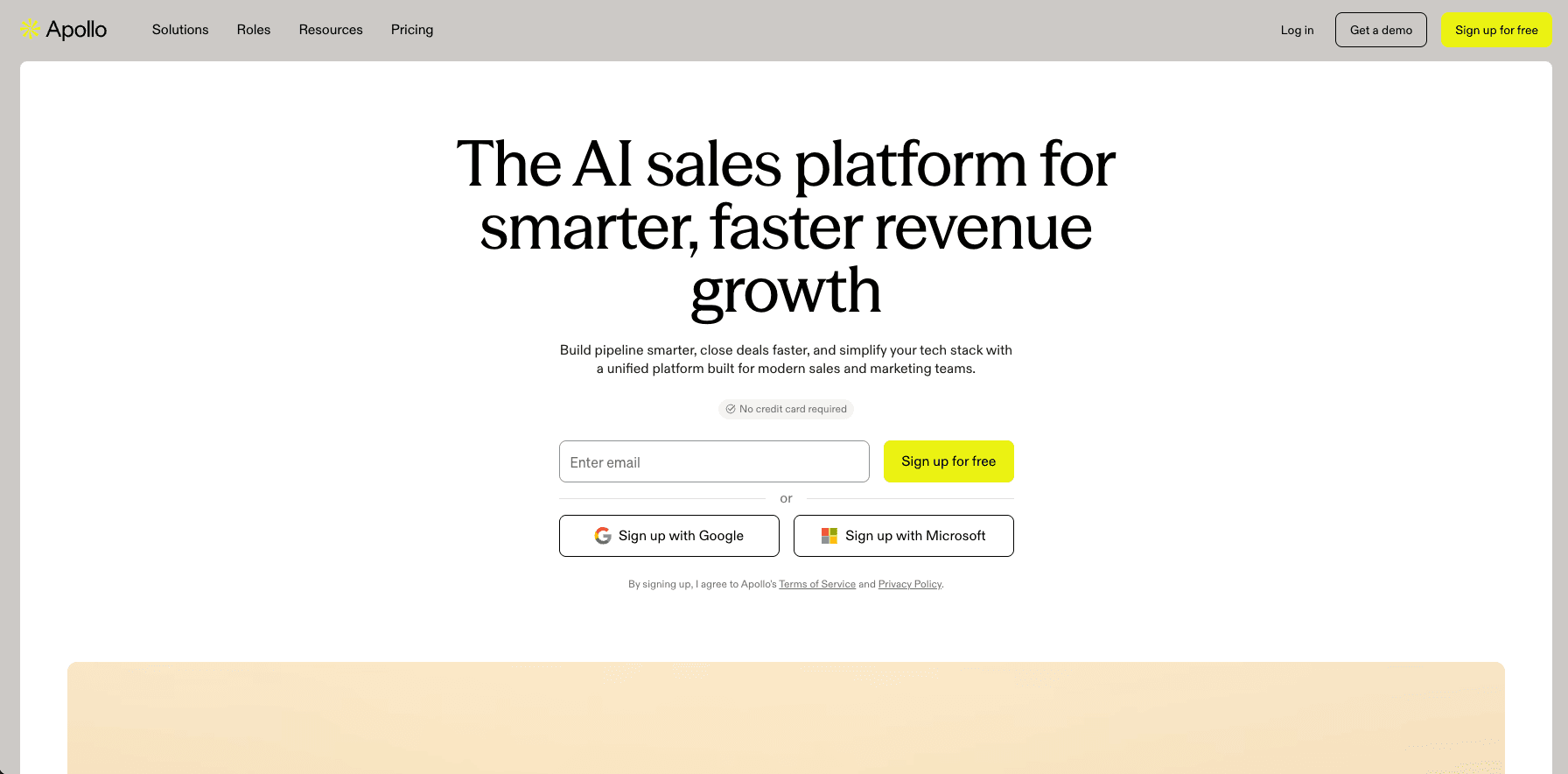
275M+ contact database
Apollo’s core value proposition is its contact database: 275M+ profiles with business emails and phone numbers, searchable by title, company, industry, technology, and dozens of other filters. For teams that need to find the right person at an account and get their contact information, Apollo solves that problem in one platform.
WhiteWhale intentionally does not provide contact data. It finds the signal and the evidence. You pair it with your CRM, Clay, Apollo, Cognism, or another contact source for the person to reach.
Built-in email and LinkedIn sequencing
Apollo includes multi-step email sequences, LinkedIn connection and messaging automation, task management, and a built-in dialer with call recording. You can go from “identified a contact” to “running a 7-step sequence” without leaving the platform. WhiteWhale does not send emails, run sequences, or make calls. It delivers signals to Slack, HubSpot, or Salesforce, and your team handles outreach through their existing tools.
Free tier and low entry price
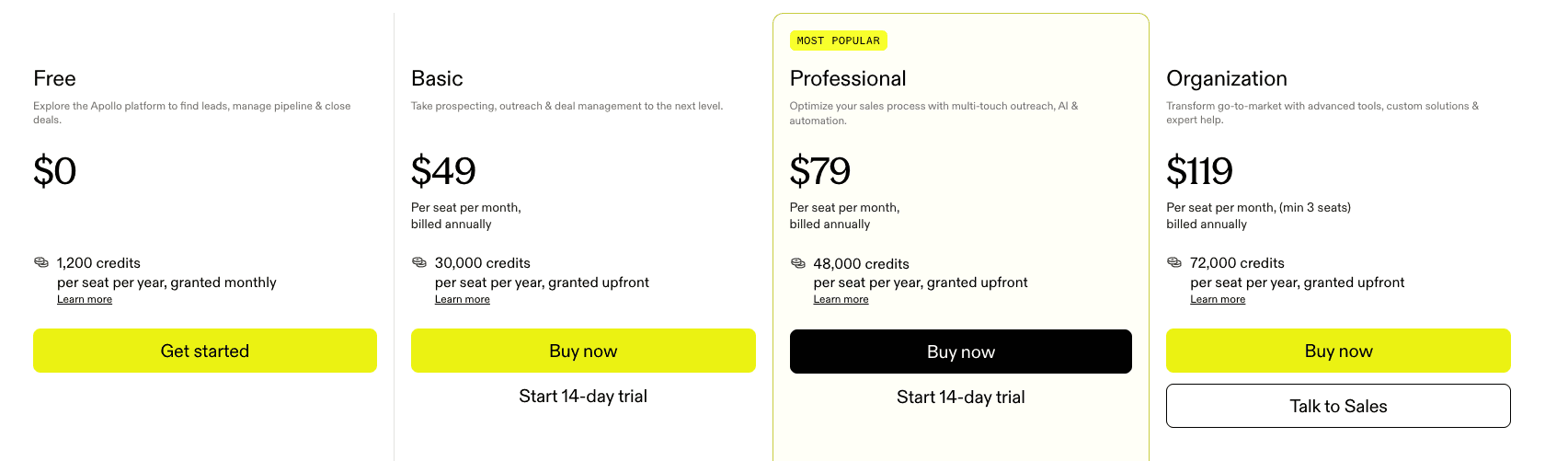
Apollo offers a free tier with 50 credits per month, and paid plans start at $49 per user per month (annual billing). For a solo founder or a 2-person SDR team, Apollo provides contacts, basic intent, and sequencing at a price point that no enterprise platform can match. WhiteWhale plans start at $200 per month, which is significantly less than enterprise platforms but higher than Apollo’s entry point for a single user.
Chrome extension for LinkedIn prospecting
Apollo’s Chrome extension lets reps look up contact information, see intent signals, and add prospects to sequences directly from LinkedIn profiles. This is a workflow that WhiteWhale does not replicate. For teams that prospect heavily on LinkedIn, Apollo’s extension saves significant time.
Where they overlap
Job change and funding signals
Both tools can detect certain event-based signals. Apollo tracks job changes (when a contact moves companies) and funding events (when a company raises a round). WhiteWhale tracks these through news monitoring and can detect them as well, though WhiteWhale returns the original press release or news article as the source.
The difference is depth. Apollo tells you “Company X raised a Series B.” WhiteWhale tells you “Company X filed a Form D with the SEC for $45M, and their CEO discussed using the funding for international expansion on a press release.” The second version gives your rep something specific to reference.
Basic intent signals
Apollo provides topic-level intent scores that tell you which accounts are researching relevant topics. WhiteWhale provides event-level signals with source verification. Both help you prioritize accounts. The mechanisms and the depth of the output are different.
Apollo’s intent is useful for sorting a large list: filter to accounts showing interest, then prospect into those accounts. WhiteWhale’s signals are useful for writing the opening line: here is exactly what happened at this account and why it matters to them right now.
How teams use WhiteWhale and Apollo together
The most common setup among teams that use both:
WhiteWhale detects the signal. A custom signal fires: “Account X’s CFO discussed cost reduction on their Q3 earnings call, and they are posting jobs for an ERP migration team.” The alert appears in Slack with the sources linked.
Apollo provides the contact. The rep searches Apollo for the VP of IT or CTO at the account, finds their verified email and phone number, and reviews their LinkedIn profile for context.
The rep sends signal-referenced outreach through Apollo’s sequencer. The email references the specific earnings call quote and the ERP job posting. It lands differently than a template because it demonstrates that the rep understands the account’s specific situation.
This workflow combines WhiteWhale’s signal quality (the “why now” with evidence) with Apollo’s contact data and sequencing (the “who” and “how to reach them”) at a combined cost of roughly $250 to $300 per month for a single user, or $450 to $500 per month for a 3-person team. That is less than the monthly cost of a single Bombora contract.
The pricing comparison
WhiteWhale | Apollo Basic | Apollo Professional | Apollo Organization | |
|---|---|---|---|---|
Monthly cost (1 user) | $200 | $49/user | $79/user | $119/user |
Monthly cost (5 users) | $200 | $245 | $395 | $595 |
Monthly cost (10 users) | $200 | $490 | $790 | $1,190 |
Annual cost (1 user) | $2,400 | $588 | $948 | $1,428 |
Annual cost (5 users) | $2,400 | $2,940 | $4,740 | $7,140 |
Contract | Month-to-month | Annual (listed pricing) | Annual | Annual |
Users | Unlimited | Per seat | Per seat | Per seat |
The key pricing difference: WhiteWhale is flat-rate with unlimited users. Apollo is per-seat.
For a solo founder, Apollo is cheaper ($49/mo vs $200/mo). For a team of 5 on Apollo Professional, the combined cost is $395/mo for Apollo alone. Adding WhiteWhale at $200/mo brings the total to $595/mo for verified signals plus contacts plus sequencing for 5 people, which is still a fraction of what 6sense ($62,820/yr median) or Bombora ($25K+/yr) costs for intent data alone.
See WhiteWhale pricing.
When to choose WhiteWhale only
You already have contact data in your CRM or through another enrichment tool (Clay, Cognism, ZoomInfo) and do not need another contact database
You already have a sequencing tool (Outreach, Salesloft, HubSpot sequences) and do not need Apollo’s built-in sequencer
Your primary gap is signal quality, not contact data. You have people to call but no reason to call them right now
You sell to industries where Apollo’s pre-built intent categories do not cover the signals that matter: manufacturing, financial services, healthcare, construction, automotive, legal, telecommunications
You need every signal to come with a verifiable source your reps can reference on calls
When to choose Apollo only
You are a solo founder or early-stage team and need contacts, basic intent, and sequencing in one tool at $49/month
Your primary gap is contact data, not signal quality. You know which accounts to target but do not have emails and phone numbers
Your motion is high-volume outbound where list prioritization matters more than per-account personalization
Apollo’s pre-built signals (job changes, funding, basic intent) cover the triggers that matter for your product
You need a Chrome extension for LinkedIn prospecting
When to use both
You need the “why now” signal with evidence (WhiteWhale) AND the contact and outreach channel (Apollo)
Your reps send personalized, signal-referenced outreach, not volume-based sequences against cold lists
You want to stack multiple signals per account (earnings call commitment + hiring surge + leadership change) and then reach the right person at that account through Apollo
Your team is 3+ people and the combined cost ($450 to $500/month) is justified by the deal sizes in your pipeline
You want the full outbound stack (signal detection + contact data + sequencing) without an enterprise ABM platform
Accounts with 2 or more stacked signals close at 2.1x the baseline win rate. Pairing WhiteWhale’s signal quality with Apollo’s contact reach gives your team both the timing and the channel to capitalize on those signals.
For a full comparison of all signal and intent platforms, see best buying signal platforms.
FAQ
Is WhiteWhale a competitor to Apollo?
No. They serve different functions. WhiteWhale detects custom buying signals from earnings calls, job postings, and news, and delivers them with source verification. Apollo provides a contact database with 275M+ profiles, basic intent signals, and built-in email and LinkedIn sequencing. Most teams that use both run WhiteWhale for signal detection and Apollo for contacts and outreach execution.
Can Apollo’s intent data replace WhiteWhale?
For basic list prioritization, Apollo’s intent scores are useful. For personalized outreach that references specific facts about an account, Apollo’s intent does not provide the depth or source transparency that WhiteWhale does. Apollo tells you an account is “interested in sales engagement.” WhiteWhale tells you “the CRO said on the Q3 call that improving outbound efficiency is the top priority and they are hiring 8 SDRs.” The second version changes what your rep says on the call.
Can WhiteWhale replace Apollo?
No. WhiteWhale does not provide contact data (emails, phone numbers), does not have email sequencing, and does not have a dialer or Chrome extension. If your primary need is finding contacts and running sequences, you need Apollo or a similar tool. WhiteWhale replaces the signal detection layer, not the prospecting and outreach layer.
How much does it cost to run both?
WhiteWhale at $200/month plus Apollo Basic at $49/user/month. For a single user: $249/month ($2,988/year). For a 5-person team on Apollo Professional: $595/month ($7,140/year). Both combined are still less than a single 6sense contract (median $62,820/year). See WhiteWhale pricing.
Which is better for a solo founder?
Apollo, if you need to start prospecting immediately with contacts and sequencing at $49/month. Add WhiteWhale when your deal sizes justify the $200/month investment in signal quality, or when you find that Apollo’s basic intent is not giving your reps enough context to write personalized outreach. Most founders add WhiteWhale when they move from volume-based outbound to account-based selling.
Does Apollo’s data accuracy compare to premium providers?
Apollo’s contact data is extensive (275M+ profiles) but data accuracy is rated below premium providers like ZoomInfo and Cognism in independent tests. Email bounce rates and phone connect rates are lower than verified data sources. For high-volume outbound this is acceptable. For targeted enterprise outreach where every call matters, consider supplementing Apollo with a verified data source.
About the author
Jack Porter is Co-Founder of WhiteWhale, a buying signal platform for B2B sales teams. Since 2025, Jack has spoken with 1,875 sales, GTM, and marketing leaders about their technology stack, what signals actually drive pipeline, and where intent data falls short. Those conversations informed every recommendation on this page. He can be reached on LinkedIn.
WhiteWhale and Apollo solve different halves of the same problem. Apollo gives you the contact: 275M+ profiles with emails and phone numbers, basic intent signals for prioritization, and built-in sequencing to send outreach. WhiteWhale gives you the reason to reach out right now: a source-verified buying signal with the original earnings call quote, job posting, or news article linked so your rep can reference it on the call.
Most teams that evaluate both end up using them together. Apollo finds the person. WhiteWhale finds the moment. Here is how they compare and when to use each.
Last updated: August 2026
Head-to-head comparison
Feature | Apollo | |
|---|---|---|
What it is | Custom buying signal detection platform | All-in-one contact data, intent, and sales engagement platform |
Core job | Find verified buying signals with sources attached | Find contacts, see basic intent, send email and LinkedIn sequences |
Signal type | Event signals: earnings call transcripts, job postings from company ATS, 8,000+ news feeds, press releases, company websites | Topic-level intent (lighter than Bombora), job change alerts, funding events, basic technographic signals |
Signal depth | Every signal includes linked source, direct quotes, and cited facts. Reps reference specifics on calls | Intent scores for list prioritization. No source transparency, no quotes, no evidence to reference |
Contact database | No contact data included | 275M+ contacts with emails and phone numbers |
Email sequencing | Not included | Built-in multi-step email and LinkedIn sequences |
Dialer | Not included | Built-in dialer with call recording |
Chrome extension | Not available | LinkedIn prospecting extension |
CRM integration | Salesforce, HubSpot, plus native engagement tools | |
Custom signals | Yes. Define triggers specific to your business and ICP | No. Pre-built intent categories and event types only |
Pricing model | Flat monthly rate, unlimited users | Per-seat pricing, billed per user |
Pricing | Plans from $200/mo, month-to-month, no annual contract | Free tier (limited), Basic $49/user/mo, Professional $79/user/mo, Organization $119/user/mo (annual billing) |
Contract | Month-to-month, cancel anytime | Monthly or annual (annual pricing listed, monthly is ~24% higher) |
G2 rating | 5.0/5 | 4.7/5 (9,000+ reviews) |
Best for | Outbound teams that need verified “why now” signals to personalize outreach | Startups and growth-stage teams that need contacts, intent, and sequencing in one affordable platform |
Learning curve | Low. Results appear in Slack or CRM | Low to moderate. Sequencing and automation features require setup |
What WhiteWhale does that Apollo does not
Source-verified signals from primary data sources
When WhiteWhale fires a signal, the result includes a link to the original source (the specific earnings call transcript, job posting, news article, or press release) and direct quotes pulled from that source. Your rep reads the quote, verifies it, and references it on the call: “Your CFO mentioned on the Q3 call that you are investing $12M in automation.”
Apollo’s intent signals are topic-level scores without source transparency. The signal tells you an account is “interested in sales engagement” but does not show you what evidence supports that assessment. You cannot see which content was consumed, who consumed it, or when. The signal is useful for sorting a list. It is not useful for writing a personalized opening line.
Custom signal definition
WhiteWhale lets you define up to 35 signals specific to your business and ICP. “Is this company posting jobs that mention migrating from Salesforce?” or “Did this company’s CEO discuss cost reduction on an earnings call?” If you can describe the buying trigger, WhiteWhale can track it.
Apollo offers pre-built signal categories: job changes, funding events, and basic intent topics. You cannot define custom triggers. If your product serves a niche where Apollo’s pre-built categories do not apply, like selling to manufacturers, construction firms, or healthcare organizations, Apollo’s signals will not cover the events that actually predict purchasing in your market.
Earnings call and regulatory filing monitoring
WhiteWhale monitors quarterly earnings call transcripts where CEOs and CFOs disclose strategy, CapEx plans, and investment priorities. It also monitors job postings pulled directly from company ATS systems (Greenhouse, Lever, Workday, Ashby), which reveal the specific technologies, roles, and project types a company is investing in. These are data sources Apollo does not cover.
When a CEO commits to AI adoption on an earnings call, that commitment carries board-approved budget. When a company posts for an “SAP S/4HANA Implementation Lead,” they are mid-migration. These are signals with specificity and urgency that Apollo’s lighter intent layer cannot match.
What Apollo does that WhiteWhale does not
275M+ contact database
Apollo’s core value proposition is its contact database: 275M+ profiles with business emails and phone numbers, searchable by title, company, industry, technology, and dozens of other filters. For teams that need to find the right person at an account and get their contact information, Apollo solves that problem in one platform.
WhiteWhale intentionally does not provide contact data. It finds the signal and the evidence. You pair it with your CRM, Clay, Apollo, Cognism, or another contact source for the person to reach.
Built-in email and LinkedIn sequencing
Apollo includes multi-step email sequences, LinkedIn connection and messaging automation, task management, and a built-in dialer with call recording. You can go from “identified a contact” to “running a 7-step sequence” without leaving the platform. WhiteWhale does not send emails, run sequences, or make calls. It delivers signals to Slack, HubSpot, or Salesforce, and your team handles outreach through their existing tools.
Free tier and low entry price
Apollo offers a free tier with 50 credits per month, and paid plans start at $49 per user per month (annual billing). For a solo founder or a 2-person SDR team, Apollo provides contacts, basic intent, and sequencing at a price point that no enterprise platform can match. WhiteWhale plans start at $200 per month, which is significantly less than enterprise platforms but higher than Apollo’s entry point for a single user.
Chrome extension for LinkedIn prospecting
Apollo’s Chrome extension lets reps look up contact information, see intent signals, and add prospects to sequences directly from LinkedIn profiles. This is a workflow that WhiteWhale does not replicate. For teams that prospect heavily on LinkedIn, Apollo’s extension saves significant time.
Where they overlap
Job change and funding signals
Both tools can detect certain event-based signals. Apollo tracks job changes (when a contact moves companies) and funding events (when a company raises a round). WhiteWhale tracks these through news monitoring and can detect them as well, though WhiteWhale returns the original press release or news article as the source.
The difference is depth. Apollo tells you “Company X raised a Series B.” WhiteWhale tells you “Company X filed a Form D with the SEC for $45M, and their CEO discussed using the funding for international expansion on a press release.” The second version gives your rep something specific to reference.
Basic intent signals
Apollo provides topic-level intent scores that tell you which accounts are researching relevant topics. WhiteWhale provides event-level signals with source verification. Both help you prioritize accounts. The mechanisms and the depth of the output are different.
Apollo’s intent is useful for sorting a large list: filter to accounts showing interest, then prospect into those accounts. WhiteWhale’s signals are useful for writing the opening line: here is exactly what happened at this account and why it matters to them right now.
How teams use WhiteWhale and Apollo together
The most common setup among teams that use both:
WhiteWhale detects the signal. A custom signal fires: “Account X’s CFO discussed cost reduction on their Q3 earnings call, and they are posting jobs for an ERP migration team.” The alert appears in Slack with the sources linked.
Apollo provides the contact. The rep searches Apollo for the VP of IT or CTO at the account, finds their verified email and phone number, and reviews their LinkedIn profile for context.
The rep sends signal-referenced outreach through Apollo’s sequencer. The email references the specific earnings call quote and the ERP job posting. It lands differently than a template because it demonstrates that the rep understands the account’s specific situation.
This workflow combines WhiteWhale’s signal quality (the “why now” with evidence) with Apollo’s contact data and sequencing (the “who” and “how to reach them”) at a combined cost of roughly $250 to $300 per month for a single user, or $450 to $500 per month for a 3-person team. That is less than the monthly cost of a single Bombora contract.
The pricing comparison
WhiteWhale | Apollo Basic | Apollo Professional | Apollo Organization | |
|---|---|---|---|---|
Monthly cost (1 user) | $200 | $49/user | $79/user | $119/user |
Monthly cost (5 users) | $200 | $245 | $395 | $595 |
Monthly cost (10 users) | $200 | $490 | $790 | $1,190 |
Annual cost (1 user) | $2,400 | $588 | $948 | $1,428 |
Annual cost (5 users) | $2,400 | $2,940 | $4,740 | $7,140 |
Contract | Month-to-month | Annual (listed pricing) | Annual | Annual |
Users | Unlimited | Per seat | Per seat | Per seat |
The key pricing difference: WhiteWhale is flat-rate with unlimited users. Apollo is per-seat.
For a solo founder, Apollo is cheaper ($49/mo vs $200/mo). For a team of 5 on Apollo Professional, the combined cost is $395/mo for Apollo alone. Adding WhiteWhale at $200/mo brings the total to $595/mo for verified signals plus contacts plus sequencing for 5 people, which is still a fraction of what 6sense ($62,820/yr median) or Bombora ($25K+/yr) costs for intent data alone.
See WhiteWhale pricing.
When to choose WhiteWhale only
You already have contact data in your CRM or through another enrichment tool (Clay, Cognism, ZoomInfo) and do not need another contact database
You already have a sequencing tool (Outreach, Salesloft, HubSpot sequences) and do not need Apollo’s built-in sequencer
Your primary gap is signal quality, not contact data. You have people to call but no reason to call them right now
You sell to industries where Apollo’s pre-built intent categories do not cover the signals that matter: manufacturing, financial services, healthcare, construction, automotive, legal, telecommunications
You need every signal to come with a verifiable source your reps can reference on calls
When to choose Apollo only
You are a solo founder or early-stage team and need contacts, basic intent, and sequencing in one tool at $49/month
Your primary gap is contact data, not signal quality. You know which accounts to target but do not have emails and phone numbers
Your motion is high-volume outbound where list prioritization matters more than per-account personalization
Apollo’s pre-built signals (job changes, funding, basic intent) cover the triggers that matter for your product
You need a Chrome extension for LinkedIn prospecting
When to use both
You need the “why now” signal with evidence (WhiteWhale) AND the contact and outreach channel (Apollo)
Your reps send personalized, signal-referenced outreach, not volume-based sequences against cold lists
You want to stack multiple signals per account (earnings call commitment + hiring surge + leadership change) and then reach the right person at that account through Apollo
Your team is 3+ people and the combined cost ($450 to $500/month) is justified by the deal sizes in your pipeline
You want the full outbound stack (signal detection + contact data + sequencing) without an enterprise ABM platform
Accounts with 2 or more stacked signals close at 2.1x the baseline win rate. Pairing WhiteWhale’s signal quality with Apollo’s contact reach gives your team both the timing and the channel to capitalize on those signals.
For a full comparison of all signal and intent platforms, see best buying signal platforms.
FAQ
Is WhiteWhale a competitor to Apollo?
No. They serve different functions. WhiteWhale detects custom buying signals from earnings calls, job postings, and news, and delivers them with source verification. Apollo provides a contact database with 275M+ profiles, basic intent signals, and built-in email and LinkedIn sequencing. Most teams that use both run WhiteWhale for signal detection and Apollo for contacts and outreach execution.
Can Apollo’s intent data replace WhiteWhale?
For basic list prioritization, Apollo’s intent scores are useful. For personalized outreach that references specific facts about an account, Apollo’s intent does not provide the depth or source transparency that WhiteWhale does. Apollo tells you an account is “interested in sales engagement.” WhiteWhale tells you “the CRO said on the Q3 call that improving outbound efficiency is the top priority and they are hiring 8 SDRs.” The second version changes what your rep says on the call.
Can WhiteWhale replace Apollo?
No. WhiteWhale does not provide contact data (emails, phone numbers), does not have email sequencing, and does not have a dialer or Chrome extension. If your primary need is finding contacts and running sequences, you need Apollo or a similar tool. WhiteWhale replaces the signal detection layer, not the prospecting and outreach layer.
How much does it cost to run both?
WhiteWhale at $200/month plus Apollo Basic at $49/user/month. For a single user: $249/month ($2,988/year). For a 5-person team on Apollo Professional: $595/month ($7,140/year). Both combined are still less than a single 6sense contract (median $62,820/year). See WhiteWhale pricing.
Which is better for a solo founder?
Apollo, if you need to start prospecting immediately with contacts and sequencing at $49/month. Add WhiteWhale when your deal sizes justify the $200/month investment in signal quality, or when you find that Apollo’s basic intent is not giving your reps enough context to write personalized outreach. Most founders add WhiteWhale when they move from volume-based outbound to account-based selling.
Does Apollo’s data accuracy compare to premium providers?
Apollo’s contact data is extensive (275M+ profiles) but data accuracy is rated below premium providers like ZoomInfo and Cognism in independent tests. Email bounce rates and phone connect rates are lower than verified data sources. For high-volume outbound this is acceptable. For targeted enterprise outreach where every call matters, consider supplementing Apollo with a verified data source.
About the author
Jack Porter is Co-Founder of WhiteWhale, a buying signal platform for B2B sales teams. Since 2025, Jack has spoken with 1,875 sales, GTM, and marketing leaders about their technology stack, what signals actually drive pipeline, and where intent data falls short. Those conversations informed every recommendation on this page. He can be reached on LinkedIn.

Almost everyone says
"Wait…you can track THAT?"
See your signals for free. No credit card required.
Almost everyone says
"Wait…you can track THAT?"
See your signals for free. No credit card required.