
Most WhiteWhale customers also use ZoomInfo. That is not a competitive problem. It is by design.
ZoomInfo is the largest B2B contact database in the world: 500M+ contacts, 135M+ verified phone numbers, 120M direct dials, 200M+ verified business emails. It tells you who works at a company and how to reach them. WhiteWhale tells you which companies your reps should call this week and gives them a verified reason to call. One answers “who do I contact?” The other answers “why should I contact them today?”
This post explains what each platform does, where they overlap, where they do not, and how teams that use both get results that neither delivers alone.
WhiteWhale vs ZoomInfo: Quick Comparison
Factor | WhiteWhale | ZoomInfo |
|---|---|---|
Core purpose | Custom buying signals with source verification | B2B contact database and sales intelligence |
What it answers | “Which accounts should I call and why?” | “Who works there and how do I reach them?” |
Starting price | $200/mo, month-to-month | ~$15K/yr minimum (quote-based) |
Contract | Month-to-month, no annual required | Annual, auto-renewal |
Contact database | No | Yes (500M+ contacts, 120M direct dials) |
Email data | No | Yes (200M+ verified) |
Phone data | No | Yes (135M+ verified) |
Custom signals | Yes (35 signals in plain English) | No |
Event-based: SEC filings, earnings calls, job postings, news, LinkedIn | Topic-based: Bombora-powered + proprietary Scoops | |
Source verification | Yes (linked source, quotes, cited facts) | No (account-level scores) |
Signal stacking | Yes (2.1x win rate with 2+ signals) | No |
Earnings call monitoring | Yes | No |
SEC filing monitoring | Yes | No |
Job posting analysis | Yes (ATS-level detail from Greenhouse, Lever, Workday) | Yes (basic) |
Revenue validation | Yes (test signals against closed-won data) | No |
CRM integration | All plans (HubSpot, Salesforce, Slack, Teams) | All plans (Salesforce, HubSpot, Dynamics + 120+ integrations) |
Setup time | 15 minutes | Weeks (enterprise onboarding) |
Per-seat pricing | No (unlimited users) | Yes |
G2 rating | N/A (newer platform) | 4.5/5 (9,000+ reviews) |
Best for | Knowing why to call | Knowing who to call |
Why They Are Not Competitors
The question “should I use WhiteWhale or ZoomInfo?” is like asking “should I use a GPS or a car?” You need both to get where you are going.
ZoomInfo solves the contact problem. Your rep identifies a target account. They need the VP of Engineering’s direct dial, the CFO’s verified email, the org chart, the tech stack, and the firmographic data. ZoomInfo provides all of that better than any other platform on the market. 500M+ contacts. 120M direct dials. 300+ human researchers maintaining data quality. Forrester Wave Leader for Intent Data Providers in Q1 2025. This is not a tool you replace.
WhiteWhale solves the timing and prioritization problem. Your rep has 500 accounts in their book. ZoomInfo gives them contacts at all 500. But which 15 should they call this week? And what should they say? ZoomInfo’s intent data (Bombora-powered topic surges plus proprietary Scoops) provides account-level scores, but no linked source, no direct quote, no verifiable evidence the rep can reference.
WhiteWhale monitors SEC filings, earnings call transcripts, job postings from ATS systems, 8,000+ news feeds, press releases, and company LinkedIn posts. When a signal fires, the rep gets a linked source with direct quotes. “Acme Corp’s CFO said on the Q2 earnings call that they are ‘increasing cloud infrastructure spending by 40% year-over-year to support our data center expansion.’” That is not a score. That is a reason to call.
What ZoomInfo Does That WhiteWhale Does Not
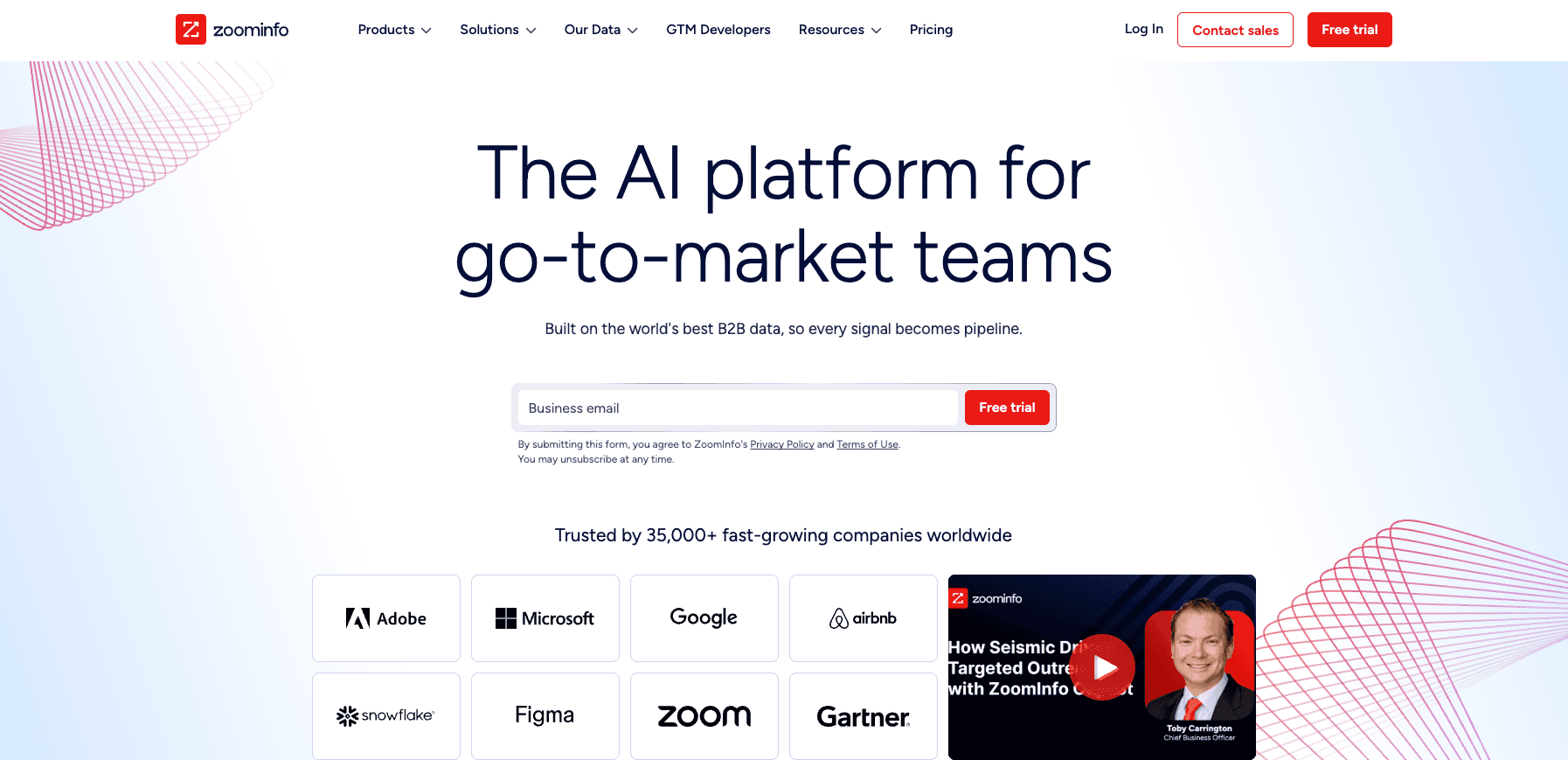
Contact data. WhiteWhale does not provide emails, phone numbers, direct dials, or any contact information. If you do not have a contact data provider, you need one. ZoomInfo is the strongest option for US and global coverage. Cognism is the strongest for EMEA. Apollo is the most affordable. WhiteWhale integrates with all of them but replaces none of them.
Firmographic and technographic data. ZoomInfo provides company size, revenue, industry, technology stack, org charts, and 65+ filterable attributes. WhiteWhale does not provide any company data enrichment.
Website visitor identification (WebSights). ZoomInfo identifies companies visiting your website at the account level. WhiteWhale does not track website visitors.
Conversation intelligence (Chorus). ZoomInfo includes Chorus for recording, transcribing, and analyzing sales calls. WhiteWhale does not offer conversation intelligence.
GTM Studio. ZoomInfo’s orchestration workspace lets RevOps teams build GTM plays with waterfall enrichment across 25+ vendors, audience building, and automated activation triggers. WhiteWhale is a signal platform, not an orchestration layer.
Ad targeting. ZoomInfo offers display advertising capabilities through its DSP. WhiteWhale does not run ads.
Enterprise scale and analyst validation. ZoomInfo has 35,000+ customers, $1.24B in annual revenue (2025), Forrester Wave Leader designation, and the largest installed base in B2B sales intelligence. WhiteWhale is two bootstrapped founders with 715+ sellers, no VC, and no analyst coverage.
What WhiteWhale Does That ZoomInfo Does Not
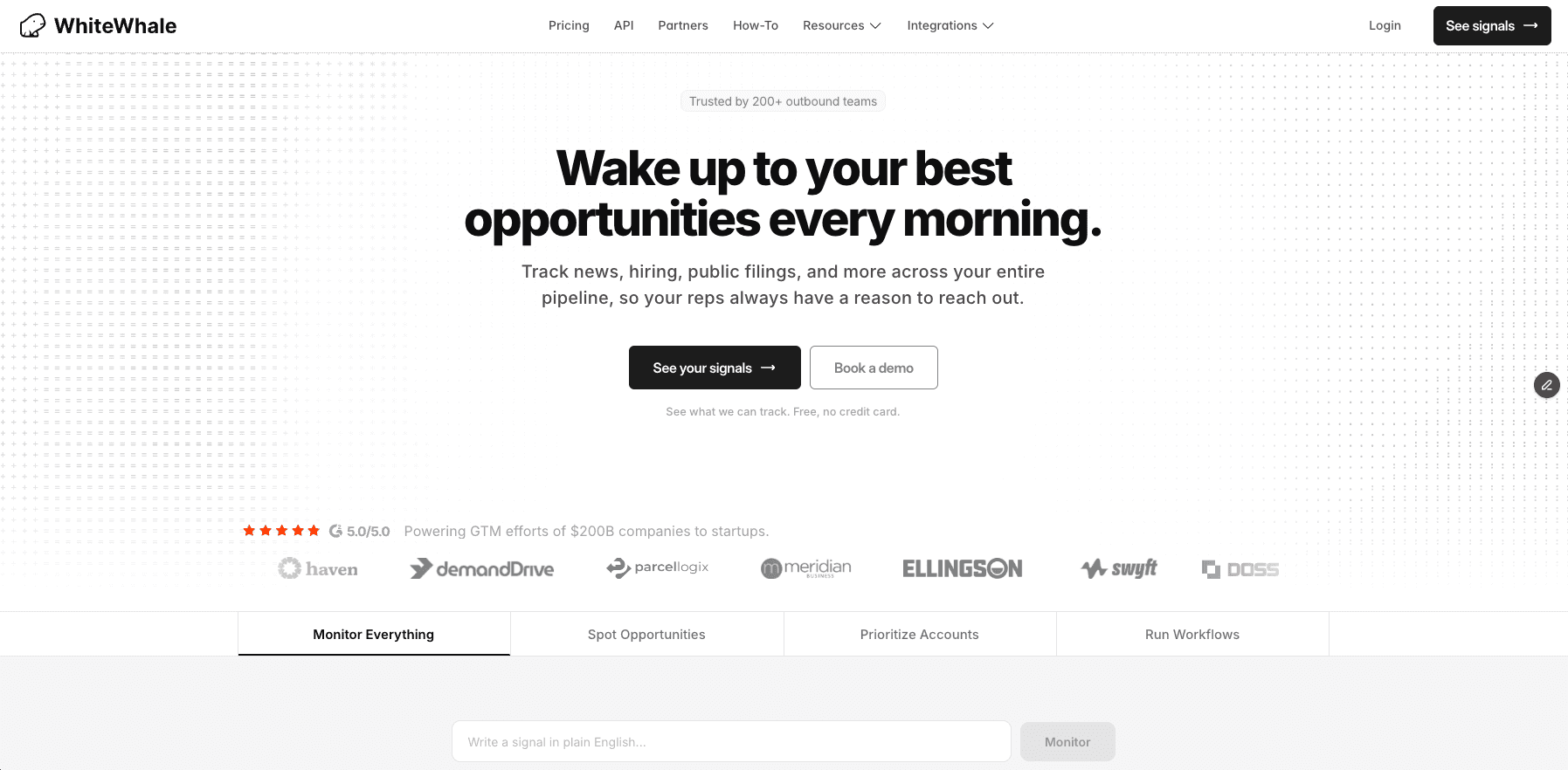
Custom signals specific to just your business. You write a signal like “company mentions migrating from on-premise infrastructure to cloud on an earnings call” or “company posts a VP of Data Engineering role that mentions building a new data platform.” ZoomInfo does not let you define custom signals. It offers pre-built topic categories (Bombora-powered) and Scoops (human-researched buying hints). Both are useful but not customizable to your specific business.
Source verification on every result. Every WhiteWhale signal includes a linked source, direct quotes from the original document, and cited facts. Your rep clicks the link, reads the earnings call transcript or press release, and references the specific detail on the call. ZoomInfo’s intent data provides an account-level score with no linked source. Scoops provide brief human-written summaries but not the level of source detail WhiteWhale delivers.
Earnings call transcript monitoring. WhiteWhale reads quarterly earnings call transcripts and matches them against your signal definitions. When a CFO discusses increasing CapEx, launching a new division, or investing in a specific technology area, WhiteWhale catches it. ZoomInfo does not monitor earnings calls.
SEC filing monitoring. WhiteWhale monitors 10-K, 10-Q, and 8-K filings for signals like executive changes, material events, strategic shifts, and financial disclosures. ZoomInfo does not parse SEC filings.
Signal stacking with “Why Now” narratives. WhiteWhale combines multiple signals per account into a single story: “Acme Corp increased cloud CapEx 40% (earnings call), posted 12 cloud architect roles (job postings), and their new CTO previously led cloud migration at [prior company] (news).” Accounts with 2+ stacked signals close at 2.1x the baseline win rate. ZoomInfo does not stack signals into narratives.
Revenue validation. WhiteWhale lets you test which signal patterns predict pipeline for your specific team by comparing signal data against your closed-won deals. ZoomInfo does not offer signal-to-revenue correlation testing.
$200/month with no annual contract. ZoomInfo’s entry point is approximately $15,000/year with annual auto-renewal. WhiteWhale starts at $200/month, month-to-month, with unlimited users and no per-seat pricing.
How Teams Use Both Together
The most common workflow for teams running WhiteWhale and ZoomInfo together:
Step 1: WhiteWhale identifies which accounts to prioritize and why. Custom signals fire daily. The rep receives a Slack notification: “3 new signals on Acme Corp.” They see the earnings call quote about cloud investment, the job postings for cloud engineers, and the press release about a new data center. Each signal has a linked source.
Step 2: ZoomInfo provides the contacts to reach. The rep pulls up Acme Corp in ZoomInfo. They find the VP of Cloud Infrastructure (direct dial), the CTO (verified email), and two Directors of Engineering (LinkedIn profiles). They see the org chart, tech stack, and firmographic data.
Step 3: The rep reaches out with signal-referenced context. “Hi [Name], I saw your CFO mentioned on the Q2 call that Acme is increasing cloud infrastructure spending 40% year-over-year to support your data center expansion, and your team posted 12 cloud architect roles last month. Companies scaling cloud investment at that pace typically need [your solution] for [specific requirement]. Would that be relevant?”
That email stacks two verifiable signals (earnings call quote plus job posting data) with a contact sourced from ZoomInfo. The rep did not send a generic “I help companies like yours” message. They referenced specific, verifiable facts about the company’s stated priorities.
Without WhiteWhale: The rep has 500 accounts in ZoomInfo with contacts for all of them. They pick accounts to call based on gut feel, alphabetical order, or a vague intent score they cannot verify. Outreach is generic.
Without ZoomInfo: The rep knows exactly which 15 accounts to call and has a verified reason for each one. But they do not have the VP of Cloud Infrastructure’s direct dial. They spend 20 minutes on LinkedIn trying to find the right person.
With both: The rep knows which 15 accounts to call, has a verified reason for each one, and has the direct dial. They make 15 high-quality calls in the time it would have taken to make 5.
Pricing: What the Combined Stack Costs
Component | Cost | What You Get |
|---|---|---|
ZoomInfo (entry) | ~$15,000/yr | Contact data, firmographics, technographics, basic intent |
ZoomInfo (mid-market typical) | ~$25,000 to $40,000/yr | Above plus Scoops, deeper intent, more credits |
WhiteWhale | $2,400/yr ($200/mo) | 35 custom signals, source verification, signal stacking, revenue validation |
Combined (entry) | ~$17,400/yr | Contacts + verified custom signals |
Combined (mid-market) | ~$27,400 to $42,400/yr | Full ZoomInfo + verified custom signals |
WhiteWhale adds less than 10% to the cost of a typical ZoomInfo contract while solving the problem ZoomInfo does not: telling your reps exactly which accounts to prioritize and giving them a verifiable reason to call.
For comparison, adding 6sense on top of ZoomInfo (which some enterprise teams do) costs $60,000 to $175,000/year and still does not provide source-verified signals or custom signal definitions.
What About ZoomInfo’s Own Intent Data?
ZoomInfo includes intent data through two channels:
Bombora-powered topic intent. ZoomInfo licenses Bombora’s publisher co-op data and surfaces it as account-level topic surges. This is the same co-op data available through Bombora directly (and resold by Apollo, Cognism, and others). It tells you an account is “researching cloud migration” but not why, not which person, and not with any source your rep can verify.
Scoops. ZoomInfo’s proprietary human-researched intelligence. Scoops are brief summaries of upcoming projects, leadership changes, and company initiatives gathered by surveying knowledge workers. These are more specific than topic surges and are unique to ZoomInfo, but they are not customizable to your business and do not include linked sources with direct quotes.
Both are useful as general prioritization layers. Neither lets you define a signal like “company mentions expanding European operations on an earnings call” and get back the exact transcript quote with a link to the source.
WhiteWhale does not replace ZoomInfo’s intent. It adds a layer of custom, source-verified signals on top of it. Teams that use both often find that WhiteWhale signals identify accounts 2 to 4 weeks before ZoomInfo’s Bombora data flags the same companies, because earnings call disclosures and job postings precede the content consumption that Bombora’s publisher network detects.
Customer Results
Justin Ager, Strategic Growth Manager at Kaleris, saw ROI in five days: “You close one deal and it’s paid for itself. If you try to track this on your own, you’re going to miss stuff. You miss a lot less with WhiteWhale.”
Beau Blanchard at Gravitate chose WhiteWhale over ZoomInfo (for signals), Clay, and other signal companies: “Having a system that scrapes SEC filings, company posts, and job postings gives us a much warmer approach than ‘Hey, thanks for looking at our website today.’” Gravitate uses ZoomInfo for contacts and WhiteWhale for signals.
Nicholas de la Guardia at Simpli discovered 279 accounts he had never seen before in 30 minutes using WhiteWhale’s ICP Account Discovery. These were companies already showing buying signals that were not in his CRM or his ZoomInfo saved searches.
Meridian Business prioritized 2,800 accounts in 24 hours using WhiteWhale, turning a large account list from ZoomInfo into a ranked, signal-prioritized pipeline. Read the case study.
How to Get Started
If you already use ZoomInfo, adding WhiteWhale takes 15 minutes:
Go to app.getwhitewhale.com/onboarding and see what custom signals are possible for your ICP. This is free, no credit card required.
Write your first 5 to 10 signal definitions in plain English. Describe what a buying moment looks like for your product. WhiteWhale starts monitoring immediately.
Connect to Slack or your CRM so signals arrive where your reps already work. 90% of WhiteWhale users never log into the platform directly.
When a signal fires, pull up the account in ZoomInfo. Find the right contact. Reference the signal in your outreach.
Plans start at $200/month. No annual contract. No per-seat pricing. Unlimited users. Month-to-month.
For a broader comparison of how WhiteWhale fits into the sales intelligence platform landscape, see our full 11-platform ranking. For a detailed comparison with 6sense specifically, see WhiteWhale vs 6sense.
FAQ
Does WhiteWhale replace ZoomInfo?
No. WhiteWhale does not provide contact data, phone numbers, email addresses, firmographics, technographics, or any of the core capabilities ZoomInfo delivers. WhiteWhale tells you which accounts to prioritize and gives your reps a verified reason to call. ZoomInfo gives you the contact details to reach the right person. Most WhiteWhale customers use both.
Why would I add WhiteWhale if I already have ZoomInfo’s intent data?
ZoomInfo’s intent data (Bombora topic surges and Scoops) tells you an account is “researching” a topic but does not let you define custom signals, does not provide linked sources with direct quotes, and does not monitor earnings call transcripts or SEC filings. WhiteWhale adds the “why now” layer: custom signals specific to your business with source verification your reps can reference on calls. WhiteWhale signals often identify accounts 2 to 4 weeks before Bombora flags them because earnings call disclosures and job postings precede publisher-network content consumption.
How much does WhiteWhale cost on top of ZoomInfo?
WhiteWhale starts at $200/month ($2,400/year) with no annual contract and unlimited users. That is less than 10% of a typical mid-market ZoomInfo contract. Most small teams of 5 to 10 reps pay $500 to $1,000/month depending on signal volume and account coverage.
Can I use WhiteWhale with Apollo or Cognism instead of ZoomInfo?
Yes. WhiteWhale pairs with any contact data provider. If you use Apollo for contacts and outreach, Cognism for European phone-verified data, or Lusha for quick lookups, WhiteWhale delivers signals the same way. The platform is contact-provider agnostic by design.
What does the combined workflow look like day to day?
Your rep starts the day by checking Slack or their CRM for new WhiteWhale signals. They see which accounts showed buying behavior overnight: earnings call mentions, new job postings, press releases, SEC filings. They pull up those accounts in ZoomInfo to find the right contacts. They write outreach that references the specific signal with a linked source. The result is 10 to 15 high-quality, signal-informed touches per day instead of 50 generic ones. Accounts with 2+ stacked signals close at 2.1x the baseline win rate.
Sources: ZoomInfo database size, direct dials, and revenue from ZoomInfo SEC filings and product pages (2025-2026). ZoomInfo pricing estimates from Vendr, Landbase, Artisan, Factors.ai, and Cleanlist (March to August 2026). ZoomInfo GTM Studio review from OutboundSalesTools (2026). Forrester Wave Intent Data Providers Q1 2025 (ZoomInfo Leader designation). ZoomInfo GTM.AI and hybrid pricing model announcement from Q1 2026 earnings call. WhiteWhale internal data (customer results, signal stacking win rates, signal timing vs. Bombora detection).
About the author
Jack Porter is Co-Founder of WhiteWhale, a buying signal platform for B2B sales teams. Since 2025, Jack has spoken with 1,875 sales, GTM, and marketing leaders about their technology stack, what signals actually drive pipeline, and where intent data falls short. Those conversations informed every recommendation on this page. He can be reached on LinkedIn.
Most WhiteWhale customers also use ZoomInfo. That is not a competitive problem. It is by design.
ZoomInfo is the largest B2B contact database in the world: 500M+ contacts, 135M+ verified phone numbers, 120M direct dials, 200M+ verified business emails. It tells you who works at a company and how to reach them. WhiteWhale tells you which companies your reps should call this week and gives them a verified reason to call. One answers “who do I contact?” The other answers “why should I contact them today?”
This post explains what each platform does, where they overlap, where they do not, and how teams that use both get results that neither delivers alone.
WhiteWhale vs ZoomInfo: Quick Comparison
Factor | WhiteWhale | ZoomInfo |
|---|---|---|
Core purpose | Custom buying signals with source verification | B2B contact database and sales intelligence |
What it answers | “Which accounts should I call and why?” | “Who works there and how do I reach them?” |
Starting price | $200/mo, month-to-month | ~$15K/yr minimum (quote-based) |
Contract | Month-to-month, no annual required | Annual, auto-renewal |
Contact database | No | Yes (500M+ contacts, 120M direct dials) |
Email data | No | Yes (200M+ verified) |
Phone data | No | Yes (135M+ verified) |
Custom signals | Yes (35 signals in plain English) | No |
Event-based: SEC filings, earnings calls, job postings, news, LinkedIn | Topic-based: Bombora-powered + proprietary Scoops | |
Source verification | Yes (linked source, quotes, cited facts) | No (account-level scores) |
Signal stacking | Yes (2.1x win rate with 2+ signals) | No |
Earnings call monitoring | Yes | No |
SEC filing monitoring | Yes | No |
Job posting analysis | Yes (ATS-level detail from Greenhouse, Lever, Workday) | Yes (basic) |
Revenue validation | Yes (test signals against closed-won data) | No |
CRM integration | All plans (HubSpot, Salesforce, Slack, Teams) | All plans (Salesforce, HubSpot, Dynamics + 120+ integrations) |
Setup time | 15 minutes | Weeks (enterprise onboarding) |
Per-seat pricing | No (unlimited users) | Yes |
G2 rating | N/A (newer platform) | 4.5/5 (9,000+ reviews) |
Best for | Knowing why to call | Knowing who to call |
Why They Are Not Competitors
The question “should I use WhiteWhale or ZoomInfo?” is like asking “should I use a GPS or a car?” You need both to get where you are going.
ZoomInfo solves the contact problem. Your rep identifies a target account. They need the VP of Engineering’s direct dial, the CFO’s verified email, the org chart, the tech stack, and the firmographic data. ZoomInfo provides all of that better than any other platform on the market. 500M+ contacts. 120M direct dials. 300+ human researchers maintaining data quality. Forrester Wave Leader for Intent Data Providers in Q1 2025. This is not a tool you replace.
WhiteWhale solves the timing and prioritization problem. Your rep has 500 accounts in their book. ZoomInfo gives them contacts at all 500. But which 15 should they call this week? And what should they say? ZoomInfo’s intent data (Bombora-powered topic surges plus proprietary Scoops) provides account-level scores, but no linked source, no direct quote, no verifiable evidence the rep can reference.
WhiteWhale monitors SEC filings, earnings call transcripts, job postings from ATS systems, 8,000+ news feeds, press releases, and company LinkedIn posts. When a signal fires, the rep gets a linked source with direct quotes. “Acme Corp’s CFO said on the Q2 earnings call that they are ‘increasing cloud infrastructure spending by 40% year-over-year to support our data center expansion.’” That is not a score. That is a reason to call.
What ZoomInfo Does That WhiteWhale Does Not
Contact data. WhiteWhale does not provide emails, phone numbers, direct dials, or any contact information. If you do not have a contact data provider, you need one. ZoomInfo is the strongest option for US and global coverage. Cognism is the strongest for EMEA. Apollo is the most affordable. WhiteWhale integrates with all of them but replaces none of them.
Firmographic and technographic data. ZoomInfo provides company size, revenue, industry, technology stack, org charts, and 65+ filterable attributes. WhiteWhale does not provide any company data enrichment.
Website visitor identification (WebSights). ZoomInfo identifies companies visiting your website at the account level. WhiteWhale does not track website visitors.
Conversation intelligence (Chorus). ZoomInfo includes Chorus for recording, transcribing, and analyzing sales calls. WhiteWhale does not offer conversation intelligence.
GTM Studio. ZoomInfo’s orchestration workspace lets RevOps teams build GTM plays with waterfall enrichment across 25+ vendors, audience building, and automated activation triggers. WhiteWhale is a signal platform, not an orchestration layer.
Ad targeting. ZoomInfo offers display advertising capabilities through its DSP. WhiteWhale does not run ads.
Enterprise scale and analyst validation. ZoomInfo has 35,000+ customers, $1.24B in annual revenue (2025), Forrester Wave Leader designation, and the largest installed base in B2B sales intelligence. WhiteWhale is two bootstrapped founders with 715+ sellers, no VC, and no analyst coverage.
What WhiteWhale Does That ZoomInfo Does Not
Custom signals specific to just your business. You write a signal like “company mentions migrating from on-premise infrastructure to cloud on an earnings call” or “company posts a VP of Data Engineering role that mentions building a new data platform.” ZoomInfo does not let you define custom signals. It offers pre-built topic categories (Bombora-powered) and Scoops (human-researched buying hints). Both are useful but not customizable to your specific business.
Source verification on every result. Every WhiteWhale signal includes a linked source, direct quotes from the original document, and cited facts. Your rep clicks the link, reads the earnings call transcript or press release, and references the specific detail on the call. ZoomInfo’s intent data provides an account-level score with no linked source. Scoops provide brief human-written summaries but not the level of source detail WhiteWhale delivers.
Earnings call transcript monitoring. WhiteWhale reads quarterly earnings call transcripts and matches them against your signal definitions. When a CFO discusses increasing CapEx, launching a new division, or investing in a specific technology area, WhiteWhale catches it. ZoomInfo does not monitor earnings calls.
SEC filing monitoring. WhiteWhale monitors 10-K, 10-Q, and 8-K filings for signals like executive changes, material events, strategic shifts, and financial disclosures. ZoomInfo does not parse SEC filings.
Signal stacking with “Why Now” narratives. WhiteWhale combines multiple signals per account into a single story: “Acme Corp increased cloud CapEx 40% (earnings call), posted 12 cloud architect roles (job postings), and their new CTO previously led cloud migration at [prior company] (news).” Accounts with 2+ stacked signals close at 2.1x the baseline win rate. ZoomInfo does not stack signals into narratives.
Revenue validation. WhiteWhale lets you test which signal patterns predict pipeline for your specific team by comparing signal data against your closed-won deals. ZoomInfo does not offer signal-to-revenue correlation testing.
$200/month with no annual contract. ZoomInfo’s entry point is approximately $15,000/year with annual auto-renewal. WhiteWhale starts at $200/month, month-to-month, with unlimited users and no per-seat pricing.
How Teams Use Both Together
The most common workflow for teams running WhiteWhale and ZoomInfo together:
Step 1: WhiteWhale identifies which accounts to prioritize and why. Custom signals fire daily. The rep receives a Slack notification: “3 new signals on Acme Corp.” They see the earnings call quote about cloud investment, the job postings for cloud engineers, and the press release about a new data center. Each signal has a linked source.
Step 2: ZoomInfo provides the contacts to reach. The rep pulls up Acme Corp in ZoomInfo. They find the VP of Cloud Infrastructure (direct dial), the CTO (verified email), and two Directors of Engineering (LinkedIn profiles). They see the org chart, tech stack, and firmographic data.
Step 3: The rep reaches out with signal-referenced context. “Hi [Name], I saw your CFO mentioned on the Q2 call that Acme is increasing cloud infrastructure spending 40% year-over-year to support your data center expansion, and your team posted 12 cloud architect roles last month. Companies scaling cloud investment at that pace typically need [your solution] for [specific requirement]. Would that be relevant?”
That email stacks two verifiable signals (earnings call quote plus job posting data) with a contact sourced from ZoomInfo. The rep did not send a generic “I help companies like yours” message. They referenced specific, verifiable facts about the company’s stated priorities.
Without WhiteWhale: The rep has 500 accounts in ZoomInfo with contacts for all of them. They pick accounts to call based on gut feel, alphabetical order, or a vague intent score they cannot verify. Outreach is generic.
Without ZoomInfo: The rep knows exactly which 15 accounts to call and has a verified reason for each one. But they do not have the VP of Cloud Infrastructure’s direct dial. They spend 20 minutes on LinkedIn trying to find the right person.
With both: The rep knows which 15 accounts to call, has a verified reason for each one, and has the direct dial. They make 15 high-quality calls in the time it would have taken to make 5.
Pricing: What the Combined Stack Costs
Component | Cost | What You Get |
|---|---|---|
ZoomInfo (entry) | ~$15,000/yr | Contact data, firmographics, technographics, basic intent |
ZoomInfo (mid-market typical) | ~$25,000 to $40,000/yr | Above plus Scoops, deeper intent, more credits |
WhiteWhale | $2,400/yr ($200/mo) | 35 custom signals, source verification, signal stacking, revenue validation |
Combined (entry) | ~$17,400/yr | Contacts + verified custom signals |
Combined (mid-market) | ~$27,400 to $42,400/yr | Full ZoomInfo + verified custom signals |
WhiteWhale adds less than 10% to the cost of a typical ZoomInfo contract while solving the problem ZoomInfo does not: telling your reps exactly which accounts to prioritize and giving them a verifiable reason to call.
For comparison, adding 6sense on top of ZoomInfo (which some enterprise teams do) costs $60,000 to $175,000/year and still does not provide source-verified signals or custom signal definitions.
What About ZoomInfo’s Own Intent Data?
ZoomInfo includes intent data through two channels:
Bombora-powered topic intent. ZoomInfo licenses Bombora’s publisher co-op data and surfaces it as account-level topic surges. This is the same co-op data available through Bombora directly (and resold by Apollo, Cognism, and others). It tells you an account is “researching cloud migration” but not why, not which person, and not with any source your rep can verify.
Scoops. ZoomInfo’s proprietary human-researched intelligence. Scoops are brief summaries of upcoming projects, leadership changes, and company initiatives gathered by surveying knowledge workers. These are more specific than topic surges and are unique to ZoomInfo, but they are not customizable to your business and do not include linked sources with direct quotes.
Both are useful as general prioritization layers. Neither lets you define a signal like “company mentions expanding European operations on an earnings call” and get back the exact transcript quote with a link to the source.
WhiteWhale does not replace ZoomInfo’s intent. It adds a layer of custom, source-verified signals on top of it. Teams that use both often find that WhiteWhale signals identify accounts 2 to 4 weeks before ZoomInfo’s Bombora data flags the same companies, because earnings call disclosures and job postings precede the content consumption that Bombora’s publisher network detects.
Customer Results
Justin Ager, Strategic Growth Manager at Kaleris, saw ROI in five days: “You close one deal and it’s paid for itself. If you try to track this on your own, you’re going to miss stuff. You miss a lot less with WhiteWhale.”
Beau Blanchard at Gravitate chose WhiteWhale over ZoomInfo (for signals), Clay, and other signal companies: “Having a system that scrapes SEC filings, company posts, and job postings gives us a much warmer approach than ‘Hey, thanks for looking at our website today.’” Gravitate uses ZoomInfo for contacts and WhiteWhale for signals.
Nicholas de la Guardia at Simpli discovered 279 accounts he had never seen before in 30 minutes using WhiteWhale’s ICP Account Discovery. These were companies already showing buying signals that were not in his CRM or his ZoomInfo saved searches.
Meridian Business prioritized 2,800 accounts in 24 hours using WhiteWhale, turning a large account list from ZoomInfo into a ranked, signal-prioritized pipeline. Read the case study.
How to Get Started
If you already use ZoomInfo, adding WhiteWhale takes 15 minutes:
Go to app.getwhitewhale.com/onboarding and see what custom signals are possible for your ICP. This is free, no credit card required.
Write your first 5 to 10 signal definitions in plain English. Describe what a buying moment looks like for your product. WhiteWhale starts monitoring immediately.
Connect to Slack or your CRM so signals arrive where your reps already work. 90% of WhiteWhale users never log into the platform directly.
When a signal fires, pull up the account in ZoomInfo. Find the right contact. Reference the signal in your outreach.
Plans start at $200/month. No annual contract. No per-seat pricing. Unlimited users. Month-to-month.
For a broader comparison of how WhiteWhale fits into the sales intelligence platform landscape, see our full 11-platform ranking. For a detailed comparison with 6sense specifically, see WhiteWhale vs 6sense.
FAQ
Does WhiteWhale replace ZoomInfo?
No. WhiteWhale does not provide contact data, phone numbers, email addresses, firmographics, technographics, or any of the core capabilities ZoomInfo delivers. WhiteWhale tells you which accounts to prioritize and gives your reps a verified reason to call. ZoomInfo gives you the contact details to reach the right person. Most WhiteWhale customers use both.
Why would I add WhiteWhale if I already have ZoomInfo’s intent data?
ZoomInfo’s intent data (Bombora topic surges and Scoops) tells you an account is “researching” a topic but does not let you define custom signals, does not provide linked sources with direct quotes, and does not monitor earnings call transcripts or SEC filings. WhiteWhale adds the “why now” layer: custom signals specific to your business with source verification your reps can reference on calls. WhiteWhale signals often identify accounts 2 to 4 weeks before Bombora flags them because earnings call disclosures and job postings precede publisher-network content consumption.
How much does WhiteWhale cost on top of ZoomInfo?
WhiteWhale starts at $200/month ($2,400/year) with no annual contract and unlimited users. That is less than 10% of a typical mid-market ZoomInfo contract. Most small teams of 5 to 10 reps pay $500 to $1,000/month depending on signal volume and account coverage.
Can I use WhiteWhale with Apollo or Cognism instead of ZoomInfo?
Yes. WhiteWhale pairs with any contact data provider. If you use Apollo for contacts and outreach, Cognism for European phone-verified data, or Lusha for quick lookups, WhiteWhale delivers signals the same way. The platform is contact-provider agnostic by design.
What does the combined workflow look like day to day?
Your rep starts the day by checking Slack or their CRM for new WhiteWhale signals. They see which accounts showed buying behavior overnight: earnings call mentions, new job postings, press releases, SEC filings. They pull up those accounts in ZoomInfo to find the right contacts. They write outreach that references the specific signal with a linked source. The result is 10 to 15 high-quality, signal-informed touches per day instead of 50 generic ones. Accounts with 2+ stacked signals close at 2.1x the baseline win rate.
Sources: ZoomInfo database size, direct dials, and revenue from ZoomInfo SEC filings and product pages (2025-2026). ZoomInfo pricing estimates from Vendr, Landbase, Artisan, Factors.ai, and Cleanlist (March to August 2026). ZoomInfo GTM Studio review from OutboundSalesTools (2026). Forrester Wave Intent Data Providers Q1 2025 (ZoomInfo Leader designation). ZoomInfo GTM.AI and hybrid pricing model announcement from Q1 2026 earnings call. WhiteWhale internal data (customer results, signal stacking win rates, signal timing vs. Bombora detection).
About the author
Jack Porter is Co-Founder of WhiteWhale, a buying signal platform for B2B sales teams. Since 2025, Jack has spoken with 1,875 sales, GTM, and marketing leaders about their technology stack, what signals actually drive pipeline, and where intent data falls short. Those conversations informed every recommendation on this page. He can be reached on LinkedIn.

Almost everyone says
"Wait…you can track THAT?"
See your signals for free. No credit card required.
Almost everyone says
"Wait…you can track THAT?"
See your signals for free. No credit card required.