
If you're reading this, you're probably evaluating whether to stick with 6sense, switch to something else, or try a completely different approach to finding in-market accounts.
We're not going to pretend we're unbiased. We built WhiteWhale because we believe the intent data model is fundamentally broken. But we'll be specific about why, show you exactly how the two products differ, and let you decide.
The core difference put simply
6sense tracks anonymous website visitors across a network of B2B publishers and assigns topic-level "intent scores" to accounts. WhiteWhale lets you write custom buying signals in plain English and monitors real public events to find matches with verifiable sources attached.
Same category on paper. Completely different products in practice.
Dimension | 6sense | WhiteWhale |
|---|---|---|
What it tracks | Anonymous IP visits to publisher network | Real public events (SEC filings, earnings calls, job postings, press releases) |
Signal type | Pre-built topic library ("Cloud Security") | Custom signals you write in plain English |
Source verification | No, black-box score | Yes, linked source with direct quotes |
Exclusivity | Same data sold to every customer | No other team will have your signals. |
Account discovery | Scores accounts you already have | Discovers net-new accounts matching your ICP |
Setup time | 3 to 6 months typical | About 15 minutes |
Contract | Annual, $50K to $100K+/yr | Month-to-month from $200/mo |
Revenue validation | No | Signals tested against your closed-won deals |
How 6sense works
6sense operates an intent data network. When someone at a company visits a blog post on a publisher's site that's part of the 6sense network, 6sense uses reverse IP lookup to identify the company and logs that visit as "intent" for a particular topic.
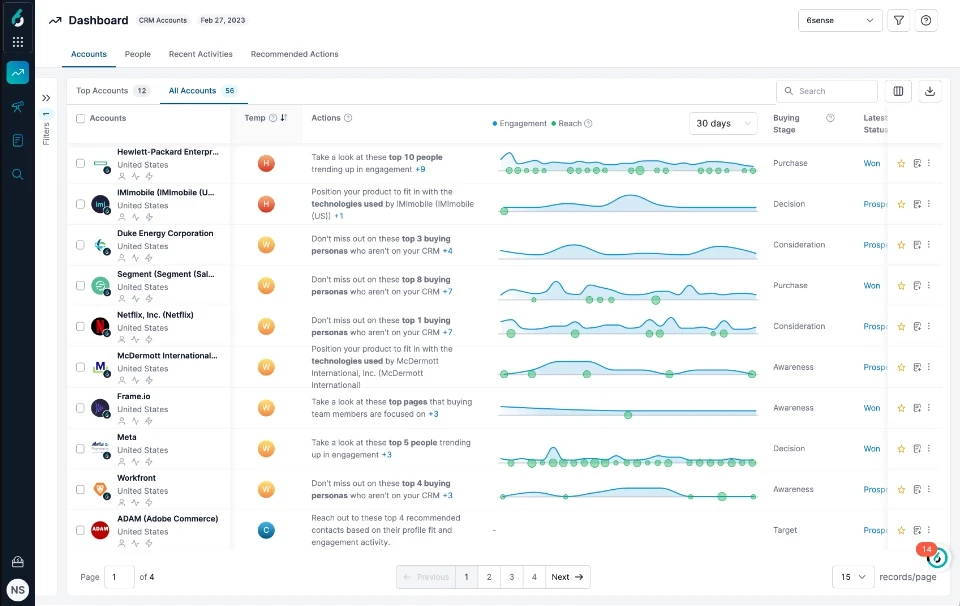
Over time, if enough people from the same company visit content about a topic (say, "CRM software"), 6sense marks that account as "in-market" for CRM software and assigns an intent score.
The core problem: the same data is sold to every 6sense customer. If you and your three biggest competitors all use 6sense, you're all seeing the same accounts "surging" for the same topics. Nobody has an advantage.
How WhiteWhale works
WhiteWhale doesn't track website visitors at all. Instead, you write the specific questions that indicate an account is ready to buy your product in plain English.
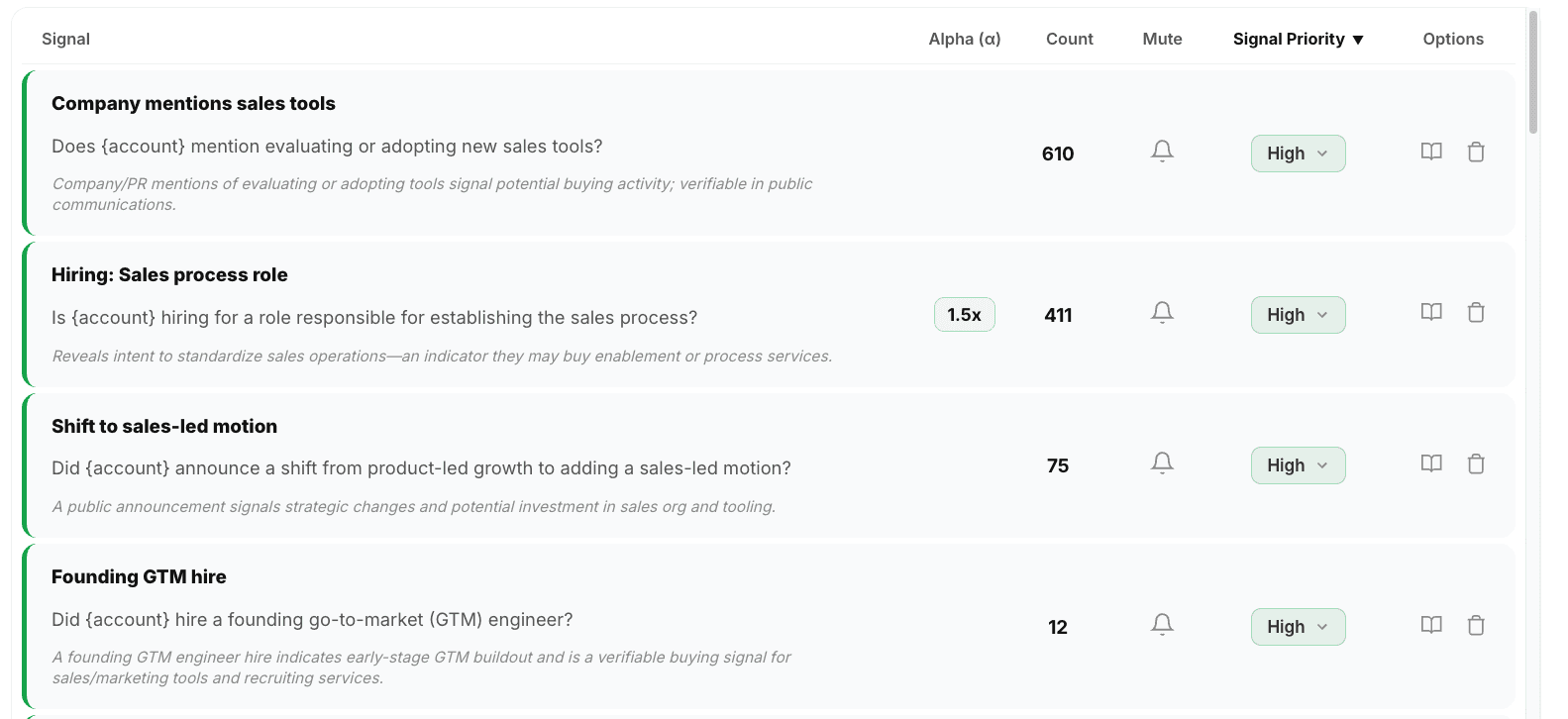
For example: "Did leadership publicly commit to replacing manual processes with automation?" or "Is this company hiring for roles that only exist if they're deploying our category?"
You write up to 35 of these signals. WhiteWhale then monitors thousands of public sources daily, SEC filings, earnings call transcripts, job postings from the company's own ATS, press releases, news coverage, and company social posts to find matches.
Every result comes with the original source, direct quotes, and cited facts. Your rep can verify any signal before picking up the phone.
The key differences
Your signals vs their topics
6sense gives you a library of pre-built intent topics. You pick from their list — "Cloud Computing," "Data Analytics," "Sales Enablement." These are broad categories that thousands of other customers are also selecting.
WhiteWhale lets you write the exact questions that matter to your specific sales motion. Nobody else sees your signals. A cybersecurity company and a manufacturing automation company would have completely different signal sets — even if they're both WhiteWhale customers.
Verified sources vs black-box scores
When 6sense tells you an account is "surging," you get a score. You don't get the source. You can't verify it. You can't reference it on a call.
When WhiteWhale fires a signal, you get the original source linked, the relevant quote pulled out, and the context explained. Your rep can say "I saw your CEO mentioned X at the Q1 earnings call" — that's a conversation starter. "Our system shows you're surging for data analytics" is not.
Signal stacking vs single scores
6sense gives you one intent score per account, a number that goes up or down. You don't know what's behind it.
WhiteWhale stacks multiple signals per account and connects them into a "Why Now" story. An account might have three signals firing simultaneously: new CIO appointed, 6 automation roles posted in 3 weeks, and CEO mandated company-wide AI deployment. Each one is individually sourced. Together, they tell a story that makes your outreach impossible to ignore.
Finding new accounts vs scoring existing ones
6sense primarily scores accounts you already know about. Their "predictive" features try to identify in-market accounts, but they're limited to companies that show activity across their publisher network.
WhiteWhale discovers net-new accounts by scanning for companies that match your ICP filters AND already have active signal activity. You find companies you've never heard of that are already showing buying behavior specific to your product.
Setup time
6sense typically requires a 6-month implementation with a dedicated CSM, data mapping, and a "learning period" before the model produces useful results.
WhiteWhale takes about 15 minutes. Write your signals, connect your CRM, and WhiteWhale runs a 90-day historical sweep immediately. Your reps have accounts to call before the end of the hour.
Pricing model
6sense contracts typically run $40K–$120K+ per year with annual commitments. Pricing is opaque and varies by company size and modules.
WhiteWhale is all month-to-month, you can have the system generate a list of signal without a credit card before you even buy. Paid plans are flat monthly fees, starting at $200/month with most teams averaging around $1,000/month with unlimited users and no per-seat pricing. No annual lock-in.
When 6sense might be the better fit
If your primary need is account-level advertising (serving targeted ads to in-market accounts), 6sense has a mature ad platform that WhiteWhale doesn't offer. If your marketing team runs large ABM campaigns and needs to orchestrate multi-channel ads based on intent data, 6sense's advertising capabilities are a differentiator.
If you're a very large enterprise (5,000+ employees) with a dedicated RevOps team that can manage a complex implementation and you need intent data integrated into a broader marketing automation stack, 6sense's ecosystem may have advantages.
When WhiteWhale is the better fit
If your sales team is outbound-first and needs specific, verifiable reasons to reach out to accounts, not vague intent scores, WhiteWhale gives your reps something they can actually use on a call.
If you're frustrated with intent data that tells you an account is "surging" but can't tell you why, WhiteWhale shows you exactly what happened, when, and where the source is.
If you sell to mid-market or enterprise companies (100+ employees) and your reps are consultative, they show up with homework done, not a generic pitch, WhiteWhale gives them the homework.
If you want to discover accounts you don't know about yet, not just score the ones you already have, WhiteWhale's account discovery finds companies matching your ICP with active signals.
If you need to be live in days, not months, and you don't want to commit to a $40K+ annual contract before seeing value.
What our customers say about switching
Justin Ager, Strategic Growth Manager at Kaleris, switched to WhiteWhale and saw ROI in 5 days: "You close one deal and it's paid for itself. If you try to track this on your own, you're going to miss stuff. You miss a lot less with WhiteWhale."
Beau Blanchard at Gravitate evaluated ZoomInfo, Clay, and other signal companies before choosing WhiteWhale: "Having a system that scrapes SEC filings, company posts, and job postings gives us a much warmer approach than 'Hey, thanks for looking at our website today.'"
Try Signals yourself
WhiteWhale is free to test. Write your signals, see what comes back, and decide if verified buying signals beat anonymous intent scores for your team.
No credit card. No 6-month commitment. No sales call required.
See your signals →
About the author
Jack Porter is Co-Founder of WhiteWhale, a buying signal platform for B2B sales teams. Since 2025, Jack has spoken with 1,875 sales, GTM, and marketing leaders about their technology stack, what signals actually drive pipeline, and where intent data falls short. Those conversations informed every recommendation on this page. He can be reached on LinkedIn.
If you're reading this, you're probably evaluating whether to stick with 6sense, switch to something else, or try a completely different approach to finding in-market accounts.
We're not going to pretend we're unbiased. We built WhiteWhale because we believe the intent data model is fundamentally broken. But we'll be specific about why, show you exactly how the two products differ, and let you decide.
The core difference put simply
6sense tracks anonymous website visitors across a network of B2B publishers and assigns topic-level "intent scores" to accounts. WhiteWhale lets you write custom buying signals in plain English and monitors real public events to find matches with verifiable sources attached.
Same category on paper. Completely different products in practice.
Dimension | 6sense | WhiteWhale |
|---|---|---|
What it tracks | Anonymous IP visits to publisher network | Real public events (SEC filings, earnings calls, job postings, press releases) |
Signal type | Pre-built topic library ("Cloud Security") | Custom signals you write in plain English |
Source verification | No, black-box score | Yes, linked source with direct quotes |
Exclusivity | Same data sold to every customer | No other team will have your signals. |
Account discovery | Scores accounts you already have | Discovers net-new accounts matching your ICP |
Setup time | 3 to 6 months typical | About 15 minutes |
Contract | Annual, $50K to $100K+/yr | Month-to-month from $200/mo |
Revenue validation | No | Signals tested against your closed-won deals |
How 6sense works
6sense operates an intent data network. When someone at a company visits a blog post on a publisher's site that's part of the 6sense network, 6sense uses reverse IP lookup to identify the company and logs that visit as "intent" for a particular topic.
Over time, if enough people from the same company visit content about a topic (say, "CRM software"), 6sense marks that account as "in-market" for CRM software and assigns an intent score.
The core problem: the same data is sold to every 6sense customer. If you and your three biggest competitors all use 6sense, you're all seeing the same accounts "surging" for the same topics. Nobody has an advantage.
How WhiteWhale works
WhiteWhale doesn't track website visitors at all. Instead, you write the specific questions that indicate an account is ready to buy your product in plain English.
For example: "Did leadership publicly commit to replacing manual processes with automation?" or "Is this company hiring for roles that only exist if they're deploying our category?"
You write up to 35 of these signals. WhiteWhale then monitors thousands of public sources daily, SEC filings, earnings call transcripts, job postings from the company's own ATS, press releases, news coverage, and company social posts to find matches.
Every result comes with the original source, direct quotes, and cited facts. Your rep can verify any signal before picking up the phone.
The key differences
Your signals vs their topics
6sense gives you a library of pre-built intent topics. You pick from their list — "Cloud Computing," "Data Analytics," "Sales Enablement." These are broad categories that thousands of other customers are also selecting.
WhiteWhale lets you write the exact questions that matter to your specific sales motion. Nobody else sees your signals. A cybersecurity company and a manufacturing automation company would have completely different signal sets — even if they're both WhiteWhale customers.
Verified sources vs black-box scores
When 6sense tells you an account is "surging," you get a score. You don't get the source. You can't verify it. You can't reference it on a call.
When WhiteWhale fires a signal, you get the original source linked, the relevant quote pulled out, and the context explained. Your rep can say "I saw your CEO mentioned X at the Q1 earnings call" — that's a conversation starter. "Our system shows you're surging for data analytics" is not.
Signal stacking vs single scores
6sense gives you one intent score per account, a number that goes up or down. You don't know what's behind it.
WhiteWhale stacks multiple signals per account and connects them into a "Why Now" story. An account might have three signals firing simultaneously: new CIO appointed, 6 automation roles posted in 3 weeks, and CEO mandated company-wide AI deployment. Each one is individually sourced. Together, they tell a story that makes your outreach impossible to ignore.
Finding new accounts vs scoring existing ones
6sense primarily scores accounts you already know about. Their "predictive" features try to identify in-market accounts, but they're limited to companies that show activity across their publisher network.
WhiteWhale discovers net-new accounts by scanning for companies that match your ICP filters AND already have active signal activity. You find companies you've never heard of that are already showing buying behavior specific to your product.
Setup time
6sense typically requires a 6-month implementation with a dedicated CSM, data mapping, and a "learning period" before the model produces useful results.
WhiteWhale takes about 15 minutes. Write your signals, connect your CRM, and WhiteWhale runs a 90-day historical sweep immediately. Your reps have accounts to call before the end of the hour.
Pricing model
6sense contracts typically run $40K–$120K+ per year with annual commitments. Pricing is opaque and varies by company size and modules.
WhiteWhale is all month-to-month, you can have the system generate a list of signal without a credit card before you even buy. Paid plans are flat monthly fees, starting at $200/month with most teams averaging around $1,000/month with unlimited users and no per-seat pricing. No annual lock-in.
When 6sense might be the better fit
If your primary need is account-level advertising (serving targeted ads to in-market accounts), 6sense has a mature ad platform that WhiteWhale doesn't offer. If your marketing team runs large ABM campaigns and needs to orchestrate multi-channel ads based on intent data, 6sense's advertising capabilities are a differentiator.
If you're a very large enterprise (5,000+ employees) with a dedicated RevOps team that can manage a complex implementation and you need intent data integrated into a broader marketing automation stack, 6sense's ecosystem may have advantages.
When WhiteWhale is the better fit
If your sales team is outbound-first and needs specific, verifiable reasons to reach out to accounts, not vague intent scores, WhiteWhale gives your reps something they can actually use on a call.
If you're frustrated with intent data that tells you an account is "surging" but can't tell you why, WhiteWhale shows you exactly what happened, when, and where the source is.
If you sell to mid-market or enterprise companies (100+ employees) and your reps are consultative, they show up with homework done, not a generic pitch, WhiteWhale gives them the homework.
If you want to discover accounts you don't know about yet, not just score the ones you already have, WhiteWhale's account discovery finds companies matching your ICP with active signals.
If you need to be live in days, not months, and you don't want to commit to a $40K+ annual contract before seeing value.
What our customers say about switching
Justin Ager, Strategic Growth Manager at Kaleris, switched to WhiteWhale and saw ROI in 5 days: "You close one deal and it's paid for itself. If you try to track this on your own, you're going to miss stuff. You miss a lot less with WhiteWhale."
Beau Blanchard at Gravitate evaluated ZoomInfo, Clay, and other signal companies before choosing WhiteWhale: "Having a system that scrapes SEC filings, company posts, and job postings gives us a much warmer approach than 'Hey, thanks for looking at our website today.'"
Try Signals yourself
WhiteWhale is free to test. Write your signals, see what comes back, and decide if verified buying signals beat anonymous intent scores for your team.
No credit card. No 6-month commitment. No sales call required.
See your signals →
About the author
Jack Porter is Co-Founder of WhiteWhale, a buying signal platform for B2B sales teams. Since 2025, Jack has spoken with 1,875 sales, GTM, and marketing leaders about their technology stack, what signals actually drive pipeline, and where intent data falls short. Those conversations informed every recommendation on this page. He can be reached on LinkedIn.

Almost everyone says
"Wait…you can track THAT?"
See your signals for free. No credit card required.
Almost everyone says
"Wait…you can track THAT?"
See your signals for free. No credit card required.