
Most sales intelligence listicles are written by the vendors themselves. ZoomInfo’s version puts ZoomInfo first. Amplemarket’s version puts Amplemarket first. Each one ranks their own product #1 across their own scoring criteria.
We’re taking a different approach. Instead of scoring platforms against a framework we invented, we’ll make one distinction the other lists skip: the difference between intent data and buying signals. These are the two main categories of sales intelligence, however they’re not the same thing, and which one you choose determines whether your reps get vague scores or verifiable reasons to pick up the phone.
Sales intelligence is not contact data
Sales intelligence tells you where to point your sales efforts - which accounts to prioritize, when to reach out, and why now. Contact data (emails, phone numbers, org charts) tells you who to reach. Both matter, but they solve different problems.
If your reps have a CRM full of accounts and struggle with “I don’t know which ones to call today,” that’s an intelligence problem. If your reps know exactly who to call but don’t have their email, that’s a contact data problem.
This guide covers intelligence - the platforms that help you decide where to focus. We’ve included contact data platforms where their intelligence features are relevant, but we’re evaluating them on signal quality, not database size.
The two categories of sales intelligence
Every platform in this space falls into one of two camps:
Intent data platforms track anonymous behavior. They monitor IP addresses visiting web pages across publisher networks and assign a topic-level score to the company. You get output like: “Acme Corp is surging for Cloud Security.” You don’t get the source, can’t verify it, and can’t reference it on a sales call. The same data is typically sold to every customer. 6sense ($200M+ ARR, $5.2B valuation), Bombora (Forrester’s “gold standard”), and Demandbase built this category.
But even the companies that built intent data are walking away from the term. In September 2025, 6sense published an article on their own blog titled “Stop Calling It Intent: Why B2B Marketing Needs a Signal Shift.” Kerry Cunningham, a former Forrester and SiriusDecisions analyst writing for 6sense, said it plainly: “Intent data promised to reveal which buyers were ready to buy, but in reality, it mostly told us who was digitally loafing on our website. It’s time to retire the phrase.” 6sense has since rebranded its data offering around “Signalverse” - processing “1 trillion buying signals daily.” The company that helped create the intent data category is now running from the name.
Buying signal platforms represent the new era. They track real, verifiable events - SEC filings, earnings call transcripts, job postings, press releases, community activity - and match them to specific questions or criteria you define. You get output like: “Acme’s CTO announced company-wide AI adoption on the Q1 earnings call - here’s the direct quote and the link to the transcript.” Your rep can verify it and reference it on a call. This is a newer category with fewer players - WhiteWhale and Common Room are the most prominent, with different approaches to signal sourcing.
The distinction matters because it determines what your reps can actually do with the intelligence. A score with no source is hard to act on. A quote from an earnings call is a conversation starter.
11 sales intelligence platforms at a glance
Platform | G2 Rating | Signal Type | Contract | Pricing |
|---|---|---|---|---|
WhiteWhale | 5.0/5 | Custom signals with verified sources | Month-to-month | Pay-as-you-go, From $200/mo |
6sense | 4.3/5 | Anonymous intent scores | Annual | $50K to $100K+/yr |
Bombora | 4.4/5 | Cooperative intent (5,500+ sites) | Annual | Median $57K/yr (Vendr) |
ZoomInfo | 4.5/5 | Account-level intent | Annual | $15K to $60K+/yr |
Clay | 4.9/5 | Multi-provider via Explorium | Monthly available | $185 to $495/mo |
4.8/5 | Basic Bombora integration | Monthly available | Free, $49+/mo | |
Cognism | 4.6/5 | Bombora add-on | Annual | $15K+/yr |
Demandbase | 4.3/5 | Account-level intent | Annual | $50K+/yr |
Gong | 4.8/5 | Conversation signals | Annual | Quote-based |
4.5/5 | Person-level community signals | Annual | $1K to $4K+/mo | |
Lusha | 4.3/5 | Scale plan only | Annual | Free, $22+/mo |
1. WhiteWhale
Best for custom buying signals with verified sources
Category: Buying signal platform Best for: B2B outbound sales teams selling to companies with 100+ employees G2: 5.0/5.0 (Highest of all tools) | Setup: ~15 minutes | Website: getwhitewhale.com
WhiteWhale doesn’t sell intent data. Instead, you write signals in plain English - up to 35 questions that describe exactly what a buying moment looks like for your specific product. No pre-built library. No shared topics.
The platform scans SEC filings (10-K, 10-Q, Form D), earnings call transcripts, job postings from company ATS systems (Greenhouse, Lever, Workday), 8,000+ news feeds, press releases, and company websites daily. Every match includes the original source linked, direct quotes pulled out, and cited facts.
Three things set WhiteWhale apart from every other platform on this list:
Signal stacking. WhiteWhale doesn’t fire individual alerts - it connects multiple signals per account into a “Why Now” story. An account with three simultaneous signals (new CIO, 6 automation roles posted, CEO mandated AI deployment) gets a narrative that makes outreach impossible to ignore. Accounts with 2+ stacked signals close at 2.1x baseline win rate based on WhiteWhale’s customer data.
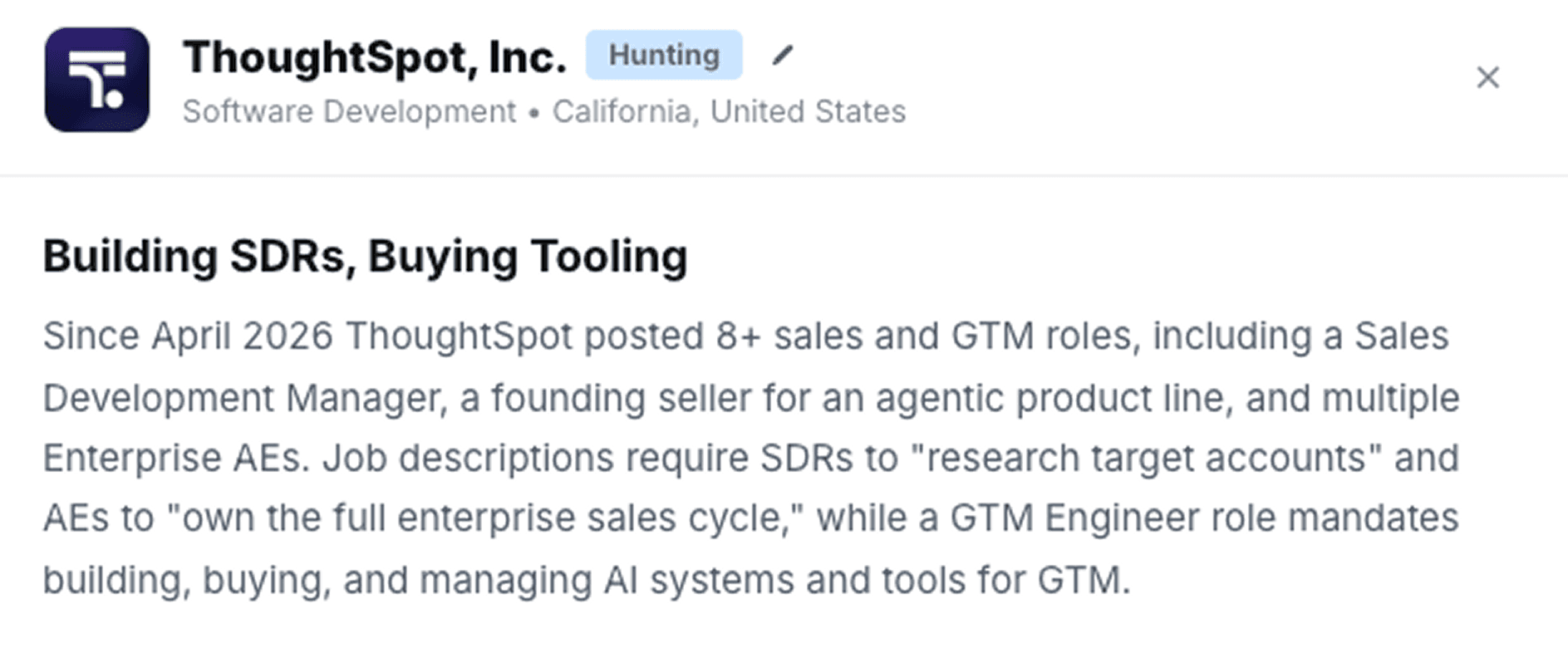
ICP-based account discovery. Set your filters (industry, geography, employee count) and WhiteWhale finds companies you’ve never heard of that already have active signal activity. This is different from scoring accounts you already know - you’re finding net-new accounts already showing buying behavior.
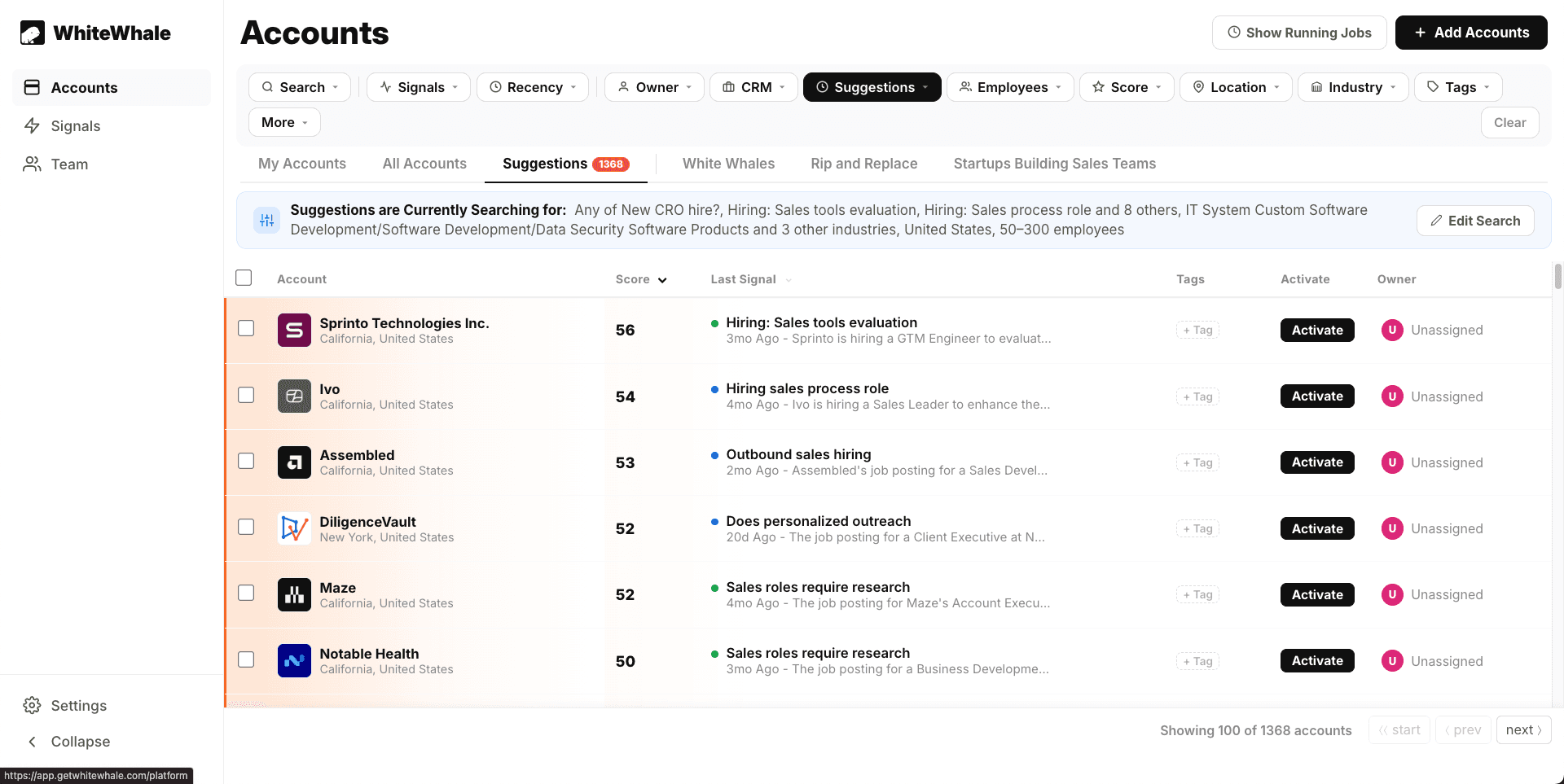
Revenue validation. Signals are analyzed against your closed-won deal history. WhiteWhale shows which signal patterns predicted pipeline for your team - not just activity in general. Signals that underperform (0.9x win rate) get flagged.
What customers say:
Justin Ager, Strategic Growth Manager at Kaleris, saw ROI in 5 days: “You close one deal and it’s paid for itself. If you try to track this on your own, you’re going to miss stuff. You miss a lot less with WhiteWhale.”
Beau Blanchard at Gravitate chose WhiteWhale over ZoomInfo and Clay: “Having a system that scrapes SEC filings, company posts, and job postings gives us a much warmer approach than ‘Hey, thanks for looking at our website today.’”
Meridian Business prioritized 2,800 accounts in 24 hours. Conner Slater at Bitdrift ranked 300+ accounts with 13 signals in two weeks. Nicholas de la Guardia at Simpli discovered 279 accounts he’d never heard of in 30 minutes. Read the full Meridian case study.
Integrations: HubSpot, Salesforce, Slack, Microsoft Teams, Clay, REST API, MCP (Claude, ChatGPT). 90% of users never log into WhiteWhale - all data flows to existing tools.
WhiteWhale key features
Feature | Details |
|---|---|
Custom signals | Up to 35 per account list, written in plain English |
Source verification | Every signal includes a linked source, direct quotes, and cited facts |
Signal stacking | Multiple signals combined into a “Why Now” story per account |
Account discovery | Finds net-new ICP-match accounts with active signals |
Revenue validation | Signals tested against your closed-won deal history |
Setup time | About 15 minutes to first signals |
Pricing | From $200/mo, month-to-month, no annual contract |
Users | Unlimited users on every plan, no per-seat pricing |
Pricing: Starts at $200/mo with unlimited users and unlimited account suggestions. No per-seat pricing. Month-to-month, no annual contract. See pricing.
Pros: Only platform where you write your own signals. Every result is verifiable. Signal stacking connects the dots. Discovers accounts you don’t know about. Free tier with no credit card.
Cons: Not a contact data provider - pair with Apollo, ZoomInfo, or Clay for emails and phone numbers. Built for companies with 100+ employees, not SMB.
Learn more about how custom buying signals work.
2. 6sense
Best for enterprise account-based marketing
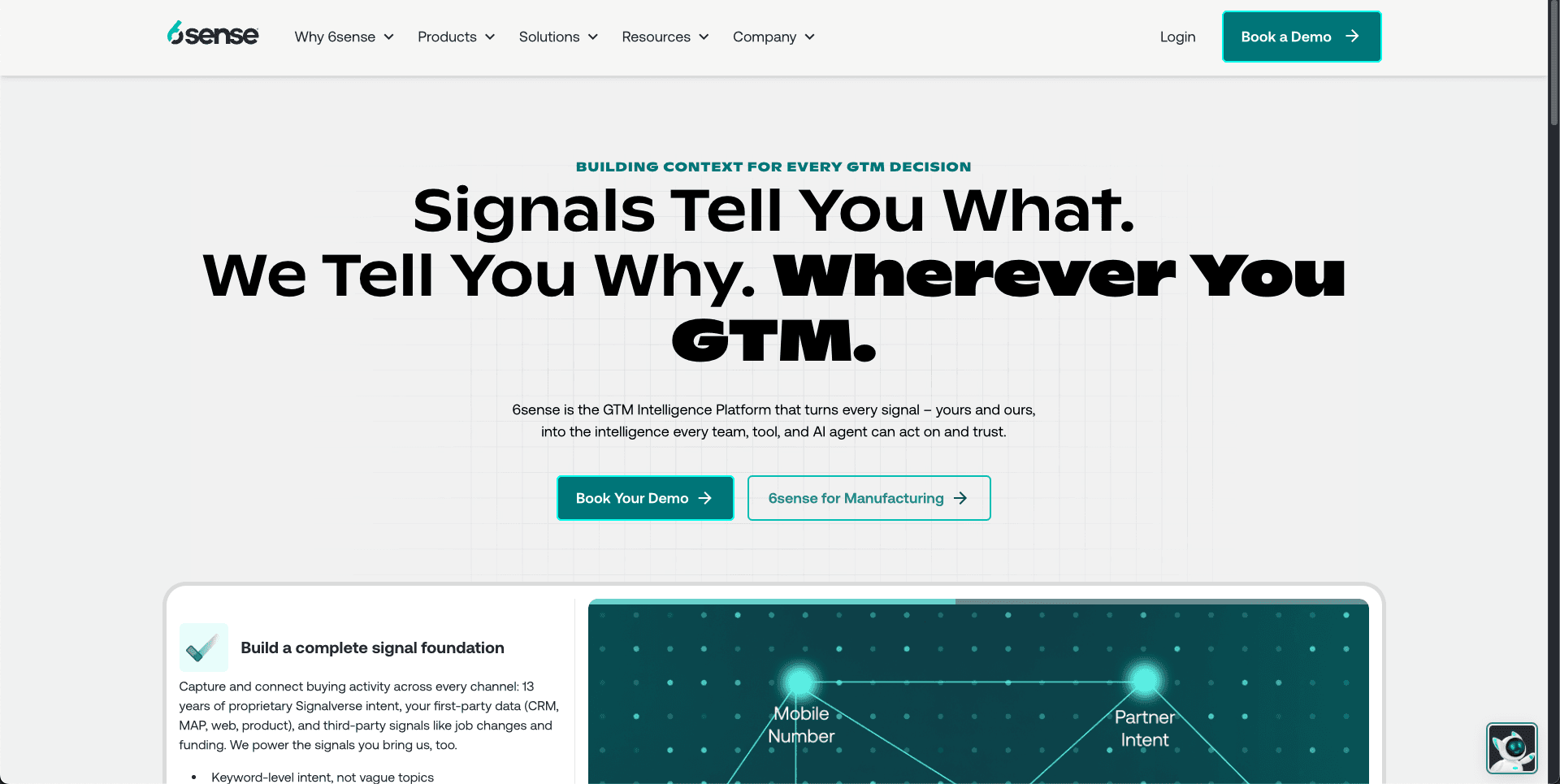
Category: Intent data + ABM platform Best for: Enterprise marketing teams with $50K+ ABM budgets G2: 4.3/5 (1,300+ reviews) | ARR: $200M+ | Valuation: $5.2B
6sense surpassed $200 million in ARR in its fiscal year ending January 2024, with 40% year-over-year revenue growth and a 30% increase in customers. The company raised $526M in total funding and was named a Leader in Gartner’s Magic Quadrant for ABM Platforms for the fifth consecutive year in 2025. It also appeared on the 2025 Deloitte Technology Fast 500.
The platform uses predictive AI to identify accounts showing anonymous research behavior, assigns buying-stage scores (awareness, consideration, decision, purchase), and orchestrates multi-channel ad campaigns. The “dark funnel” intelligence - identifying buyer intent before they visit your website - is powerful for large marketing organizations.
The core limitation: data is account-level only. “Acme Corp is in the Decision stage” doesn’t tell you which person to email. Intent scores are topic-based, drawn from anonymous IP tracking across a publisher network. You can’t verify the source or reference it on a call. The same data goes to every 6sense customer - including your competitors.
Pricing: Paid tiers are quote-based, typically $50K to $100K+/yr.
Pros: Strongest predictive buying-stage scoring. Native ABM advertising orchestration. Gartner Leader 5 consecutive years. Deloitte Fast 500.
Cons: Account-level only - no contact-level signals. Black-box scores with no verifiable source. No conversation intelligence. $50K to $100K+/yr before engagement tools. 3-6 month implementation.
See the full WhiteWhale vs 6sense breakdown.
3. Bombora
Best cooperative intent data network
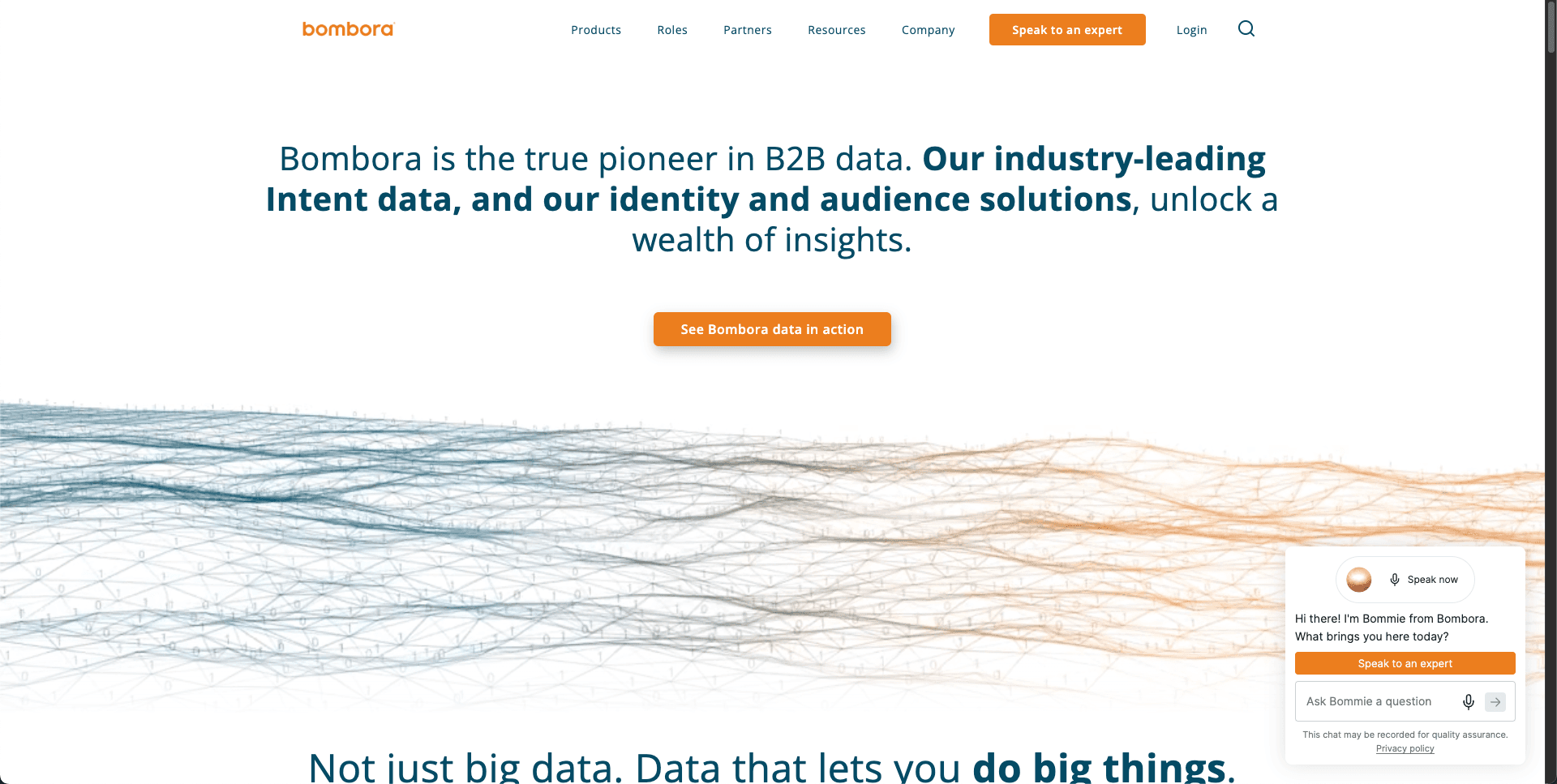
Category: Intent data feed (no platform UI) Best for: Enterprise ABM teams that want the broadest third-party intent layer G2: 4.4/5 | Forrester: “Gold standard for account-level intent data feeds” (2025)
Bombora created the B2B intent data category over 10 years ago. Their Data Co-op spans 200+ publishers and 5,500+ B2B media sites, with 86% exclusive data no other intent vendor can access. Forrester named Bombora a Leader in The Forrester Wave: Intent Data Providers for B2B, Q1 2025, noting the co-op grew approximately 20% in size and topic coverage expanded 13% over 18 months to reach 13,000+ B2B topics.
Bombora is a data company, not a platform. There is no contact database, no seller workspace, and no outreach tools. Company Surge data must be paired with a CRM, contact provider, and engagement tool to be actionable. Clients include IBM, Lenovo, and Adobe. The company has 234 employees.
Pricing: Fully quote-based. Vendr reports a median contract of $57K/yr, with real year-one TCO of $30K to $200K depending on scale and topic add-ons ($200 to $400 each).
Pros: Broadest cooperative intent coverage (86% exclusive). 13,000+ topics. Forrester “gold standard.” Integrates with Salesforce, HubSpot, Marketo, LinkedIn, 6sense, Demandbase.
Cons: Data feed only - no contacts, no UI, no outreach tools. Account-level and topic-level only. Unverifiable scores. $30K to $200K/yr for data that still needs a separate stack to act on.
4. ZoomInfo
Best for large-scale contact data + account-level intent, All-in-one solution.
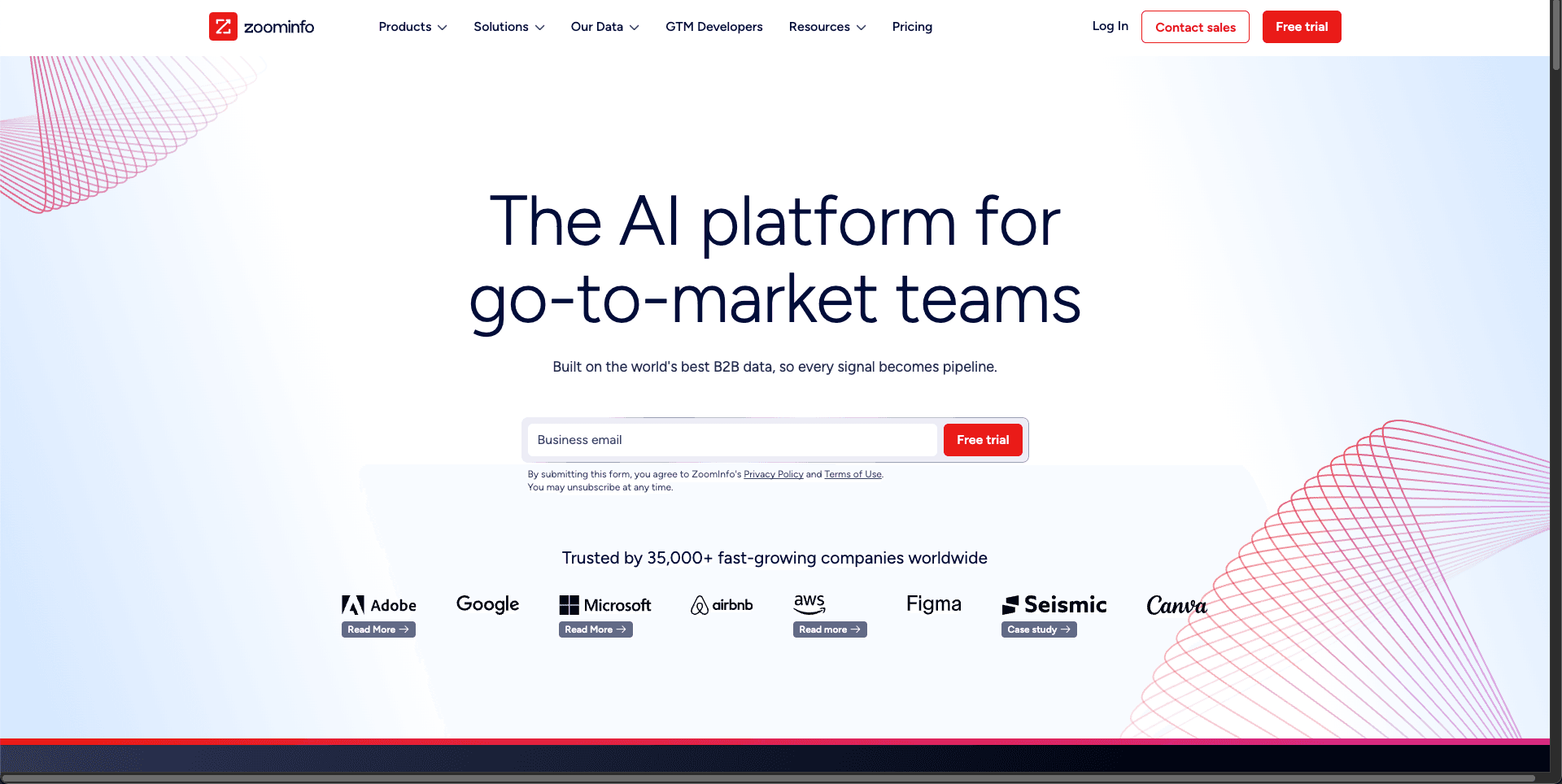
Category: Contact data platform + account-level intent Best for: Enterprise revenue teams that need the largest verified B2B database G2: 4.5/5 (12,600+ reviews) | Revenue: ~$1.24B annual run rate (2025)
ZoomInfo is the default name in B2B data. The publicly traded company (NASDAQ: ZI) reported $930.4M in revenue for the first nine months of 2025. The platform covers 500M+ contacts, 135M+ verified phone numbers, and 200M+ verified business emails across 100M+ companies. More than 35,000 companies use ZoomInfo, and the platform earned 138 #1 rankings in G2’s Winter 2025 Reports.
ZoomInfo also includes Chorus for conversation intelligence and GTM Workspace for AI-assisted seller workflows. Account-level intent tracking operates through a proprietary publisher network.
Where ZoomInfo falls short is signal specificity. Intent data tells you “Acme Corp is researching CRM solutions” without revealing the source, the specific person, or anything verifiable. The signals are pre-built topics shared across all customers. The G2/Trustpilot rating gap (4.5 vs 1.8) is the widest in this comparison, with Trustpilot complaints clustering around billing disputes, data accuracy issues, and cancellation difficulties.
Pricing: Professional $25K to $35K/yr. Advanced with Chorus $40K to $60K+/yr. Quote-based.
Pros: Largest verified B2B database (500M contacts). Chorus conversation intelligence. 138 G2 #1 rankings. Deep CRM integrations.
Cons: Account-level intent only. Pre-built topic library - no custom signals. Intent data is unverifiable and shared. $15K to $60K+/yr. G2 (4.5) vs Trustpilot (1.8) gap.
5. Clay
Best for teams building custom signal workflows
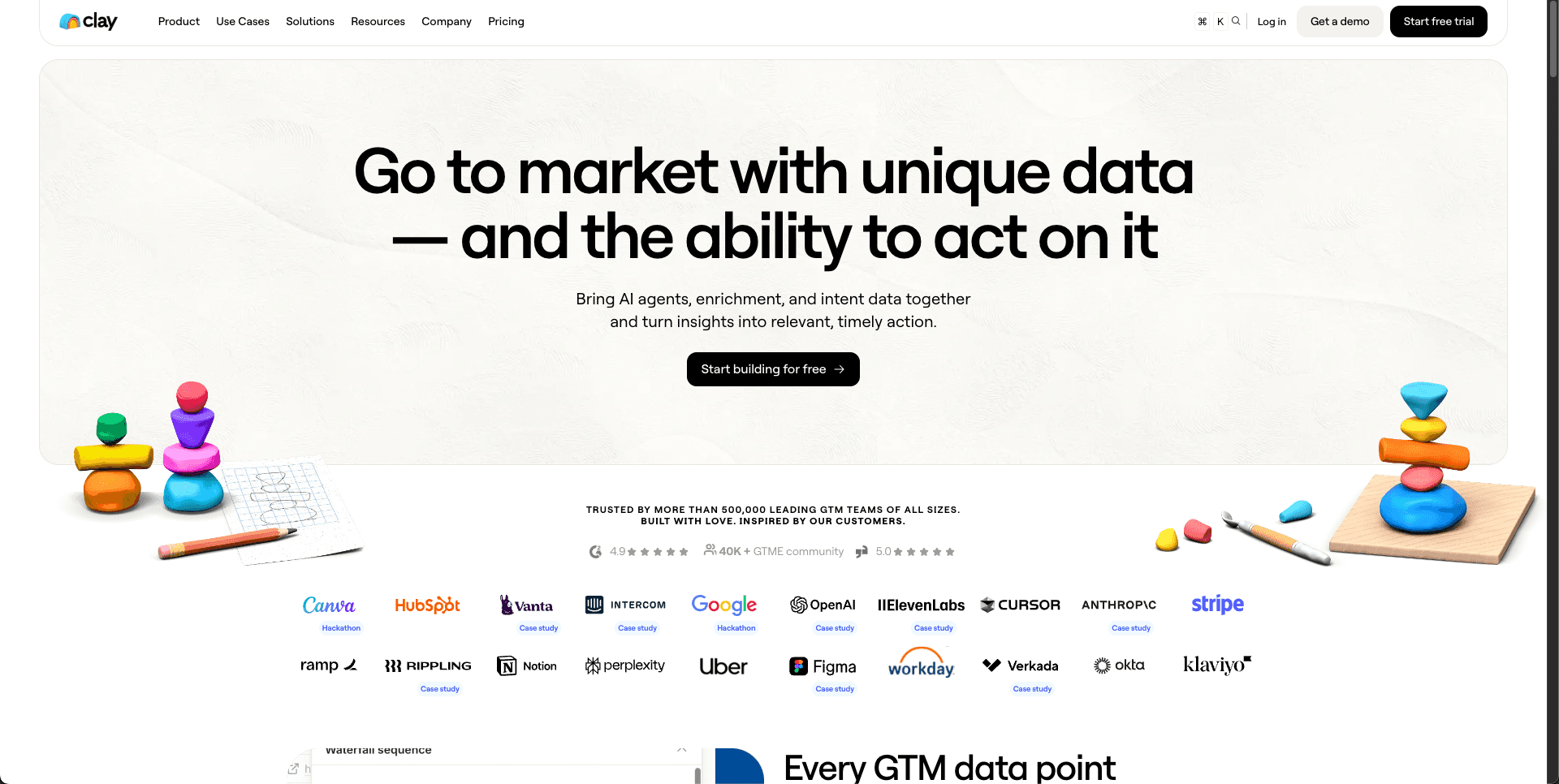
Category: Data enrichment + workflow orchestration Best for: RevOps teams that want to build custom prospecting pipelines G2: 4.9/5 (312 reviews) | Valuation: $3.1B | Users: 50,000+ teams
Clay raised $100M in Series C funding at a $3.1B valuation from CapitalG, Sequoia Capital, and Meritech Capital in 2025. It’s the most flexible data enrichment platform on the market - a spreadsheet-like interface connecting to 150+ data providers, letting you build waterfall enrichment workflows that query multiple sources sequentially until they find verified data.
Independent testing shows Clay’s waterfall approach lifts email find rates from 40% (single-provider) to 78% (multi-provider cascade). That’s Clay’s defining advantage: consolidation. Instead of managing subscriptions with Apollo, Clearbit, Hunter, ZoomInfo, and others separately, Clay routes them through one credit pool and one interface.
For signals specifically, Clay integrates with Explorium (which raised $141.1M in funding and aggregates 50+ data providers behind one API with native MCP support). Through Explorium and other providers, Clay users can track job changes, funding events, SEC filing risk factors, LinkedIn company activity, and employee review sentiment - all within Clay tables. Claygent, Clay’s AI research agent, can scrape public data to surface company-specific insights no single provider carries.
The trade-off is complexity and cost. The G2 ease-of-use score is 7.9 - lower than most alternatives. The #1 complaint on G2, with 16 separate mentions, is the learning curve. Teams typically need 2-4 weeks to build functional enrichment pipelines. And Clay’s credit-based pricing means total cost depends heavily on how efficiently you build workflows. March 2026 pricing overhaul moved CRM integrations down to the $495/month Growth plan and cut data marketplace costs 50-90%.
Pricing: Launch $185/mo. Growth $495/mo. Enterprise custom. Credit-based - real TCO is $4,200 to $9,600/yr once you factor in credit top-ups and required tools like LinkedIn Sales Navigator ($99/mo per user). March 2026 overhaul made pricing more transparent.
Pros: Highest G2 rating in the category (4.9/5). Waterfall enrichment doubles coverage vs single-provider tools. 150+ data providers in one interface. Unlimited users on all plans. Explorium integration for signal data.
Cons: Steep learning curve (G2 ease-of-use 7.9). Not a signal platform - it’s an orchestration layer that requires you to build the workflows. Credit costs are unpredictable at scale. Requires separate outreach tools. 2-4 week setup for functional pipelines.
WhiteWhale integrates directly with Clay - most Clay power users add WhiteWhale as a signal source via webhook to feed verified buying signals into their enrichment workflows.
6. Apollo
Best budget option for data + basic engagement
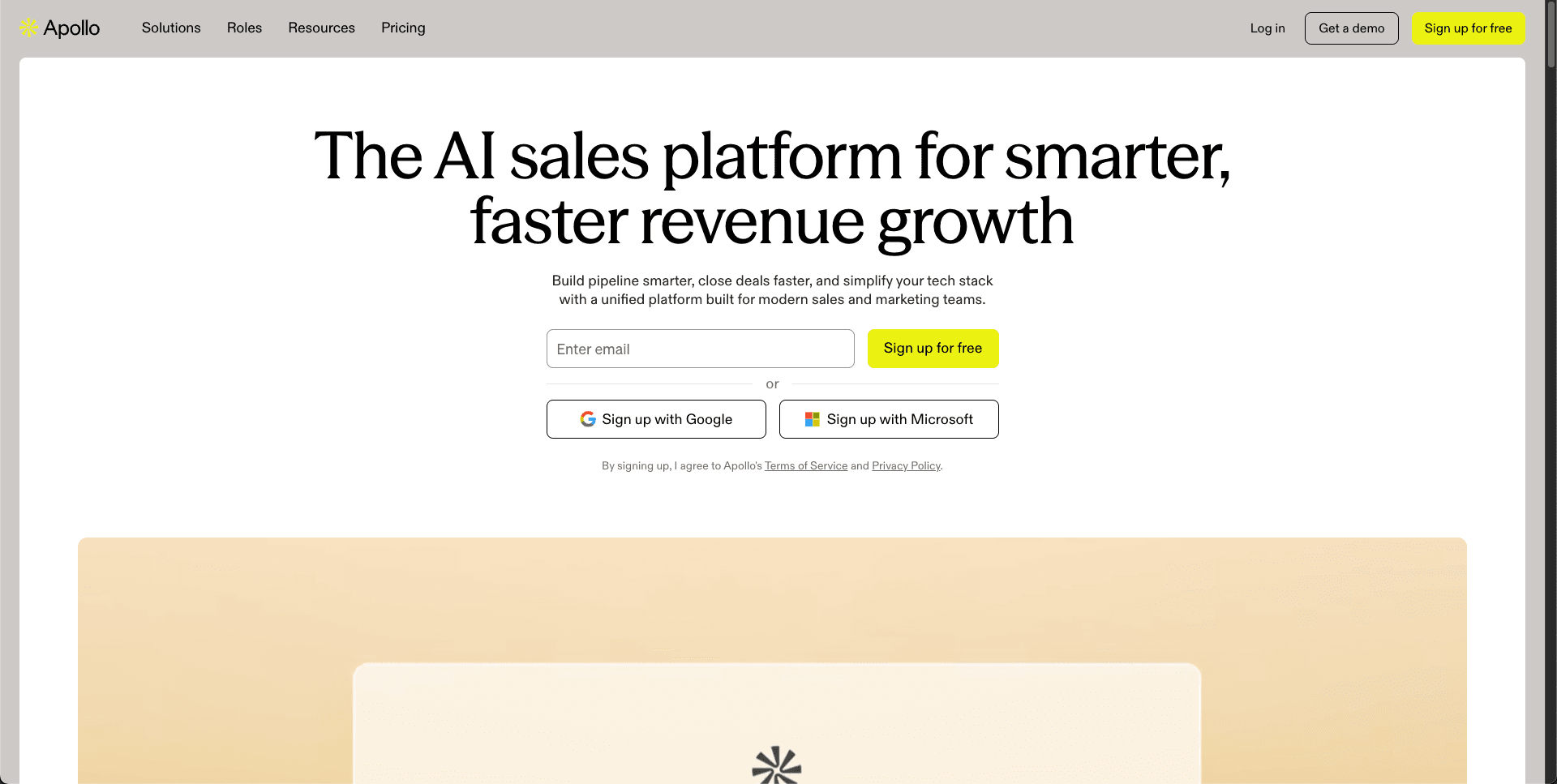
Category: Contact data + sales engagement Best for: SMB and startup teams on a tight budget G2: 4.8/5 (9,344+ reviews) | Contacts: 275M+
Apollo is the most accessible entry point: 275M+ contacts, built-in email sequencing, a basic dialer, and a free tier. At $49/user/month, it’s a fraction of ZoomInfo or Cognism.
The trade-off is data quality. Bounce rates of 20 to 30% are well-documented across user reviews and independent testing. As one Reddit user put it: “Apollo emails bounce like crazy. We burned two domains before switching.” Apollo discontinued its email warmup feature in 2024. The G2/Trustpilot gap (4.8 vs 1.9) mirrors ZoomInfo’s pattern.
Intent is basic Bombora integration - account-level only, no contact-level signals.
Pricing: Free tier. Basic $49/user/mo. Professional $99/user/mo. Organization $119/user/mo. Annual billing.
Pros: All-in-one prospecting + outreach at the lowest price point. Free tier. 9,344+ G2 reviews.
Cons: 20 to 30% bounce rates. Account-level intent only. No email warmup (discontinued 2024). G2 (4.8) vs Trustpilot (3.0) gap.
7. Cognism
Best for European phone-verified mobile data
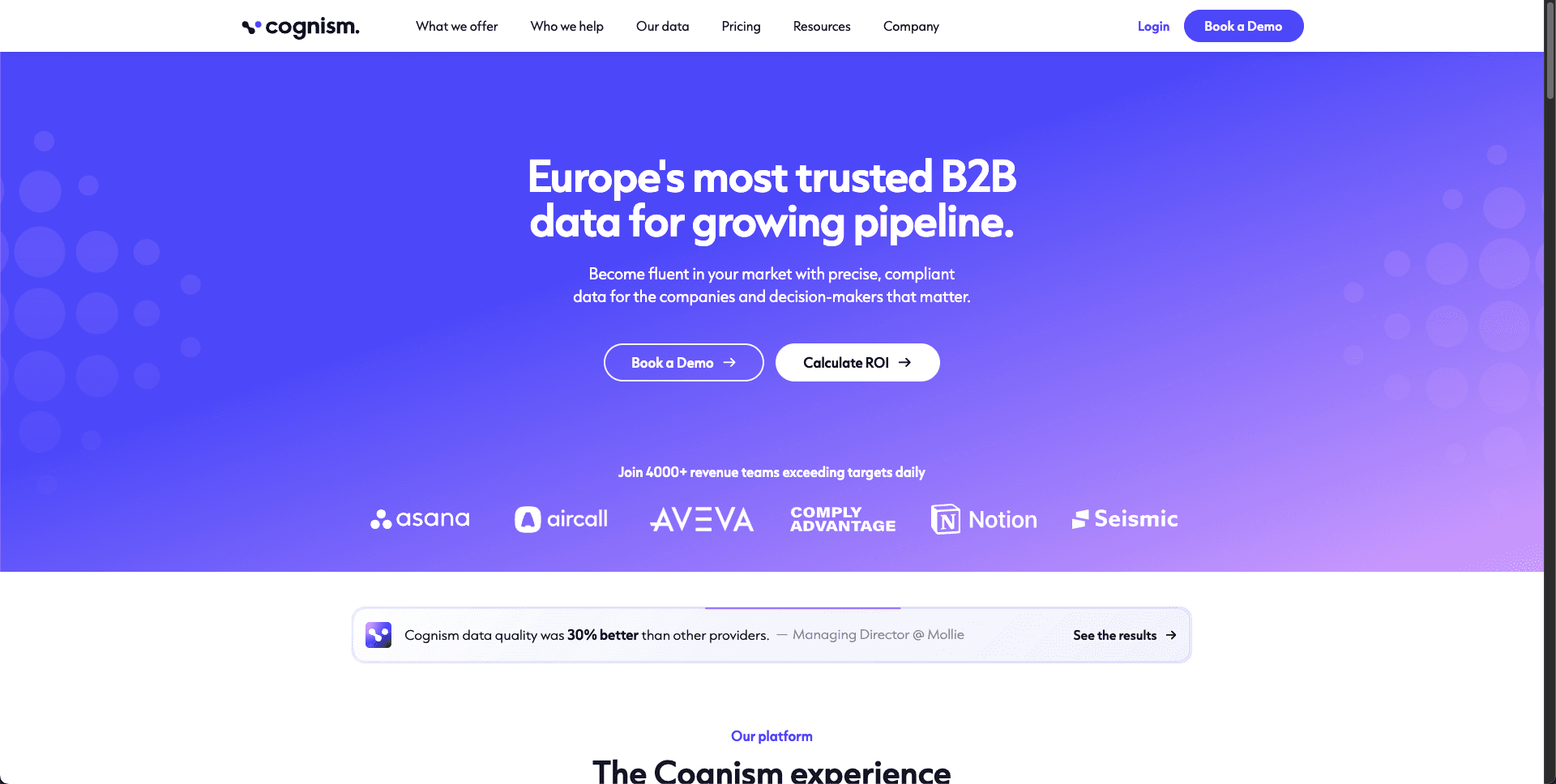
Category: EMEA-focused contact data Best for: Teams selling into European markets where phone is primary G2: 4.6/5 (1,201 reviews)
Cognism’s Diamond Verified Data manually calls each European mobile number to confirm it reaches the intended contact, claiming 87%+ accuracy and 3x industry-average connection rates on EMEA mobiles. GDPR-first compliance with a dedicated Trust Centre makes it the default for EU-focused teams.
Intent data is available only as a paid Bombora add-on - account-level only. Cognism has no engagement tools, no AI, and no deliverability infrastructure. Teams selling into both US and EMEA often maintain Cognism plus a separate US provider, effectively doubling data spend.
Pricing: Starting at $15K+/yr (annual commitment). Bombora intent add-on extra. Quote-based.
Pros: Best EMEA mobile data. GDPR-first. Diamond Verified 87%+ accuracy. 3x connection rates on EU mobiles.
Cons: $15K+/yr for data only. Weaker US coverage. Intent is a paid add-on, account-level only. No engagement or deliverability tools.
8. Demandbase
Best for ABM + programmatic advertising
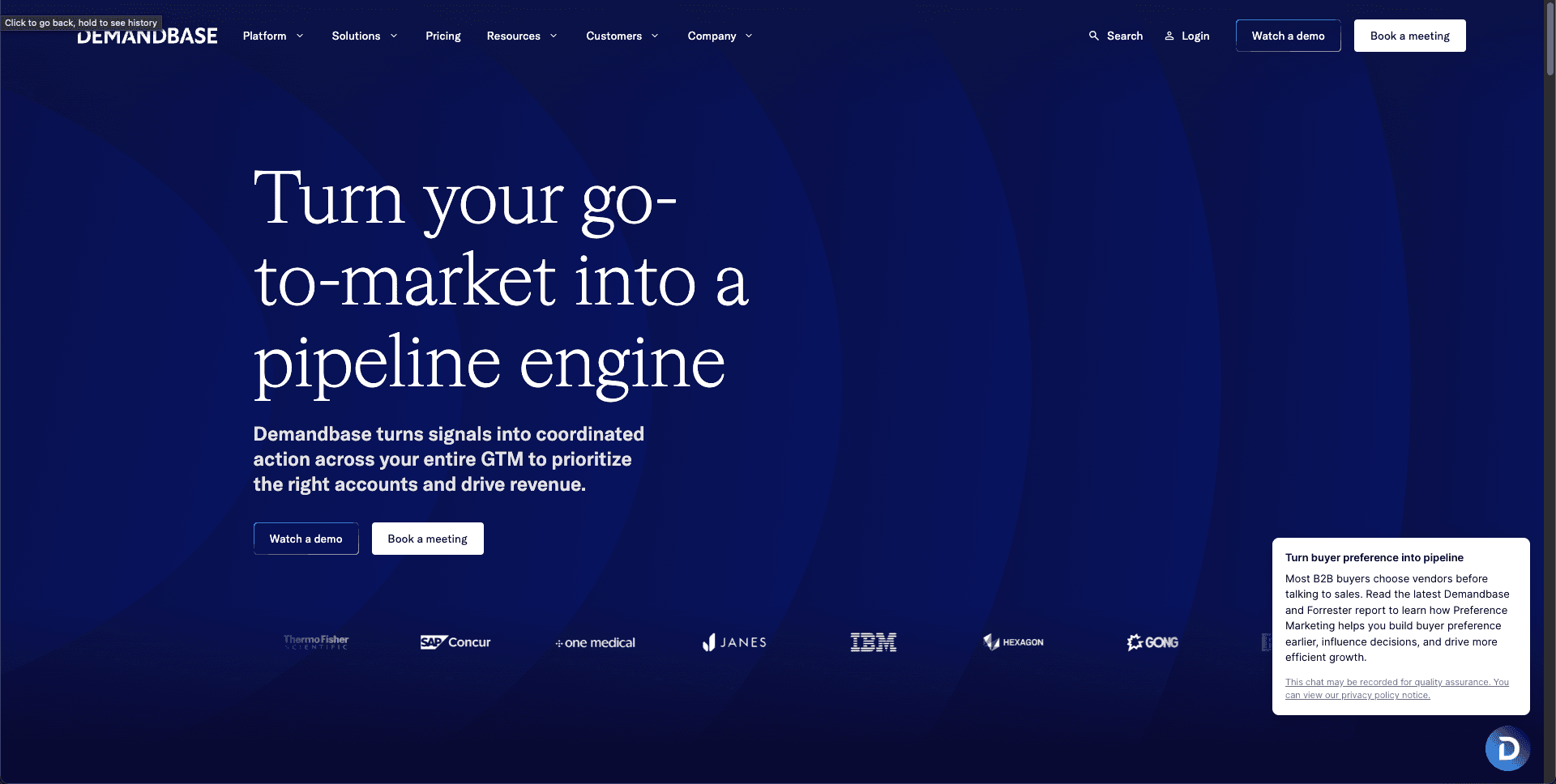
Category: ABM + advertising platform Best for: Enterprise B2B marketing teams running ABM + display ads G2: 4.3/5
Demandbase covers similar territory to 6sense - account-level intelligence, intent data, AI identification - but adds a native programmatic advertising layer. When intent triggers, ads follow automatically. The 2021 InsideView acquisition added a native B2B data layer with firmographics, technographics, and contact information.
The proprietary “Engagement Minutes” metric quantifies how much attention target accounts give your brand across channels. But like 6sense, Demandbase is account-level only, has no outbound execution tools, and requires a separate engagement stack.
Pricing: Starting at $50K+/yr. Quote-based.
Pros: Programmatic ads integrated with account intelligence. InsideView data layer. Engagement Minutes metric.
Cons: Account-level only. No outbound execution. $50K+/yr. 6-12 month deployment timelines reported.
9. Gong
Best for conversation intelligence
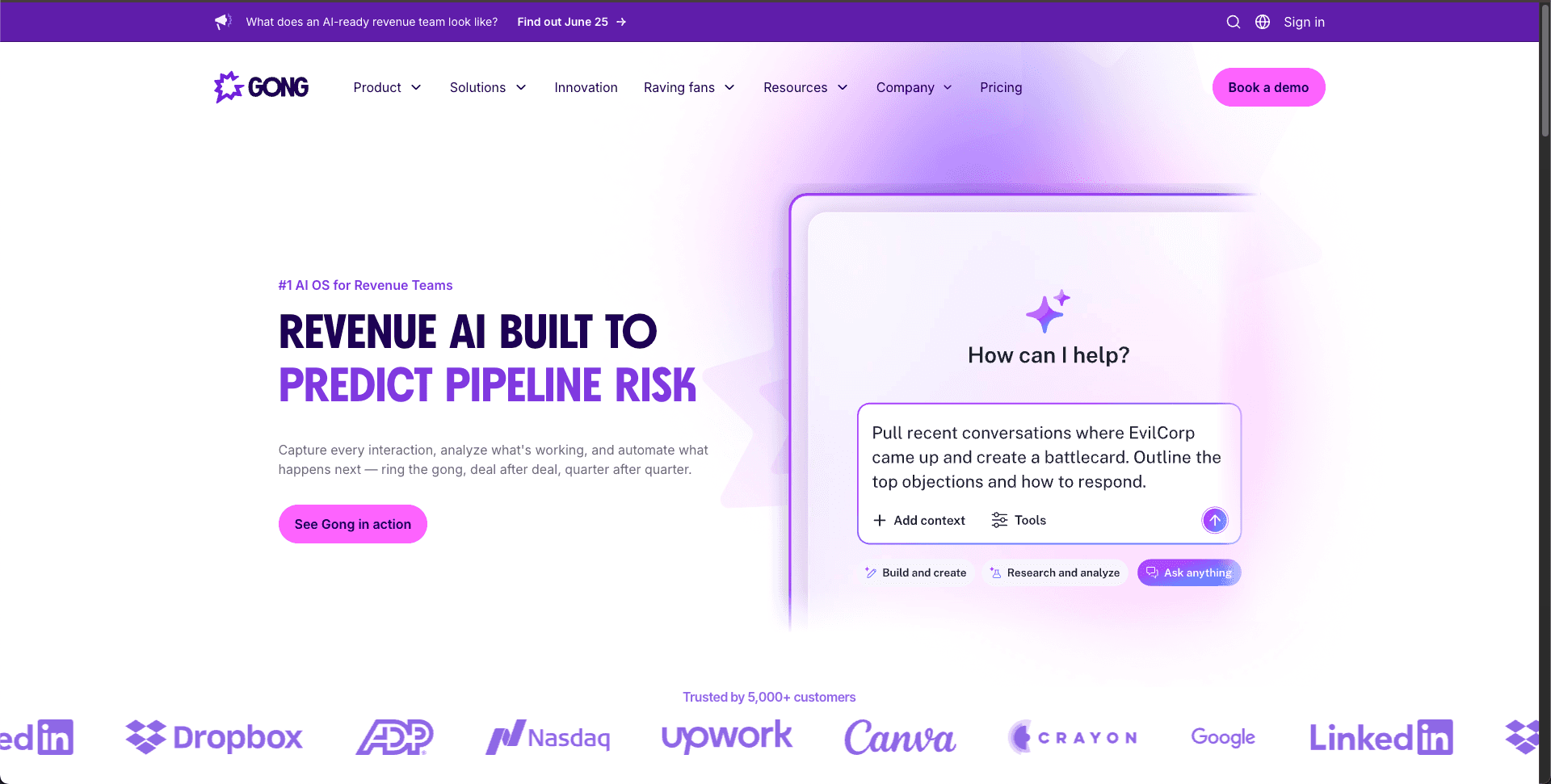
Category: Conversation intelligence Best for: Sales coaching, deal risk analysis, competitive mention tracking G2: 4.8/5 | Position: Dominant Leader in CI category
Gong is the most established standalone conversation intelligence platform in B2B SaaS. It records, transcribes, and analyzes sales calls across phone and video - surfacing coaching insights, competitive mentions, deal risks, and next-step commitments. Talk-to-listen ratios, pricing discussion detection, and objection tracking set the benchmark for the category.
Gong is not a prospecting tool and not a signal platform. It has no B2B contact database, no intent data, and no account prioritization. It analyzes conversations that already happened - it doesn’t tell you which accounts to call next. Gong Engage adds basic sales engagement, but it’s widely considered an afterthought.
Pricing: Quote-based. No published pricing or free tier.
Pros: Deepest conversation analytics in the category. Coaching insights and deal-risk detection. Strong CRM integration.
Cons: No B2B data, intent signals, or account prioritization. Cannot find new prospects. Requires separate prospecting and intelligence platforms.
10. Common Room
Best for community-led and product-led signal aggregation
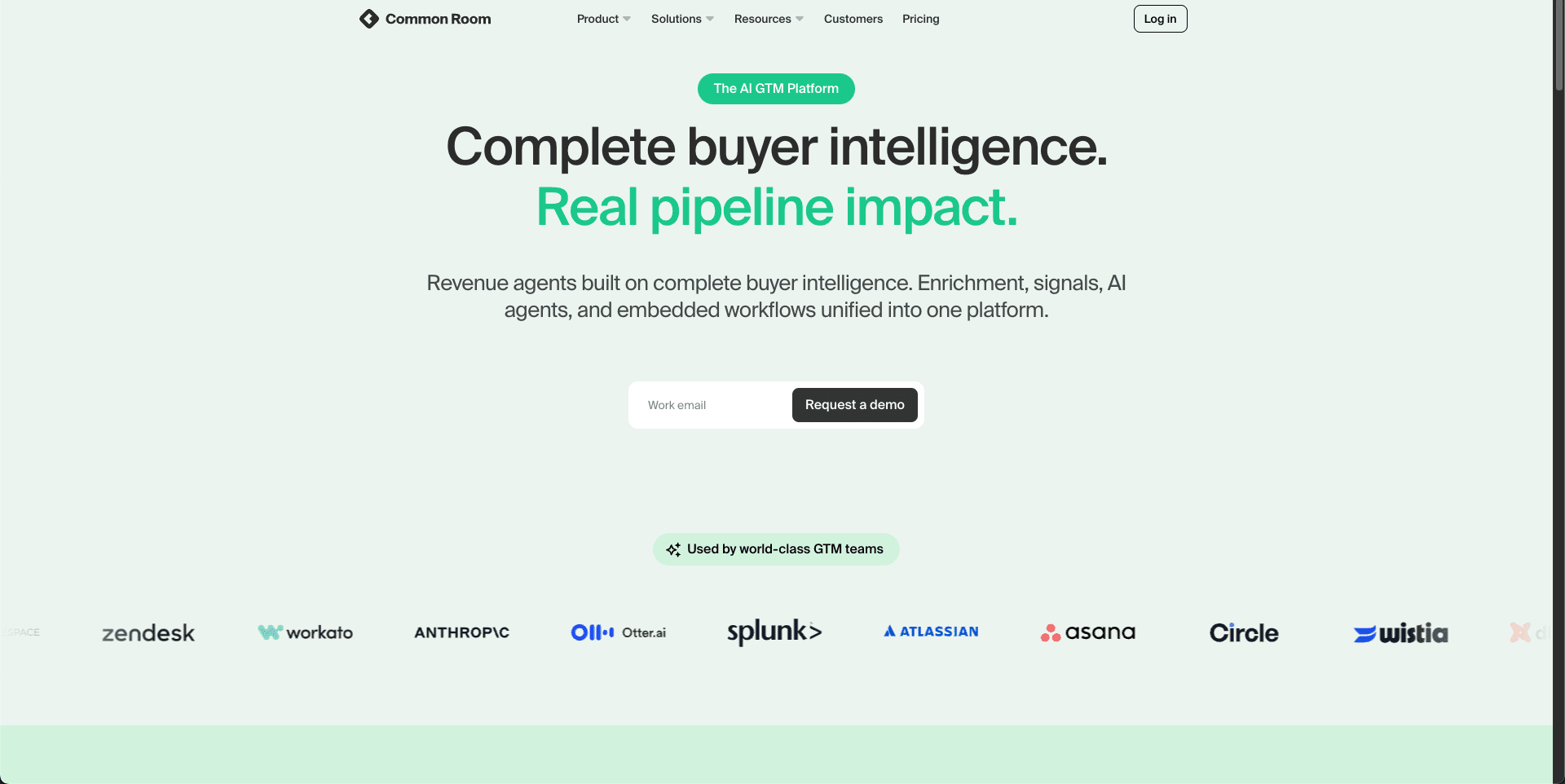
Category: Community + PLG signal platform Best for: B2B SaaS companies with active communities or product-led growth motions G2: 4.5/5 (106 reviews) | Funding: $50M+ (Greylock, Index Ventures)
Common Room is the other signal platform gaining traction in 2026, but it approaches signals from a fundamentally different direction than WhiteWhale. Where WhiteWhale monitors public business events (SEC filings, earnings calls, job postings), Common Room monitors community and product activity - Slack groups, Discord servers, GitHub repos, LinkedIn engagement, product usage, G2 browsing, and website visits.
Founded in 2020, Common Room aggregates these digital signals and resolves them to the person level (not just the account level), which is a meaningful advantage over 6sense and Bombora. When a prospect asks about your product category in an industry Slack group, stars your competitor’s GitHub repo, or engages with relevant LinkedIn content, Common Room surfaces it.
The core limitation: Common Room’s signals are only valuable if your prospects are active in trackable online communities. For traditional B2B outbound - where your buyers are CIOs at manufacturing companies, not developers in Discord - community signals are less relevant. At $1,000/month minimum ($12K/yr for Starter with just 2 seats), the price-to-value ratio depends entirely on how much community engagement you have to monitor. A Notion SDR reported Common Room “saves him 5x time” - but Notion’s prospects live in developer communities. Yours might not.
Common Room also has no native outreach execution. It surfaces signals but leaves you stacking separate enrichment and outreach tools to act on them.
Pricing: Starter $1,000/mo ($12K/yr, 2 seats, 35K contacts). Team ~$30K/yr. Enterprise $50K to $80K+/yr. Quote-based at higher tiers.
Pros: Person-level signal identification (not just account-level). Aggregates Slack, Discord, GitHub, LinkedIn, product usage, G2, website visits. Strong for PLG and community-led GTM. Notion case study shows real time savings.
Cons: Only valuable if prospects are active in trackable communities. $12K+/yr minimum. No outreach execution. Steep learning curve flagged by G2 reviewers. Price escalates rapidly as contact volume grows.
11. Lusha
Best for quick contact lookups, not signals.
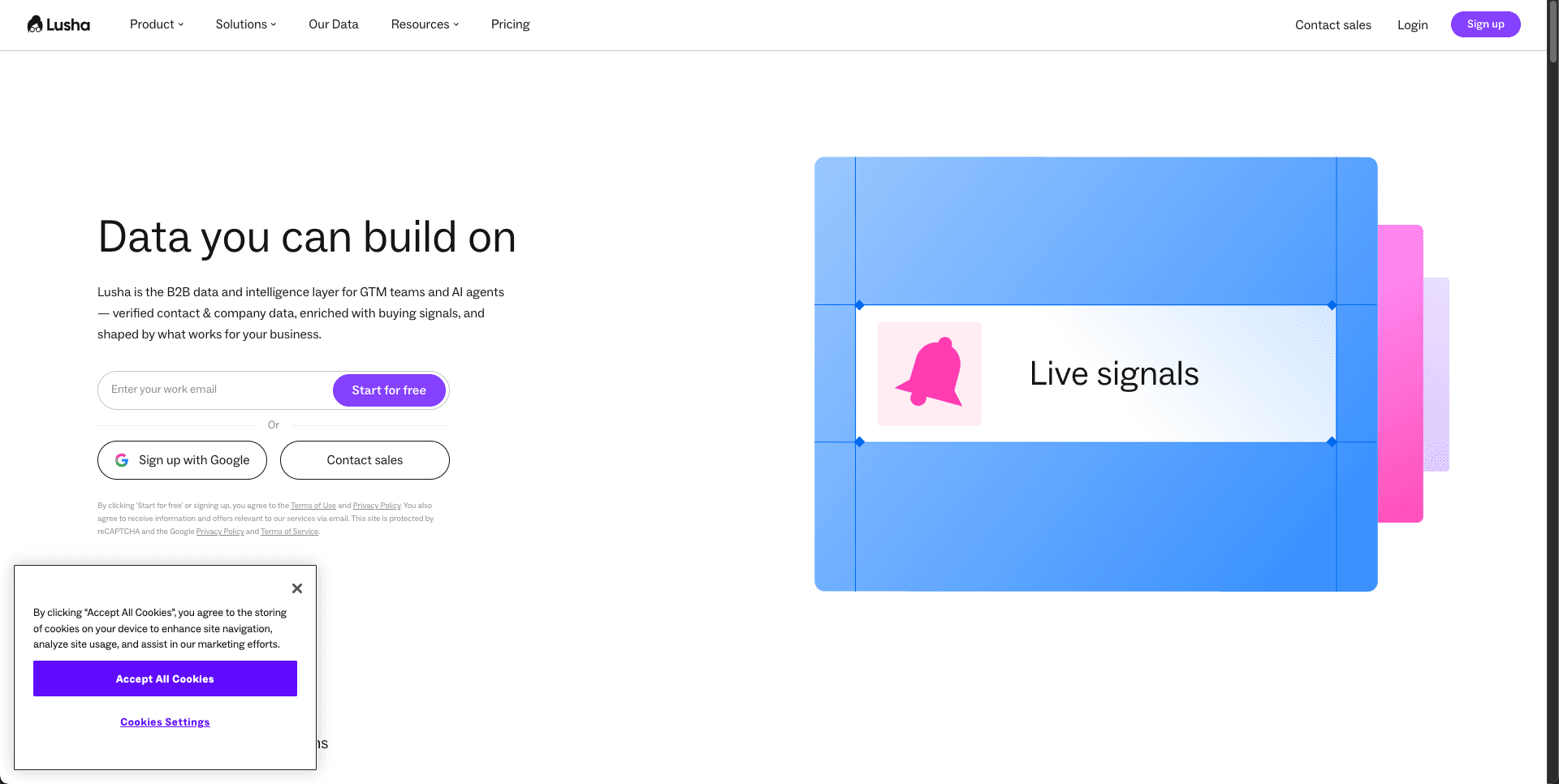
Category: Contact enrichment Best for: Individual reps who need fast LinkedIn lookups G2: 4.3/5 (1,611 reviews) | Trustpilot: 1.3/5
Lusha’s Chrome extension surfaces emails and phone numbers from LinkedIn profiles in seconds. Simple onboarding, a free tier, and $22/month starting price make it the lowest-friction entry point for individual sellers. Lusha also offers an MCP server for AI agent integration (contact lookups only).
Lusha is not a sales intelligence platform. No engagement tools, no AI, no deliverability, no intent signals (except on the Scale plan). The credit model is a known friction point - phone lookups cost 2-3x email lookups, and users report running out mid-month. The Trustpilot rating of 1.3/5 is the lowest in this comparison, with complaints about automatic renewals and cancellation difficulty.
Pricing: Free (5 credits/month). Pro $22/mo (480 credits/yr). Premium $44/mo. Scale custom.
Pros: Fastest LinkedIn-to-contact-data path. Lowest-friction entry point. MCP server for AI agents.
Cons: Credit trap - phone lookups are expensive, overages steep. Trustpilot 1.3/5. No engagement, AI, deliverability, or intent. Data accuracy declining per user reports.
Most sales intelligence listicles are written by the vendors themselves. ZoomInfo’s version puts ZoomInfo first. Amplemarket’s version puts Amplemarket first. Each one ranks their own product #1 across their own scoring criteria.
We’re taking a different approach. Instead of scoring platforms against a framework we invented, we’ll make one distinction the other lists skip: the difference between intent data and buying signals. These are the two main categories of sales intelligence, however they’re not the same thing, and which one you choose determines whether your reps get vague scores or verifiable reasons to pick up the phone.
Sales intelligence is not contact data
Sales intelligence tells you where to point your sales efforts - which accounts to prioritize, when to reach out, and why now. Contact data (emails, phone numbers, org charts) tells you who to reach. Both matter, but they solve different problems.
If your reps have a CRM full of accounts and struggle with “I don’t know which ones to call today,” that’s an intelligence problem. If your reps know exactly who to call but don’t have their email, that’s a contact data problem.
This guide covers intelligence - the platforms that help you decide where to focus. We’ve included contact data platforms where their intelligence features are relevant, but we’re evaluating them on signal quality, not database size.
The two categories of sales intelligence
Every platform in this space falls into one of two camps:
Intent data platforms track anonymous behavior. They monitor IP addresses visiting web pages across publisher networks and assign a topic-level score to the company. You get output like: “Acme Corp is surging for Cloud Security.” You don’t get the source, can’t verify it, and can’t reference it on a sales call. The same data is typically sold to every customer. 6sense ($200M+ ARR, $5.2B valuation), Bombora (Forrester’s “gold standard”), and Demandbase built this category.
But even the companies that built intent data are walking away from the term. In September 2025, 6sense published an article on their own blog titled “Stop Calling It Intent: Why B2B Marketing Needs a Signal Shift.” Kerry Cunningham, a former Forrester and SiriusDecisions analyst writing for 6sense, said it plainly: “Intent data promised to reveal which buyers were ready to buy, but in reality, it mostly told us who was digitally loafing on our website. It’s time to retire the phrase.” 6sense has since rebranded its data offering around “Signalverse” - processing “1 trillion buying signals daily.” The company that helped create the intent data category is now running from the name.
Buying signal platforms represent the new era. They track real, verifiable events - SEC filings, earnings call transcripts, job postings, press releases, community activity - and match them to specific questions or criteria you define. You get output like: “Acme’s CTO announced company-wide AI adoption on the Q1 earnings call - here’s the direct quote and the link to the transcript.” Your rep can verify it and reference it on a call. This is a newer category with fewer players - WhiteWhale and Common Room are the most prominent, with different approaches to signal sourcing.
The distinction matters because it determines what your reps can actually do with the intelligence. A score with no source is hard to act on. A quote from an earnings call is a conversation starter.
11 sales intelligence platforms at a glance
Platform | G2 Rating | Signal Type | Contract | Pricing |
|---|---|---|---|---|
WhiteWhale | 5.0/5 | Custom signals with verified sources | Month-to-month | Pay-as-you-go, From $200/mo |
6sense | 4.3/5 | Anonymous intent scores | Annual | $50K to $100K+/yr |
Bombora | 4.4/5 | Cooperative intent (5,500+ sites) | Annual | Median $57K/yr (Vendr) |
ZoomInfo | 4.5/5 | Account-level intent | Annual | $15K to $60K+/yr |
Clay | 4.9/5 | Multi-provider via Explorium | Monthly available | $185 to $495/mo |
4.8/5 | Basic Bombora integration | Monthly available | Free, $49+/mo | |
Cognism | 4.6/5 | Bombora add-on | Annual | $15K+/yr |
Demandbase | 4.3/5 | Account-level intent | Annual | $50K+/yr |
Gong | 4.8/5 | Conversation signals | Annual | Quote-based |
4.5/5 | Person-level community signals | Annual | $1K to $4K+/mo | |
Lusha | 4.3/5 | Scale plan only | Annual | Free, $22+/mo |
1. WhiteWhale
Best for custom buying signals with verified sources
Category: Buying signal platform Best for: B2B outbound sales teams selling to companies with 100+ employees G2: 5.0/5.0 (Highest of all tools) | Setup: ~15 minutes | Website: getwhitewhale.com
WhiteWhale doesn’t sell intent data. Instead, you write signals in plain English - up to 35 questions that describe exactly what a buying moment looks like for your specific product. No pre-built library. No shared topics.
The platform scans SEC filings (10-K, 10-Q, Form D), earnings call transcripts, job postings from company ATS systems (Greenhouse, Lever, Workday), 8,000+ news feeds, press releases, and company websites daily. Every match includes the original source linked, direct quotes pulled out, and cited facts.
Three things set WhiteWhale apart from every other platform on this list:
Signal stacking. WhiteWhale doesn’t fire individual alerts - it connects multiple signals per account into a “Why Now” story. An account with three simultaneous signals (new CIO, 6 automation roles posted, CEO mandated AI deployment) gets a narrative that makes outreach impossible to ignore. Accounts with 2+ stacked signals close at 2.1x baseline win rate based on WhiteWhale’s customer data.
ICP-based account discovery. Set your filters (industry, geography, employee count) and WhiteWhale finds companies you’ve never heard of that already have active signal activity. This is different from scoring accounts you already know - you’re finding net-new accounts already showing buying behavior.
Revenue validation. Signals are analyzed against your closed-won deal history. WhiteWhale shows which signal patterns predicted pipeline for your team - not just activity in general. Signals that underperform (0.9x win rate) get flagged.
What customers say:
Justin Ager, Strategic Growth Manager at Kaleris, saw ROI in 5 days: “You close one deal and it’s paid for itself. If you try to track this on your own, you’re going to miss stuff. You miss a lot less with WhiteWhale.”
Beau Blanchard at Gravitate chose WhiteWhale over ZoomInfo and Clay: “Having a system that scrapes SEC filings, company posts, and job postings gives us a much warmer approach than ‘Hey, thanks for looking at our website today.’”
Meridian Business prioritized 2,800 accounts in 24 hours. Conner Slater at Bitdrift ranked 300+ accounts with 13 signals in two weeks. Nicholas de la Guardia at Simpli discovered 279 accounts he’d never heard of in 30 minutes. Read the full Meridian case study.
Integrations: HubSpot, Salesforce, Slack, Microsoft Teams, Clay, REST API, MCP (Claude, ChatGPT). 90% of users never log into WhiteWhale - all data flows to existing tools.
WhiteWhale key features
Feature | Details |
|---|---|
Custom signals | Up to 35 per account list, written in plain English |
Source verification | Every signal includes a linked source, direct quotes, and cited facts |
Signal stacking | Multiple signals combined into a “Why Now” story per account |
Account discovery | Finds net-new ICP-match accounts with active signals |
Revenue validation | Signals tested against your closed-won deal history |
Setup time | About 15 minutes to first signals |
Pricing | From $200/mo, month-to-month, no annual contract |
Users | Unlimited users on every plan, no per-seat pricing |
Pricing: Starts at $200/mo with unlimited users and unlimited account suggestions. No per-seat pricing. Month-to-month, no annual contract. See pricing.
Pros: Only platform where you write your own signals. Every result is verifiable. Signal stacking connects the dots. Discovers accounts you don’t know about. Free tier with no credit card.
Cons: Not a contact data provider - pair with Apollo, ZoomInfo, or Clay for emails and phone numbers. Built for companies with 100+ employees, not SMB.
Learn more about how custom buying signals work.
2. 6sense
Best for enterprise account-based marketing
Category: Intent data + ABM platform Best for: Enterprise marketing teams with $50K+ ABM budgets G2: 4.3/5 (1,300+ reviews) | ARR: $200M+ | Valuation: $5.2B
6sense surpassed $200 million in ARR in its fiscal year ending January 2024, with 40% year-over-year revenue growth and a 30% increase in customers. The company raised $526M in total funding and was named a Leader in Gartner’s Magic Quadrant for ABM Platforms for the fifth consecutive year in 2025. It also appeared on the 2025 Deloitte Technology Fast 500.
The platform uses predictive AI to identify accounts showing anonymous research behavior, assigns buying-stage scores (awareness, consideration, decision, purchase), and orchestrates multi-channel ad campaigns. The “dark funnel” intelligence - identifying buyer intent before they visit your website - is powerful for large marketing organizations.
The core limitation: data is account-level only. “Acme Corp is in the Decision stage” doesn’t tell you which person to email. Intent scores are topic-based, drawn from anonymous IP tracking across a publisher network. You can’t verify the source or reference it on a call. The same data goes to every 6sense customer - including your competitors.
Pricing: Paid tiers are quote-based, typically $50K to $100K+/yr.
Pros: Strongest predictive buying-stage scoring. Native ABM advertising orchestration. Gartner Leader 5 consecutive years. Deloitte Fast 500.
Cons: Account-level only - no contact-level signals. Black-box scores with no verifiable source. No conversation intelligence. $50K to $100K+/yr before engagement tools. 3-6 month implementation.
See the full WhiteWhale vs 6sense breakdown.
3. Bombora
Best cooperative intent data network
Category: Intent data feed (no platform UI) Best for: Enterprise ABM teams that want the broadest third-party intent layer G2: 4.4/5 | Forrester: “Gold standard for account-level intent data feeds” (2025)
Bombora created the B2B intent data category over 10 years ago. Their Data Co-op spans 200+ publishers and 5,500+ B2B media sites, with 86% exclusive data no other intent vendor can access. Forrester named Bombora a Leader in The Forrester Wave: Intent Data Providers for B2B, Q1 2025, noting the co-op grew approximately 20% in size and topic coverage expanded 13% over 18 months to reach 13,000+ B2B topics.
Bombora is a data company, not a platform. There is no contact database, no seller workspace, and no outreach tools. Company Surge data must be paired with a CRM, contact provider, and engagement tool to be actionable. Clients include IBM, Lenovo, and Adobe. The company has 234 employees.
Pricing: Fully quote-based. Vendr reports a median contract of $57K/yr, with real year-one TCO of $30K to $200K depending on scale and topic add-ons ($200 to $400 each).
Pros: Broadest cooperative intent coverage (86% exclusive). 13,000+ topics. Forrester “gold standard.” Integrates with Salesforce, HubSpot, Marketo, LinkedIn, 6sense, Demandbase.
Cons: Data feed only - no contacts, no UI, no outreach tools. Account-level and topic-level only. Unverifiable scores. $30K to $200K/yr for data that still needs a separate stack to act on.
4. ZoomInfo
Best for large-scale contact data + account-level intent, All-in-one solution.
Category: Contact data platform + account-level intent Best for: Enterprise revenue teams that need the largest verified B2B database G2: 4.5/5 (12,600+ reviews) | Revenue: ~$1.24B annual run rate (2025)
ZoomInfo is the default name in B2B data. The publicly traded company (NASDAQ: ZI) reported $930.4M in revenue for the first nine months of 2025. The platform covers 500M+ contacts, 135M+ verified phone numbers, and 200M+ verified business emails across 100M+ companies. More than 35,000 companies use ZoomInfo, and the platform earned 138 #1 rankings in G2’s Winter 2025 Reports.
ZoomInfo also includes Chorus for conversation intelligence and GTM Workspace for AI-assisted seller workflows. Account-level intent tracking operates through a proprietary publisher network.
Where ZoomInfo falls short is signal specificity. Intent data tells you “Acme Corp is researching CRM solutions” without revealing the source, the specific person, or anything verifiable. The signals are pre-built topics shared across all customers. The G2/Trustpilot rating gap (4.5 vs 1.8) is the widest in this comparison, with Trustpilot complaints clustering around billing disputes, data accuracy issues, and cancellation difficulties.
Pricing: Professional $25K to $35K/yr. Advanced with Chorus $40K to $60K+/yr. Quote-based.
Pros: Largest verified B2B database (500M contacts). Chorus conversation intelligence. 138 G2 #1 rankings. Deep CRM integrations.
Cons: Account-level intent only. Pre-built topic library - no custom signals. Intent data is unverifiable and shared. $15K to $60K+/yr. G2 (4.5) vs Trustpilot (1.8) gap.
5. Clay
Best for teams building custom signal workflows
Category: Data enrichment + workflow orchestration Best for: RevOps teams that want to build custom prospecting pipelines G2: 4.9/5 (312 reviews) | Valuation: $3.1B | Users: 50,000+ teams
Clay raised $100M in Series C funding at a $3.1B valuation from CapitalG, Sequoia Capital, and Meritech Capital in 2025. It’s the most flexible data enrichment platform on the market - a spreadsheet-like interface connecting to 150+ data providers, letting you build waterfall enrichment workflows that query multiple sources sequentially until they find verified data.
Independent testing shows Clay’s waterfall approach lifts email find rates from 40% (single-provider) to 78% (multi-provider cascade). That’s Clay’s defining advantage: consolidation. Instead of managing subscriptions with Apollo, Clearbit, Hunter, ZoomInfo, and others separately, Clay routes them through one credit pool and one interface.
For signals specifically, Clay integrates with Explorium (which raised $141.1M in funding and aggregates 50+ data providers behind one API with native MCP support). Through Explorium and other providers, Clay users can track job changes, funding events, SEC filing risk factors, LinkedIn company activity, and employee review sentiment - all within Clay tables. Claygent, Clay’s AI research agent, can scrape public data to surface company-specific insights no single provider carries.
The trade-off is complexity and cost. The G2 ease-of-use score is 7.9 - lower than most alternatives. The #1 complaint on G2, with 16 separate mentions, is the learning curve. Teams typically need 2-4 weeks to build functional enrichment pipelines. And Clay’s credit-based pricing means total cost depends heavily on how efficiently you build workflows. March 2026 pricing overhaul moved CRM integrations down to the $495/month Growth plan and cut data marketplace costs 50-90%.
Pricing: Launch $185/mo. Growth $495/mo. Enterprise custom. Credit-based - real TCO is $4,200 to $9,600/yr once you factor in credit top-ups and required tools like LinkedIn Sales Navigator ($99/mo per user). March 2026 overhaul made pricing more transparent.
Pros: Highest G2 rating in the category (4.9/5). Waterfall enrichment doubles coverage vs single-provider tools. 150+ data providers in one interface. Unlimited users on all plans. Explorium integration for signal data.
Cons: Steep learning curve (G2 ease-of-use 7.9). Not a signal platform - it’s an orchestration layer that requires you to build the workflows. Credit costs are unpredictable at scale. Requires separate outreach tools. 2-4 week setup for functional pipelines.
WhiteWhale integrates directly with Clay - most Clay power users add WhiteWhale as a signal source via webhook to feed verified buying signals into their enrichment workflows.
6. Apollo
Best budget option for data + basic engagement
Category: Contact data + sales engagement Best for: SMB and startup teams on a tight budget G2: 4.8/5 (9,344+ reviews) | Contacts: 275M+
Apollo is the most accessible entry point: 275M+ contacts, built-in email sequencing, a basic dialer, and a free tier. At $49/user/month, it’s a fraction of ZoomInfo or Cognism.
The trade-off is data quality. Bounce rates of 20 to 30% are well-documented across user reviews and independent testing. As one Reddit user put it: “Apollo emails bounce like crazy. We burned two domains before switching.” Apollo discontinued its email warmup feature in 2024. The G2/Trustpilot gap (4.8 vs 1.9) mirrors ZoomInfo’s pattern.
Intent is basic Bombora integration - account-level only, no contact-level signals.
Pricing: Free tier. Basic $49/user/mo. Professional $99/user/mo. Organization $119/user/mo. Annual billing.
Pros: All-in-one prospecting + outreach at the lowest price point. Free tier. 9,344+ G2 reviews.
Cons: 20 to 30% bounce rates. Account-level intent only. No email warmup (discontinued 2024). G2 (4.8) vs Trustpilot (3.0) gap.
7. Cognism
Best for European phone-verified mobile data
Category: EMEA-focused contact data Best for: Teams selling into European markets where phone is primary G2: 4.6/5 (1,201 reviews)
Cognism’s Diamond Verified Data manually calls each European mobile number to confirm it reaches the intended contact, claiming 87%+ accuracy and 3x industry-average connection rates on EMEA mobiles. GDPR-first compliance with a dedicated Trust Centre makes it the default for EU-focused teams.
Intent data is available only as a paid Bombora add-on - account-level only. Cognism has no engagement tools, no AI, and no deliverability infrastructure. Teams selling into both US and EMEA often maintain Cognism plus a separate US provider, effectively doubling data spend.
Pricing: Starting at $15K+/yr (annual commitment). Bombora intent add-on extra. Quote-based.
Pros: Best EMEA mobile data. GDPR-first. Diamond Verified 87%+ accuracy. 3x connection rates on EU mobiles.
Cons: $15K+/yr for data only. Weaker US coverage. Intent is a paid add-on, account-level only. No engagement or deliverability tools.
8. Demandbase
Best for ABM + programmatic advertising
Category: ABM + advertising platform Best for: Enterprise B2B marketing teams running ABM + display ads G2: 4.3/5
Demandbase covers similar territory to 6sense - account-level intelligence, intent data, AI identification - but adds a native programmatic advertising layer. When intent triggers, ads follow automatically. The 2021 InsideView acquisition added a native B2B data layer with firmographics, technographics, and contact information.
The proprietary “Engagement Minutes” metric quantifies how much attention target accounts give your brand across channels. But like 6sense, Demandbase is account-level only, has no outbound execution tools, and requires a separate engagement stack.
Pricing: Starting at $50K+/yr. Quote-based.
Pros: Programmatic ads integrated with account intelligence. InsideView data layer. Engagement Minutes metric.
Cons: Account-level only. No outbound execution. $50K+/yr. 6-12 month deployment timelines reported.
9. Gong
Best for conversation intelligence
Category: Conversation intelligence Best for: Sales coaching, deal risk analysis, competitive mention tracking G2: 4.8/5 | Position: Dominant Leader in CI category
Gong is the most established standalone conversation intelligence platform in B2B SaaS. It records, transcribes, and analyzes sales calls across phone and video - surfacing coaching insights, competitive mentions, deal risks, and next-step commitments. Talk-to-listen ratios, pricing discussion detection, and objection tracking set the benchmark for the category.
Gong is not a prospecting tool and not a signal platform. It has no B2B contact database, no intent data, and no account prioritization. It analyzes conversations that already happened - it doesn’t tell you which accounts to call next. Gong Engage adds basic sales engagement, but it’s widely considered an afterthought.
Pricing: Quote-based. No published pricing or free tier.
Pros: Deepest conversation analytics in the category. Coaching insights and deal-risk detection. Strong CRM integration.
Cons: No B2B data, intent signals, or account prioritization. Cannot find new prospects. Requires separate prospecting and intelligence platforms.
10. Common Room
Best for community-led and product-led signal aggregation
Category: Community + PLG signal platform Best for: B2B SaaS companies with active communities or product-led growth motions G2: 4.5/5 (106 reviews) | Funding: $50M+ (Greylock, Index Ventures)
Common Room is the other signal platform gaining traction in 2026, but it approaches signals from a fundamentally different direction than WhiteWhale. Where WhiteWhale monitors public business events (SEC filings, earnings calls, job postings), Common Room monitors community and product activity - Slack groups, Discord servers, GitHub repos, LinkedIn engagement, product usage, G2 browsing, and website visits.
Founded in 2020, Common Room aggregates these digital signals and resolves them to the person level (not just the account level), which is a meaningful advantage over 6sense and Bombora. When a prospect asks about your product category in an industry Slack group, stars your competitor’s GitHub repo, or engages with relevant LinkedIn content, Common Room surfaces it.
The core limitation: Common Room’s signals are only valuable if your prospects are active in trackable online communities. For traditional B2B outbound - where your buyers are CIOs at manufacturing companies, not developers in Discord - community signals are less relevant. At $1,000/month minimum ($12K/yr for Starter with just 2 seats), the price-to-value ratio depends entirely on how much community engagement you have to monitor. A Notion SDR reported Common Room “saves him 5x time” - but Notion’s prospects live in developer communities. Yours might not.
Common Room also has no native outreach execution. It surfaces signals but leaves you stacking separate enrichment and outreach tools to act on them.
Pricing: Starter $1,000/mo ($12K/yr, 2 seats, 35K contacts). Team ~$30K/yr. Enterprise $50K to $80K+/yr. Quote-based at higher tiers.
Pros: Person-level signal identification (not just account-level). Aggregates Slack, Discord, GitHub, LinkedIn, product usage, G2, website visits. Strong for PLG and community-led GTM. Notion case study shows real time savings.
Cons: Only valuable if prospects are active in trackable communities. $12K+/yr minimum. No outreach execution. Steep learning curve flagged by G2 reviewers. Price escalates rapidly as contact volume grows.
11. Lusha
Best for quick contact lookups, not signals.
Category: Contact enrichment Best for: Individual reps who need fast LinkedIn lookups G2: 4.3/5 (1,611 reviews) | Trustpilot: 1.3/5
Lusha’s Chrome extension surfaces emails and phone numbers from LinkedIn profiles in seconds. Simple onboarding, a free tier, and $22/month starting price make it the lowest-friction entry point for individual sellers. Lusha also offers an MCP server for AI agent integration (contact lookups only).
Lusha is not a sales intelligence platform. No engagement tools, no AI, no deliverability, no intent signals (except on the Scale plan). The credit model is a known friction point - phone lookups cost 2-3x email lookups, and users report running out mid-month. The Trustpilot rating of 1.3/5 is the lowest in this comparison, with complaints about automatic renewals and cancellation difficulty.
Pricing: Free (5 credits/month). Pro $22/mo (480 credits/yr). Premium $44/mo. Scale custom.
Pros: Fastest LinkedIn-to-contact-data path. Lowest-friction entry point. MCP server for AI agents.
Cons: Credit trap - phone lookups are expensive, overages steep. Trustpilot 1.3/5. No engagement, AI, deliverability, or intent. Data accuracy declining per user reports.
Summary Comparison: Types of Intent and Signals.
Dimension | Intent Data (6sense, Bombora) | Buying Signals (WhiteWhale) | Community Signals (Common Room) |
|---|---|---|---|
What it tracks | Anonymous IP visits to publisher pages | Real public events (SEC filings, earnings calls, job postings) | Community activity (Slack, Discord, GitHub, LinkedIn) |
Signal specificity | Pre-built topic library | Custom signals you write in plain English | Activity patterns (repos, Slack threads) |
Source verification | No, black-box score | Yes, linked source with direct quotes and cited facts | Partial, activity visible but motivation unclear |
Exclusivity | Same data sold to every customer | Your signals are unique, nobody else sees them | Depends on community monitoring |
Contact vs account | Account-level only | Account-level with signal stacking | Person-level identification |
Best fit | Enterprise with $50K+ ABM budgets | Mid-market and enterprise outbound (100+ employees) | SaaS with developer or technical communities |
Setup time | 3 to 6 months (6sense) | About 15 minutes | 2 to 4 weeks |
What a rep says on a call | "Our system shows you are surging for data analytics" | "I saw your CEO committed to AI deployment at the Q1 earnings call" | "I noticed you asking about X in the Y Slack community" |
Contract commitment | Annual contracts required ($50K to $100K+) | Month-to-month starting at $200/mo, no annual contract | Annual contracts ($12K to $80K+/yr) |
Annual cost | $50K to $100K+ | From $200/mo | $12K to $80K+/yr |
How to choose
Choose intent data (6sense, Bombora, Demandbase) if:
You run enterprise ABM with $50K+ budgets
Your primary need is account-level scoring to align marketing and sales
You have a separate engagement stack in place
Your marketing team orchestrates multi-channel ad campaigns
Choose buying signals (WhiteWhale) if:
Your reps are outbound-first and need specific, verifiable reasons to reach out
You sell to companies with 100+ employees and your deals are consultative
You want signals unique to your business that competitors can't see
You need to be live in days, not months, without a $50K+ commitment
Choose community/PLG signals (Common Room) if:
Your prospects are active in Slack, Discord, GitHub, or online communities
You run a product-led growth motion and need to identify high-intent users
You're a B2B SaaS company at Series B+ with a developer or technical buyer persona
Community activity is a meaningful part of your buyer's research journey
Choose enrichment + workflow (Clay) if:
You have RevOps resources to build and maintain custom pipelines
You want to combine signals from multiple providers (Explorium, Bombora, etc.) in one interface
You need waterfall enrichment to maximize contact data coverage
You're comfortable with a 2-4 week setup and credit-based pricing
Choose contact data (ZoomInfo, Apollo, Cognism) if:
Your primary problem is finding verified emails and direct dials
You need the largest possible database for high-volume prospecting
Most teams that use WhiteWhale pair it with a contact data source. WhiteWhale tells you which accounts to prioritize and why. The contact provider tells you who to reach. They solve different problems. See how WhiteWhale works with Clay, HubSpot, or Salesforce.
FAQ
What is the best sales intelligence platform for B2B teams? It depends on your primary problem. For verified buying signals with sources attached, WhiteWhale lets you write custom signals in plain English. For the largest contact database, ZoomInfo has 500M+ contacts. For enterprise ABM with predictive scoring, 6sense is the category leader (Gartner Magic Quadrant Leader 5 years running). For custom enrichment workflows, Clay connects 150+ providers. Most teams use a signal platform alongside a contact data provider.
What is the difference between intent data and buying signals? Intent data tracks anonymous website visits across a publisher network and assigns topic-level scores. You can't verify the source or reference it on a call. Buying signals track real public events - SEC filings, earnings calls, job postings - matched to specific questions you define. Every result includes a linked source. Read the full breakdown in What Are Buying Signals?
How much do sales intelligence tools cost? The range is enormous. WhiteWhale and Apollo offer free tiers. Lusha starts at $22/mo. Clay starts at $185/mo. ZoomInfo starts at $15K+/yr. Cognism starts at $15K+/yr. 6sense runs $50K to $100K+/yr. Bombora's median contract is $57K/yr (Vendr). Intent data platforms require separate engagement, deliverability, and contact data tools that can double effective TCO.
Can small teams use sales intelligence platforms? Yes. WhiteWhale, Apollo, and Lusha offer free tiers. WhiteWhale includes unlimited users on every plan. Apollo is the most accessible budget option at $49/user/month. For teams under 10, prioritize signal quality and CRM integration over feature breadth.
Do I need both a signal platform and a contact data provider? Often, yes. Sales intelligence (WhiteWhale, 6sense, Bombora) tells you which accounts to prioritize. Contact data (ZoomInfo, Apollo, Cognism, Lusha) gives you emails and phone numbers. Clay can serve as a bridge - combining signal data from Explorium and others with contact enrichment in one workflow. WhiteWhale integrates with Clay via webhook so you can pair custom buying signals with Clay's enrichment in a single pipeline.
What are buying signals examples? Custom buying signals include: "Did the CEO publicly commit to AI adoption?", "Is this company hiring roles that only exist if they're deploying our category?", "Did leadership announce expansion into our territory?" These are questions specific to your sales motion that a platform monitors daily. See more in What Are Buying Signals?
Sources and methodology
All G2 ratings, revenue figures, pricing data, and customer counts cited in this article were verified through public sources as of June 2026. Key sources include G2.com review pages, SEC filings (ZoomInfo 10-Q FY2025), company press releases (6sense ARR announcement March 2024), Forrester Wave: Intent Data Providers Q1 2025 (Bombora), Vendr contract benchmarking (Bombora median), Gartner Magic Quadrant for ABM Platforms 2025 (6sense), Deloitte Technology Fast 500 2025 (6sense), 6sense.com "Stop Calling It Intent: Why B2B Marketing Needs a Signal Shift" by Kerry Cunningham (September 2025), Clay Series C announcement (2025), Common Room G2 reviews and pricing pages, Explorium company profile (Tracxn/StartupIntros), Tracxn company profiles, and company websites for pricing pages accessed June 2026.
About the author
Jack Porter is Co-Founder of WhiteWhale, a buying signal platform for B2B sales teams. Since 2025, Jack has spoken with 1,875 sales, GTM, and marketing leaders about their technology stack, what signals actually drive pipeline, and where intent data falls short. Those conversations informed every recommendation on this page. He can be reached on LinkedIn.

Almost everyone says
"Wait…you can track THAT?"
See your signals for free. No credit card required.
Almost everyone says
"Wait…you can track THAT?"
See your signals for free. No credit card required.