UserGems built the category around a compelling insight: when a past champion changes jobs and lands at a new company, that is one of the warmest signals in B2B sales. Champions at a target account increase close rates by 114%, shorten sales cycles by 12%, and drive 54% larger deals, according to UserGems’ own research. That data is real, and the product delivers on it.
But there is a problem with building your entire outbound motion around signals that every competitor sees at the same time.
UserGems tracks job changes, funding rounds, hiring surges, M&A activity, website visits, and 21+ other signal types. These are useful triggers. They are also pre-built, standardized, and shared. When your past champion joins a new company, every vendor who sold to that champion’s previous employer sees the same job change at the same time and reaches out in the same week. The signal is warm. The timing is crowded. Most other major tools have these same signals too (Clay, Apollo, Zoominfo) for free or low cost.
WhiteWhale takes a different approach. Instead of monitoring a fixed set of pre-built triggers, you write up to 35 buying signals specific just to your business, describing what a buying moment looks like for your specific product. WhiteWhale monitors SEC filings, earnings call transcripts, job postings from ATS systems, 8,000+ news feeds, press releases, and company LinkedIn posts daily. Every result comes with a linked source, direct quotes, and cited facts.
The difference is not which platform has more signals. It is whether the signals are unique to your business or shared with every competitor in your category.
WhiteWhale vs UserGems: Quick Comparison
Factor | WhiteWhale | UserGems |
|---|---|---|
Core approach | Full custom signals to your business. | Pre-built signal library (21+ types) |
Signal philosophy | Signals unique to your business | Standardized signals shared across all customers |
Starting price | $200/mo, month-to-month | $2,750/mo ($33K/yr), annual contract |
Implementation fee | None | $3,000 to $10,000 |
Contract | Month-to-month, cancel anytime | Annual |
Users included | Unlimited | Core: 3 admins, 20 end users |
Champion tracking | No | Yes (core strength) |
Job change tracking | Yes (via job posting analysis) | Yes (core strength) |
Custom signal definitions | Yes (35 in plain English) | No |
Source verification | Yes (linked source, quotes, cited facts) | No |
Earnings call monitoring | Yes | Limited (10-K filing analysis on higher tiers) |
SEC filing monitoring | Yes | Limited (10-K analysis on higher tiers) |
Signal stacking | Yes (2.1x win rate with 2+ signals) | Limited (no prioritization when multiple signals fire) |
Revenue validation | Yes (test signals against closed-won data) | No |
AI outreach drafting | No | Yes (Gem-E) |
Contact enrichment | No | Yes (built-in) |
Website visitor ID | No | Yes (on higher tiers) |
CRM integration | All plans (HubSpot, Salesforce, Slack) | Salesforce, HubSpot |
Sequencer integration | Via webhooks | Outreach, Salesloft, Gong, Instantly |
Setup time | 15 minutes | Days to weeks |
G2 rating | N/A (newer platform) | 4.8/5 (196 reviews) |
Signals 1.0 vs Signals 2.0
UserGems represents the first generation of signal-based selling tools. The model is straightforward: monitor a fixed set of triggers (job changes, funding, hiring, M&A) across your target accounts, alert the rep when something happens, and draft the first touch. The value is real. Knowing that your past champion just became VP of Engineering at a target account is genuinely useful information.
The limitation is structural, not product-specific. Every signal UserGems tracks is a pre-built trigger that fires identically for every customer.
When your champion changes jobs, every vendor sees it. UserGems monitors job changes across your CRM contacts. But so does Champify. And LinkedIn Sales Navigator. And Apollo. And ZoomInfo. And Clay. The job change itself is public information (LinkedIn profile update) that every sales tool in the ecosystem can detect. The signal is warm, but by the time your rep reaches out, the champion has already received 5 to 15 vendor emails referencing the same job change.
When a company raises funding, every vendor sees it. Funding rounds are announced on Crunchbase, TechCrunch, and press wires. UserGems surfaces the signal, but so does every other tool that monitors Crunchbase data. Your competitor’s SDR got the same alert you did.
When a company posts a hiring surge, every vendor sees it. Job postings are public on LinkedIn, Indeed, and company career pages. UserGems tracks them, but the underlying data is available to anyone monitoring the same sources.
This is not a criticism of UserGems. It is the nature of pre-built signals. They are useful precisely because they track events that reliably predict purchasing behavior. But because they track events that are publicly visible and standardized, every competitor using any signal tool sees the same opportunities at the same time.
Custom signals change this dynamic. A signal like “company mentions migrating from on-premise data infrastructure to cloud on an earnings call” is unique to companies selling cloud infrastructure. A signal like “company posts a VP of Compliance role that mentions SOX remediation in the job description” is unique to companies selling compliance software. A signal like “oil and gas company discusses increasing drilling CapEx on Q3 earnings call” is unique to companies selling into energy.
These signals are specific to your product, your ICP, and the exact buying moments that precede your deals. Your competitors are not tracking them because they have not written them. That is the difference between signals 1.0 and signals 2.0.
What UserGems Does Well
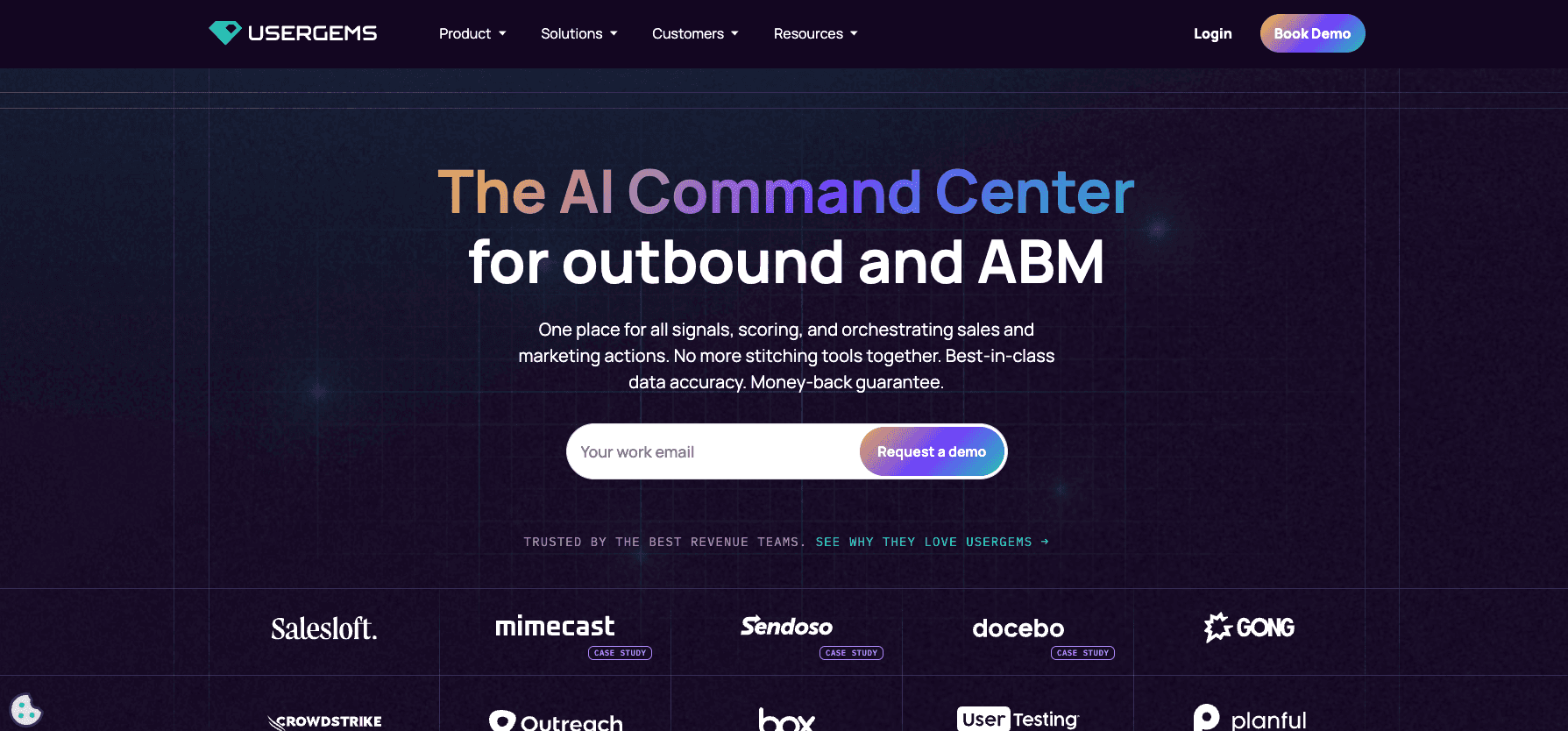
UserGems deserves credit for the product it has built. Here is where it is genuinely strong.
Champion tracking is the highest-converting signal in B2B. When a past buyer, user, or champion moves to a new company, they already know your product, trust it, and can advocate for it internally. UserGems automates this at scale by monitoring job changes across your entire CRM. The 114% increase in close rates and 54% larger deal sizes are not marketing fluff. They reflect a real dynamic: warm relationships convert better than cold outreach.
Gem-E drafts outreach automatically. UserGems’ AI agent builds contact lists, scores accounts, and generates email sequences, call scripts, and LinkedIn messages based on the signal that fired. For teams that want signal detection plus outreach drafting in one platform, this saves time.
21+ signal types in one platform. Beyond job changes, UserGems tracks buyer intent, website visits, M&A activity, 10-K filing analysis, hiring changes, and more. The signal breadth has expanded significantly from its champion-tracking roots.
Published pricing. UserGems is one of the few enterprise signal platforms with transparent pricing: Core at $2,750/month ($33K/year), Advanced at $5,750/month ($69K/year), Elite at $10,000/month ($120K/year). Implementation fees range from $3,000 to $10,000.
Real customer results. Sendoso achieved a 20% reply rate and created 47 opportunities in 30 days using Gem-E. UserTesting reported 18x ROI in closed-won revenue. Dozuki generated $28M in new pipeline. These are legitimate outcomes.
Where UserGems Falls Short
No custom signal definitions. You cannot write a signal in your own words. You choose from UserGems’ pre-built menu: job changes, funding, hiring, M&A, website visits, intent topics. If the buying moment that precedes your deals is not on the menu, UserGems cannot track it. For companies selling into specialized verticals like energy, insurance, government, hospitality, or automotive, the pre-built signals miss the industry-specific triggers that actually drive purchasing.
No source verification. When a signal fires, UserGems tells you what happened (job change, funding round, hiring surge) but does not link to the original source with direct quotes your rep can reference on the call. The signal is a fact delivered without context. WhiteWhale delivers the same fact with the linked article, the relevant quote, and the cited detail, so your rep shows up informed, not just notified.
No earnings call monitoring. Earnings calls are the richest public source of buying intent for mid-market and enterprise accounts. When a CFO discusses increasing CapEx, launching a new division, or investing in a specific technology area, that is a direct signal of funded purchasing intent. UserGems added 10-K filing analysis on higher tiers but does not monitor quarterly earnings call transcripts.
Signals cannot be prioritized when multiple fire. G2 reviewers consistently note that when several signals fire on the same account, UserGems does not help you prioritize which one matters most or combine them into a single narrative. You get multiple alerts without a synthesized “Why Now” story.
$33K/year minimum with annual commitment. The Core plan starts at $2,750/month ($33,000/year) plus a $3,000 to $10,000 implementation fee. The Advanced plan costs $69,000/year. The Elite plan costs $120,000/year. These are enterprise price points for pre-built signals that every competitor also receives.
Requires clean CRM data. Champion tracking only works if your CRM has accurate records of past buyers, users, and contacts. If your CRM is messy (and most are), the signal quality degrades. WhiteWhale does not depend on your CRM data quality because it monitors external public sources, not your internal records.
What WhiteWhale Does Differently
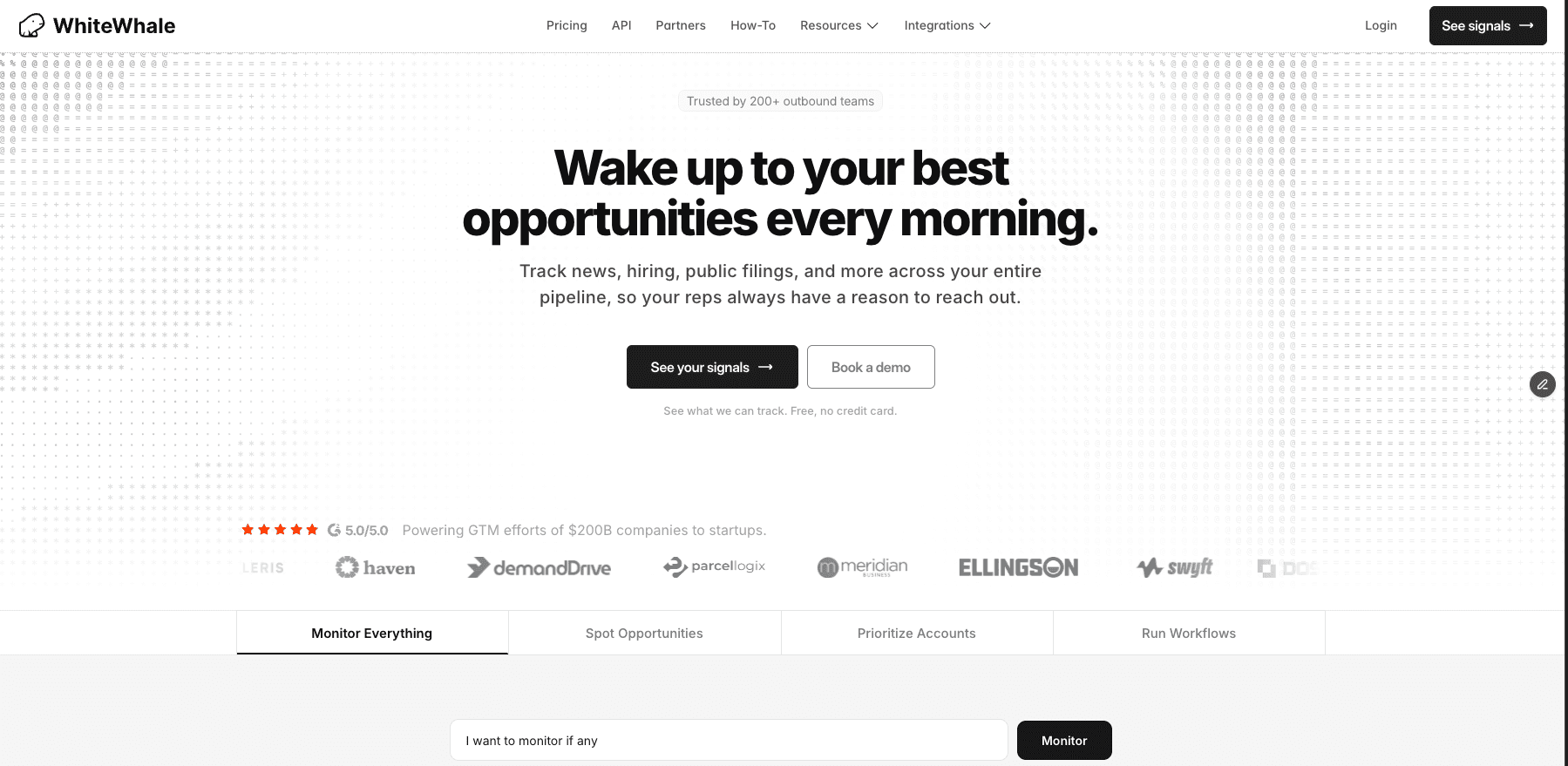
You write the signals. Describe what a buying moment looks like for your product in plain English. “Company mentions migrating from legacy ERP to cloud on an earnings call.” “Company posts a Head of Data Engineering role that mentions building a new data platform from scratch.” “Insurance carrier announces claims system modernization on an earnings call.” WhiteWhale interprets the intent and monitors for matches across SEC filings, earnings call transcripts, job postings, 8,000+ news feeds, press releases, and company LinkedIn posts.
Every result has a linked source. When a signal fires, your rep sees the original article, transcript, or job posting with the relevant quote highlighted. They click the link, verify the signal, and reference the specific detail on the call. “I saw your CFO mentioned on the Q2 call that you are increasing cloud infrastructure spending 40% year-over-year.” That is not a notification. That is a conversation starter.
Signal stacking creates “Why Now” narratives. WhiteWhale combines multiple signals per account into a single story. Three signals on one account is not three separate alerts. It is one narrative: “Acme Corp increased cloud CapEx 40% (earnings call), posted 12 cloud architect roles (job postings), and their new CTO previously led cloud migration at [prior company] (news).” Accounts with 2+ stacked signals close at 2.1x baseline win rate.
Revenue validation proves what works. WhiteWhale lets you test which signal patterns predict pipeline for your specific team by comparing signal data against your closed-won deals. Instead of trusting that job changes predict revenue (UserGems’ thesis), you can prove which of your custom signals actually correlate with closed deals for your product.
Account discovery finds companies you have never heard of. WhiteWhale’s ICP discovery does not rely on your CRM. It scans public sources for companies matching your ICP that are showing buying signals right now, including companies you have never targeted, never heard of, and would never find in a pre-built signal feed. Nicholas de la Guardia at Simpli discovered 279 accounts he had never seen before in 30 minutes.
$200/month with no annual contract. WhiteWhale starts at $200/month, month-to-month, with unlimited users and no implementation fee. Most teams of 5 to 10 reps pay $500 to $1,000/month. That is 6 to 15% of what UserGems Core costs.
The Real Difference: Unique Signals vs Shared Signals
Here is the simplest way to think about it.
UserGems model: Every customer gets the same 21+ signal types. When a champion changes jobs, every vendor who sold to that champion’s old company gets the alert. When a company raises funding, every UserGems customer in that vertical gets the alert. The signals are warm but crowded.
WhiteWhale model: Every customer writes their own signals. When an energy company discusses increasing drilling CapEx on an earnings call, only the WhiteWhale customer who wrote that signal gets the alert. When an insurance carrier announces claims system modernization, only the WhiteWhale customer who wrote that signal gets the alert. The signals are unique and uncrowded.
This matters because the value of a signal degrades with the number of people who see it. A job change that triggers 15 vendor emails in the same week is less valuable per email than a custom signal that only your team sees. The champion is still warm, but the window is crowded. A custom signal gives you a window that is yours alone.
When UserGems Is the Better Choice
UserGems is the better choice when:
Champion tracking is your primary motion. If your business has a large installed base of past buyers and users who regularly change jobs, and re-engaging those champions is your highest-converting play, UserGems automates this at scale better than any other tool. WhiteWhale does not track champion job changes from your CRM.
You want AI-drafted outreach from signals. Gem-E builds contact lists, scores accounts, and drafts personalized sequences. WhiteWhale delivers signals but does not draft outreach. If you want signal-to-sequence in one platform, UserGems covers that loop.
You sell horizontally and pre-built signals are sufficient. If your ICP is “VP of Sales at SaaS companies with 100-500 employees,” pre-built signals (job changes, funding, hiring) cover the buying triggers that matter. Custom signals add more value when your ICP is vertical-specific and the buying triggers are industry-specific.
When WhiteWhale Is the Better Choice
WhiteWhale is the better choice when:
Your competitors use UserGems (or similar signal tools) and you need an edge. If everyone in your category tracks job changes and funding rounds, those signals have become table stakes. Custom signals give you triggers that your competitors are not tracking.
You sell into verticals where pre-built signals miss the buying triggers. Energy companies buy based on drilling permits and CapEx cycles. Insurance carriers buy based on AM Best rating changes and claims modernization mandates. Government agencies buy based on budget appropriations and CIO transitions. None of these triggers exist in UserGems’ pre-built menu.
Your reps need a verifiable reason to call, not just a notification. Source-verified signals with linked quotes give reps something to say on the call. “I saw your CFO mentioned increasing cloud CapEx 40% on the Q2 call” is a better opening than “I noticed you recently changed jobs.”
You need to discover accounts, not just track them. UserGems monitors accounts already in your CRM. WhiteWhale discovers companies you have never heard of that are showing buying signals right now.
Budget is a constraint. WhiteWhale at $200/month is 94% cheaper than UserGems Core at $2,750/month. For teams that cannot justify $33K+/year for pre-built signals, WhiteWhale delivers custom signals with source verification at a fraction of the cost.
You want to test without an annual commitment. WhiteWhale is month-to-month. UserGems requires an annual contract plus implementation fees. You can try WhiteWhale for a month, see if the signals drive pipeline, and cancel if they do not.
Can You Use Both?
Yes, and some teams do. The combination makes sense when champion tracking is a core play AND you need custom signals for account prioritization and discovery.
UserGems handles the “who changed jobs” motion: monitoring your CRM contacts for job changes, alerting reps, and drafting outreach. WhiteWhale handles the “why call today” motion: monitoring public sources for custom buying signals, stacking multiple signals per account, and delivering source-verified “Why Now” narratives.
The combined cost (UserGems Core at $33K/year plus WhiteWhale at $2,400/year) is roughly $35K/year. For teams that can justify UserGems’ price, adding WhiteWhale is less than 7% incremental cost for an entirely different signal layer.
But for most teams evaluating both, the question is whether champion tracking alone justifies $33K+/year when custom signals cover a broader range of buying triggers at $2,400/year. The answer depends on how much of your pipeline comes from past champions vs. net-new accounts.
Customer Results
Justin Ager, Strategic Growth Manager at Kaleris, saw ROI in five days: “You close one deal and it’s paid for itself. If you try to track this on your own, you’re going to miss stuff. You miss a lot less with WhiteWhale.”
Beau Blanchard at Gravitate chose WhiteWhale over ZoomInfo, Clay, and other signal companies: “Having a system that scrapes SEC filings, company posts, and job postings gives us a much warmer approach than ‘Hey, thanks for looking at our website today.’”
Meridian Business prioritized 2,800 accounts in 24 hours, turning a large, undifferentiated account list into a ranked, signal-prioritized pipeline. Read the case study.
Conner Slater at Bitdrift ranked 300+ accounts and found 13 signals in his first two weeks. These were signals specific to his ICP that no pre-built signal tool would have surfaced.
See What Custom Signals Look Like for Your ICP
If you want to see what custom buying signals are possible for your specific ICP, try the free signal preview at app.getwhitewhale.com/onboarding. You will see real signal examples before you pay anything.
Plans start at $200/month. No annual contract. No per-seat pricing. No implementation fee. Unlimited users. Month-to-month.
For a broader view of how WhiteWhale fits into the signal platform landscape, see the best custom signal tools comparison or the full sales intelligence platform ranking.
FAQ
Does WhiteWhale replace UserGems?
Not entirely. WhiteWhale does not track champion job changes from your CRM, which is UserGems’ core strength. WhiteWhale replaces the need for UserGems if your primary goal is knowing which accounts to prioritize and why, discovering net-new accounts showing buying signals, and having source-verified reasons to call. If champion re-engagement is a major part of your pipeline, UserGems covers that motion better. Many teams can get more value from WhiteWhale’s custom signals at $200/month than from UserGems’ pre-built signals at $2,750/month, but the right choice depends on how much pipeline comes from past champions.
Why are shared signals a problem?
When every competitor in your category uses the same signal tools (UserGems, LinkedIn Sales Navigator, Apollo, ZoomInfo), everyone sees the same job changes, funding rounds, and hiring surges at the same time. The champion who just changed jobs receives 5 to 15 vendor emails in the same week. The company that just raised funding gets bombarded. The signal is still warm, but the window is crowded. Custom signals give you triggers that only your team sees, because only your team wrote them.
What signals does WhiteWhale track that UserGems does not?
WhiteWhale monitors SEC filings, quarterly earnings call transcripts, job posting descriptions (not just the existence of a posting, but what the description says), 8,000+ news feeds, press releases, and company LinkedIn posts. UserGems does not monitor earnings calls or SEC filings (except limited 10-K analysis on higher tiers). The biggest difference is customization: WhiteWhale lets you write any signal in plain English. UserGems gives you a fixed menu of 21+ pre-built types.
How much cheaper is WhiteWhale than UserGems?
WhiteWhale starts at $200/month ($2,400/year) with no annual contract and unlimited users. UserGems Core starts at $2,750/month ($33,000/year) plus $3,000 to $10,000 implementation fees. UserGems Advanced costs $69,000/year. For a team that needs buying signals but cannot justify $33K+/year, WhiteWhale delivers custom, source-verified signals at roughly 7% of UserGems’ cost.
Can I use WhiteWhale and UserGems together?
Yes. UserGems handles champion job change tracking from your CRM. WhiteWhale handles custom buying signal detection from public sources. Adding WhiteWhale ($2,400/year) to a UserGems contract ($33K+/year) is less than 7% incremental cost for an entirely different signal layer, including earnings call monitoring, SEC filing analysis, custom signal definitions, and source-verified results that UserGems does not provide.
Sources: UserGems published pricing (2026): Core $2,750/mo, Advanced $5,750/mo, Elite $10,000/mo. UserGems customer results (Sendoso, UserTesting, Dozuki) from usergems.com case studies. UserGems champion tracking statistics (114% close rate increase, 54% larger deals, 12% shorter cycles) from usergems.com. G2 ratings (UserGems 4.8/5, 196 reviews) accessed August 2026. UserGems feature set and Gem-E capabilities from usergems.com and third-party reviews (Salesforge, Salesmotion, Breakout, KeepSync). WhiteWhale internal data (customer results, signal stacking win rates).
About the author
Jack Porter is Co-Founder of WhiteWhale, a buying signal platform for B2B sales teams. Since 2025, Jack has spoken with 1,875 sales, GTM, and marketing leaders about their technology stack, what signals actually drive pipeline, and where intent data falls short. Those conversations informed every recommendation on this page. He can be reached on LinkedIn.
UserGems built the category around a compelling insight: when a past champion changes jobs and lands at a new company, that is one of the warmest signals in B2B sales. Champions at a target account increase close rates by 114%, shorten sales cycles by 12%, and drive 54% larger deals, according to UserGems’ own research. That data is real, and the product delivers on it.
But there is a problem with building your entire outbound motion around signals that every competitor sees at the same time.
UserGems tracks job changes, funding rounds, hiring surges, M&A activity, website visits, and 21+ other signal types. These are useful triggers. They are also pre-built, standardized, and shared. When your past champion joins a new company, every vendor who sold to that champion’s previous employer sees the same job change at the same time and reaches out in the same week. The signal is warm. The timing is crowded. Most other major tools have these same signals too (Clay, Apollo, Zoominfo) for free or low cost.
WhiteWhale takes a different approach. Instead of monitoring a fixed set of pre-built triggers, you write up to 35 buying signals specific just to your business, describing what a buying moment looks like for your specific product. WhiteWhale monitors SEC filings, earnings call transcripts, job postings from ATS systems, 8,000+ news feeds, press releases, and company LinkedIn posts daily. Every result comes with a linked source, direct quotes, and cited facts.
The difference is not which platform has more signals. It is whether the signals are unique to your business or shared with every competitor in your category.
WhiteWhale vs UserGems: Quick Comparison
Factor | WhiteWhale | UserGems |
|---|---|---|
Core approach | Full custom signals to your business. | Pre-built signal library (21+ types) |
Signal philosophy | Signals unique to your business | Standardized signals shared across all customers |
Starting price | $200/mo, month-to-month | $2,750/mo ($33K/yr), annual contract |
Implementation fee | None | $3,000 to $10,000 |
Contract | Month-to-month, cancel anytime | Annual |
Users included | Unlimited | Core: 3 admins, 20 end users |
Champion tracking | No | Yes (core strength) |
Job change tracking | Yes (via job posting analysis) | Yes (core strength) |
Custom signal definitions | Yes (35 in plain English) | No |
Source verification | Yes (linked source, quotes, cited facts) | No |
Earnings call monitoring | Yes | Limited (10-K filing analysis on higher tiers) |
SEC filing monitoring | Yes | Limited (10-K analysis on higher tiers) |
Signal stacking | Yes (2.1x win rate with 2+ signals) | Limited (no prioritization when multiple signals fire) |
Revenue validation | Yes (test signals against closed-won data) | No |
AI outreach drafting | No | Yes (Gem-E) |
Contact enrichment | No | Yes (built-in) |
Website visitor ID | No | Yes (on higher tiers) |
CRM integration | All plans (HubSpot, Salesforce, Slack) | Salesforce, HubSpot |
Sequencer integration | Via webhooks | Outreach, Salesloft, Gong, Instantly |
Setup time | 15 minutes | Days to weeks |
G2 rating | N/A (newer platform) | 4.8/5 (196 reviews) |
Signals 1.0 vs Signals 2.0
UserGems represents the first generation of signal-based selling tools. The model is straightforward: monitor a fixed set of triggers (job changes, funding, hiring, M&A) across your target accounts, alert the rep when something happens, and draft the first touch. The value is real. Knowing that your past champion just became VP of Engineering at a target account is genuinely useful information.
The limitation is structural, not product-specific. Every signal UserGems tracks is a pre-built trigger that fires identically for every customer.
When your champion changes jobs, every vendor sees it. UserGems monitors job changes across your CRM contacts. But so does Champify. And LinkedIn Sales Navigator. And Apollo. And ZoomInfo. And Clay. The job change itself is public information (LinkedIn profile update) that every sales tool in the ecosystem can detect. The signal is warm, but by the time your rep reaches out, the champion has already received 5 to 15 vendor emails referencing the same job change.
When a company raises funding, every vendor sees it. Funding rounds are announced on Crunchbase, TechCrunch, and press wires. UserGems surfaces the signal, but so does every other tool that monitors Crunchbase data. Your competitor’s SDR got the same alert you did.
When a company posts a hiring surge, every vendor sees it. Job postings are public on LinkedIn, Indeed, and company career pages. UserGems tracks them, but the underlying data is available to anyone monitoring the same sources.
This is not a criticism of UserGems. It is the nature of pre-built signals. They are useful precisely because they track events that reliably predict purchasing behavior. But because they track events that are publicly visible and standardized, every competitor using any signal tool sees the same opportunities at the same time.
Custom signals change this dynamic. A signal like “company mentions migrating from on-premise data infrastructure to cloud on an earnings call” is unique to companies selling cloud infrastructure. A signal like “company posts a VP of Compliance role that mentions SOX remediation in the job description” is unique to companies selling compliance software. A signal like “oil and gas company discusses increasing drilling CapEx on Q3 earnings call” is unique to companies selling into energy.
These signals are specific to your product, your ICP, and the exact buying moments that precede your deals. Your competitors are not tracking them because they have not written them. That is the difference between signals 1.0 and signals 2.0.
What UserGems Does Well
UserGems deserves credit for the product it has built. Here is where it is genuinely strong.
Champion tracking is the highest-converting signal in B2B. When a past buyer, user, or champion moves to a new company, they already know your product, trust it, and can advocate for it internally. UserGems automates this at scale by monitoring job changes across your entire CRM. The 114% increase in close rates and 54% larger deal sizes are not marketing fluff. They reflect a real dynamic: warm relationships convert better than cold outreach.
Gem-E drafts outreach automatically. UserGems’ AI agent builds contact lists, scores accounts, and generates email sequences, call scripts, and LinkedIn messages based on the signal that fired. For teams that want signal detection plus outreach drafting in one platform, this saves time.
21+ signal types in one platform. Beyond job changes, UserGems tracks buyer intent, website visits, M&A activity, 10-K filing analysis, hiring changes, and more. The signal breadth has expanded significantly from its champion-tracking roots.
Published pricing. UserGems is one of the few enterprise signal platforms with transparent pricing: Core at $2,750/month ($33K/year), Advanced at $5,750/month ($69K/year), Elite at $10,000/month ($120K/year). Implementation fees range from $3,000 to $10,000.
Real customer results. Sendoso achieved a 20% reply rate and created 47 opportunities in 30 days using Gem-E. UserTesting reported 18x ROI in closed-won revenue. Dozuki generated $28M in new pipeline. These are legitimate outcomes.
Where UserGems Falls Short
No custom signal definitions. You cannot write a signal in your own words. You choose from UserGems’ pre-built menu: job changes, funding, hiring, M&A, website visits, intent topics. If the buying moment that precedes your deals is not on the menu, UserGems cannot track it. For companies selling into specialized verticals like energy, insurance, government, hospitality, or automotive, the pre-built signals miss the industry-specific triggers that actually drive purchasing.
No source verification. When a signal fires, UserGems tells you what happened (job change, funding round, hiring surge) but does not link to the original source with direct quotes your rep can reference on the call. The signal is a fact delivered without context. WhiteWhale delivers the same fact with the linked article, the relevant quote, and the cited detail, so your rep shows up informed, not just notified.
No earnings call monitoring. Earnings calls are the richest public source of buying intent for mid-market and enterprise accounts. When a CFO discusses increasing CapEx, launching a new division, or investing in a specific technology area, that is a direct signal of funded purchasing intent. UserGems added 10-K filing analysis on higher tiers but does not monitor quarterly earnings call transcripts.
Signals cannot be prioritized when multiple fire. G2 reviewers consistently note that when several signals fire on the same account, UserGems does not help you prioritize which one matters most or combine them into a single narrative. You get multiple alerts without a synthesized “Why Now” story.
$33K/year minimum with annual commitment. The Core plan starts at $2,750/month ($33,000/year) plus a $3,000 to $10,000 implementation fee. The Advanced plan costs $69,000/year. The Elite plan costs $120,000/year. These are enterprise price points for pre-built signals that every competitor also receives.
Requires clean CRM data. Champion tracking only works if your CRM has accurate records of past buyers, users, and contacts. If your CRM is messy (and most are), the signal quality degrades. WhiteWhale does not depend on your CRM data quality because it monitors external public sources, not your internal records.
What WhiteWhale Does Differently
You write the signals. Describe what a buying moment looks like for your product in plain English. “Company mentions migrating from legacy ERP to cloud on an earnings call.” “Company posts a Head of Data Engineering role that mentions building a new data platform from scratch.” “Insurance carrier announces claims system modernization on an earnings call.” WhiteWhale interprets the intent and monitors for matches across SEC filings, earnings call transcripts, job postings, 8,000+ news feeds, press releases, and company LinkedIn posts.
Every result has a linked source. When a signal fires, your rep sees the original article, transcript, or job posting with the relevant quote highlighted. They click the link, verify the signal, and reference the specific detail on the call. “I saw your CFO mentioned on the Q2 call that you are increasing cloud infrastructure spending 40% year-over-year.” That is not a notification. That is a conversation starter.
Signal stacking creates “Why Now” narratives. WhiteWhale combines multiple signals per account into a single story. Three signals on one account is not three separate alerts. It is one narrative: “Acme Corp increased cloud CapEx 40% (earnings call), posted 12 cloud architect roles (job postings), and their new CTO previously led cloud migration at [prior company] (news).” Accounts with 2+ stacked signals close at 2.1x baseline win rate.
Revenue validation proves what works. WhiteWhale lets you test which signal patterns predict pipeline for your specific team by comparing signal data against your closed-won deals. Instead of trusting that job changes predict revenue (UserGems’ thesis), you can prove which of your custom signals actually correlate with closed deals for your product.
Account discovery finds companies you have never heard of. WhiteWhale’s ICP discovery does not rely on your CRM. It scans public sources for companies matching your ICP that are showing buying signals right now, including companies you have never targeted, never heard of, and would never find in a pre-built signal feed. Nicholas de la Guardia at Simpli discovered 279 accounts he had never seen before in 30 minutes.
$200/month with no annual contract. WhiteWhale starts at $200/month, month-to-month, with unlimited users and no implementation fee. Most teams of 5 to 10 reps pay $500 to $1,000/month. That is 6 to 15% of what UserGems Core costs.
The Real Difference: Unique Signals vs Shared Signals
Here is the simplest way to think about it.
UserGems model: Every customer gets the same 21+ signal types. When a champion changes jobs, every vendor who sold to that champion’s old company gets the alert. When a company raises funding, every UserGems customer in that vertical gets the alert. The signals are warm but crowded.
WhiteWhale model: Every customer writes their own signals. When an energy company discusses increasing drilling CapEx on an earnings call, only the WhiteWhale customer who wrote that signal gets the alert. When an insurance carrier announces claims system modernization, only the WhiteWhale customer who wrote that signal gets the alert. The signals are unique and uncrowded.
This matters because the value of a signal degrades with the number of people who see it. A job change that triggers 15 vendor emails in the same week is less valuable per email than a custom signal that only your team sees. The champion is still warm, but the window is crowded. A custom signal gives you a window that is yours alone.
When UserGems Is the Better Choice
UserGems is the better choice when:
Champion tracking is your primary motion. If your business has a large installed base of past buyers and users who regularly change jobs, and re-engaging those champions is your highest-converting play, UserGems automates this at scale better than any other tool. WhiteWhale does not track champion job changes from your CRM.
You want AI-drafted outreach from signals. Gem-E builds contact lists, scores accounts, and drafts personalized sequences. WhiteWhale delivers signals but does not draft outreach. If you want signal-to-sequence in one platform, UserGems covers that loop.
You sell horizontally and pre-built signals are sufficient. If your ICP is “VP of Sales at SaaS companies with 100-500 employees,” pre-built signals (job changes, funding, hiring) cover the buying triggers that matter. Custom signals add more value when your ICP is vertical-specific and the buying triggers are industry-specific.
When WhiteWhale Is the Better Choice
WhiteWhale is the better choice when:
Your competitors use UserGems (or similar signal tools) and you need an edge. If everyone in your category tracks job changes and funding rounds, those signals have become table stakes. Custom signals give you triggers that your competitors are not tracking.
You sell into verticals where pre-built signals miss the buying triggers. Energy companies buy based on drilling permits and CapEx cycles. Insurance carriers buy based on AM Best rating changes and claims modernization mandates. Government agencies buy based on budget appropriations and CIO transitions. None of these triggers exist in UserGems’ pre-built menu.
Your reps need a verifiable reason to call, not just a notification. Source-verified signals with linked quotes give reps something to say on the call. “I saw your CFO mentioned increasing cloud CapEx 40% on the Q2 call” is a better opening than “I noticed you recently changed jobs.”
You need to discover accounts, not just track them. UserGems monitors accounts already in your CRM. WhiteWhale discovers companies you have never heard of that are showing buying signals right now.
Budget is a constraint. WhiteWhale at $200/month is 94% cheaper than UserGems Core at $2,750/month. For teams that cannot justify $33K+/year for pre-built signals, WhiteWhale delivers custom signals with source verification at a fraction of the cost.
You want to test without an annual commitment. WhiteWhale is month-to-month. UserGems requires an annual contract plus implementation fees. You can try WhiteWhale for a month, see if the signals drive pipeline, and cancel if they do not.
Can You Use Both?
Yes, and some teams do. The combination makes sense when champion tracking is a core play AND you need custom signals for account prioritization and discovery.
UserGems handles the “who changed jobs” motion: monitoring your CRM contacts for job changes, alerting reps, and drafting outreach. WhiteWhale handles the “why call today” motion: monitoring public sources for custom buying signals, stacking multiple signals per account, and delivering source-verified “Why Now” narratives.
The combined cost (UserGems Core at $33K/year plus WhiteWhale at $2,400/year) is roughly $35K/year. For teams that can justify UserGems’ price, adding WhiteWhale is less than 7% incremental cost for an entirely different signal layer.
But for most teams evaluating both, the question is whether champion tracking alone justifies $33K+/year when custom signals cover a broader range of buying triggers at $2,400/year. The answer depends on how much of your pipeline comes from past champions vs. net-new accounts.
Customer Results
Justin Ager, Strategic Growth Manager at Kaleris, saw ROI in five days: “You close one deal and it’s paid for itself. If you try to track this on your own, you’re going to miss stuff. You miss a lot less with WhiteWhale.”
Beau Blanchard at Gravitate chose WhiteWhale over ZoomInfo, Clay, and other signal companies: “Having a system that scrapes SEC filings, company posts, and job postings gives us a much warmer approach than ‘Hey, thanks for looking at our website today.’”
Meridian Business prioritized 2,800 accounts in 24 hours, turning a large, undifferentiated account list into a ranked, signal-prioritized pipeline. Read the case study.
Conner Slater at Bitdrift ranked 300+ accounts and found 13 signals in his first two weeks. These were signals specific to his ICP that no pre-built signal tool would have surfaced.
See What Custom Signals Look Like for Your ICP
If you want to see what custom buying signals are possible for your specific ICP, try the free signal preview at app.getwhitewhale.com/onboarding. You will see real signal examples before you pay anything.
Plans start at $200/month. No annual contract. No per-seat pricing. No implementation fee. Unlimited users. Month-to-month.
For a broader view of how WhiteWhale fits into the signal platform landscape, see the best custom signal tools comparison or the full sales intelligence platform ranking.
FAQ
Does WhiteWhale replace UserGems?
Not entirely. WhiteWhale does not track champion job changes from your CRM, which is UserGems’ core strength. WhiteWhale replaces the need for UserGems if your primary goal is knowing which accounts to prioritize and why, discovering net-new accounts showing buying signals, and having source-verified reasons to call. If champion re-engagement is a major part of your pipeline, UserGems covers that motion better. Many teams can get more value from WhiteWhale’s custom signals at $200/month than from UserGems’ pre-built signals at $2,750/month, but the right choice depends on how much pipeline comes from past champions.
Why are shared signals a problem?
When every competitor in your category uses the same signal tools (UserGems, LinkedIn Sales Navigator, Apollo, ZoomInfo), everyone sees the same job changes, funding rounds, and hiring surges at the same time. The champion who just changed jobs receives 5 to 15 vendor emails in the same week. The company that just raised funding gets bombarded. The signal is still warm, but the window is crowded. Custom signals give you triggers that only your team sees, because only your team wrote them.
What signals does WhiteWhale track that UserGems does not?
WhiteWhale monitors SEC filings, quarterly earnings call transcripts, job posting descriptions (not just the existence of a posting, but what the description says), 8,000+ news feeds, press releases, and company LinkedIn posts. UserGems does not monitor earnings calls or SEC filings (except limited 10-K analysis on higher tiers). The biggest difference is customization: WhiteWhale lets you write any signal in plain English. UserGems gives you a fixed menu of 21+ pre-built types.
How much cheaper is WhiteWhale than UserGems?
WhiteWhale starts at $200/month ($2,400/year) with no annual contract and unlimited users. UserGems Core starts at $2,750/month ($33,000/year) plus $3,000 to $10,000 implementation fees. UserGems Advanced costs $69,000/year. For a team that needs buying signals but cannot justify $33K+/year, WhiteWhale delivers custom, source-verified signals at roughly 7% of UserGems’ cost.
Can I use WhiteWhale and UserGems together?
Yes. UserGems handles champion job change tracking from your CRM. WhiteWhale handles custom buying signal detection from public sources. Adding WhiteWhale ($2,400/year) to a UserGems contract ($33K+/year) is less than 7% incremental cost for an entirely different signal layer, including earnings call monitoring, SEC filing analysis, custom signal definitions, and source-verified results that UserGems does not provide.
Sources: UserGems published pricing (2026): Core $2,750/mo, Advanced $5,750/mo, Elite $10,000/mo. UserGems customer results (Sendoso, UserTesting, Dozuki) from usergems.com case studies. UserGems champion tracking statistics (114% close rate increase, 54% larger deals, 12% shorter cycles) from usergems.com. G2 ratings (UserGems 4.8/5, 196 reviews) accessed August 2026. UserGems feature set and Gem-E capabilities from usergems.com and third-party reviews (Salesforge, Salesmotion, Breakout, KeepSync). WhiteWhale internal data (customer results, signal stacking win rates).
About the author
Jack Porter is Co-Founder of WhiteWhale, a buying signal platform for B2B sales teams. Since 2025, Jack has spoken with 1,875 sales, GTM, and marketing leaders about their technology stack, what signals actually drive pipeline, and where intent data falls short. Those conversations informed every recommendation on this page. He can be reached on LinkedIn.

Almost everyone says
"Wait…you can track THAT?"
See your signals for free. No credit card required.
Almost everyone says
"Wait…you can track THAT?"
See your signals for free. No credit card required.